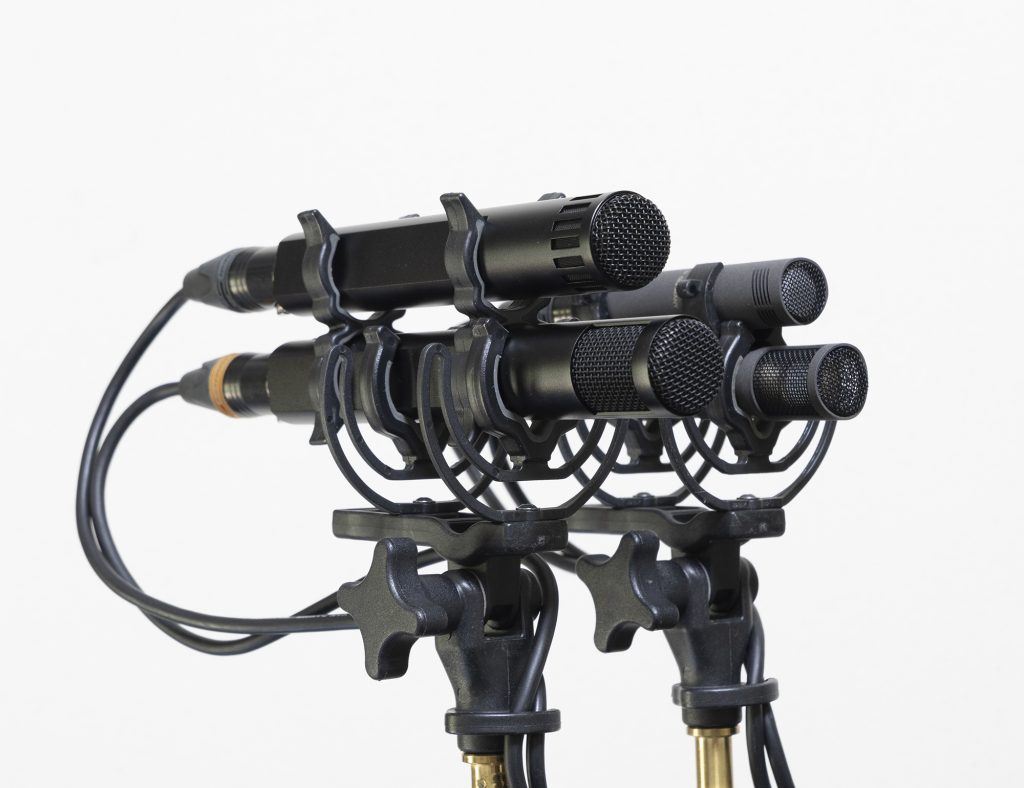
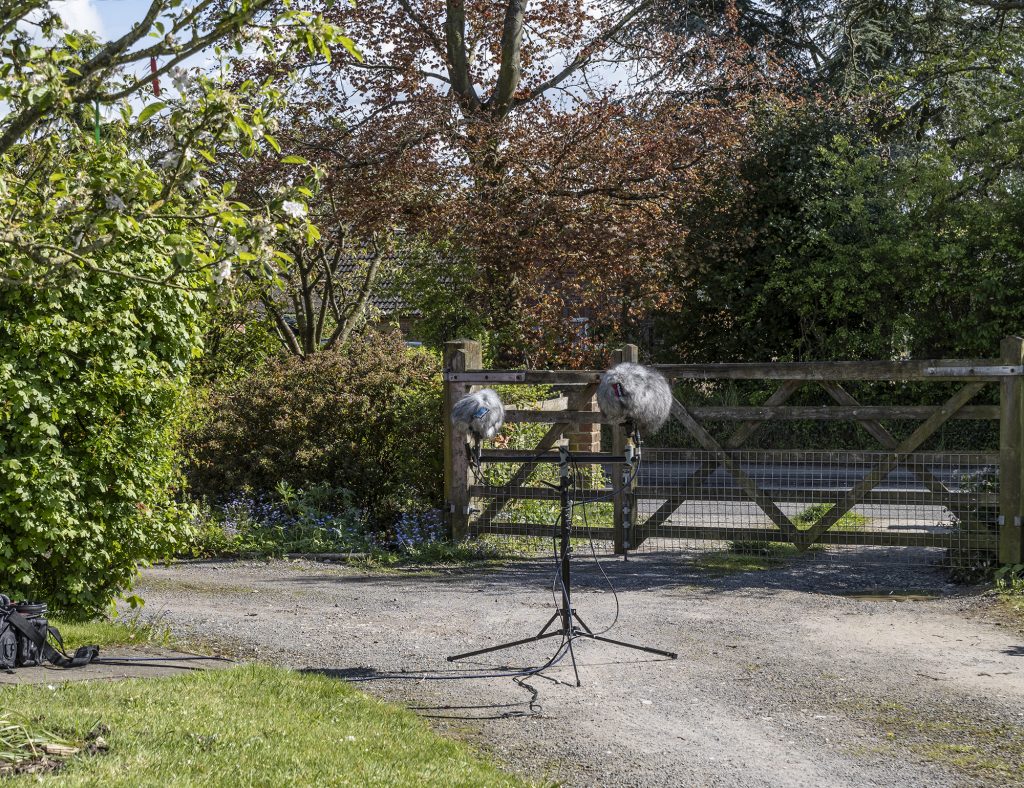
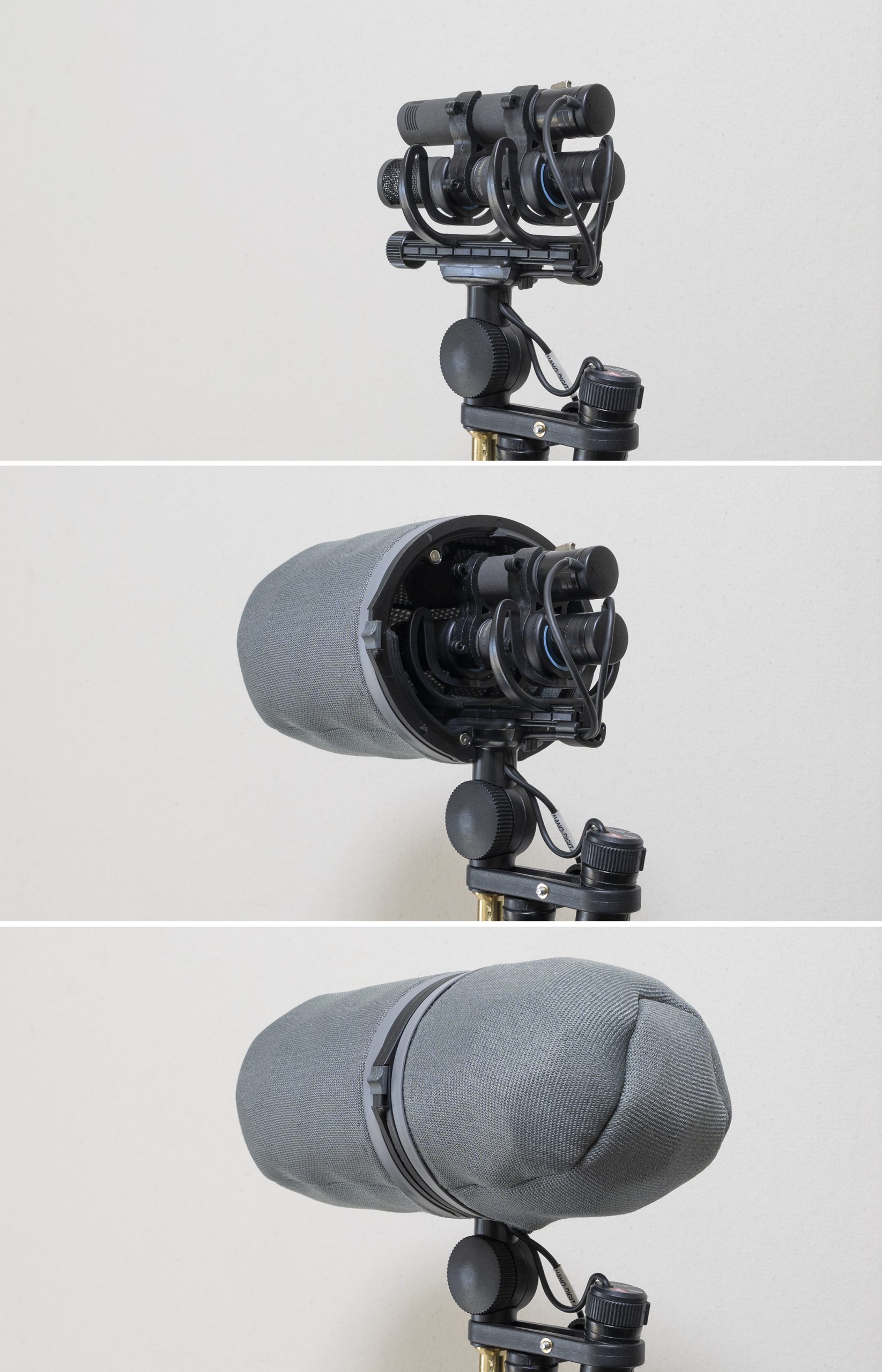
Rigging two fig 8s end-to-end for Blumlein or mid-side field recording in a Rycote Modular WS4.
With a pair of the final production versions of the BD-10s in hand, I thought it was high time that I followed up my earlier studio tests of the mics in a Blumlein pair with some field recordings. It’s not often you come across Blumlein pairs (or, indeed, mid-side pairs with two fig 8s) used for anything but music recording. I suspect this has to do with two different things: first, field recordists rarely have multiple fig 8s, perhaps only having one for mid-side recording; and, second, I wonder whether there is a bit of concern about the inversion of the rear ‘image’ of the mics. What might be a boon in the studio – arranging a group of musicians in an arc in front of the mic and doing likewise with a facing group to the rear, so that all combine beautifully into stereo with the rear musicians naturally flipped the right way round (listen to John Cuniberti’s wonderful OneMic recordings if this seems alien to you: and you can read about my Cuniberti-inspired recording of the Lucy Grubb band in an earlier post) – might seem problematic outside, where things usually can’t be controlled so well. What will happen if that bird sings from the front right instead of the rear left?! And what about those grey areas to the sides of the pair, where imaging transitions from the ‘correct’ to the ‘wrong’ way round: won’t the world in those areas come crashing down into a phasey mess? In a recording world where much about Blumlein and mid-side with two fig 8s puzzles beginners (and many who should know better), it is easy to see why the techniques see little use outside.
Just to kick things off for those not familiar with how Blumlein and mid-side with two fig 8s (which decodes to Blumlein) reverse L and R to the rear of the mic, here are two simple recordings (made indoors) in which I walk round the mic pair at the same distance, calling out the degrees as I do so. First up is a recording with a pair of BD-10s, in this case set up as an MS pair to allow simultaneous recording of a comparison with omni mid-side:
At face value the recording might appear to show that there is real reason to avoid using pairs of fig 8s: certainly, for example, a Blumlein pair (or mid-side with two fig 8s) wouldn’t suit recording a group of singers forming an unbroken circle around a pair of mics (which is essentially what this test did, albeit sequentially and, thankfully, without my singing involved!), although, nonetheless, some do this. But what single stereo pair of mics (as opposed to a surround set up) would work best for such a scenario? MS with an omni mid would seem obvious, although, of course, there would be no distinction between, say, 45 degrees and 135 degrees, and the equivalent this produces with a 50:50 ratio (i.e. equivalent to back-to-back cardioids) means that sensitivity of the pair isn’t constant around the 360 degrees. You can hear this in my second demonstration, recorded at the same time as the above test, but using omni mid side with a Rycote OM-08 as the front mic and a BD-10 as the side mic:
But what do most field recordings have to do with direct sound coming to a mic pair at equal amplitude from 360 degrees? Many, if not most, field recordings will involve sounds that are louder in one direction, or across an arc: a car or train passing, the main animal of interest in the foreground, a clearly localized person undertaking some activity. The full 360 degrees might be wanted for ambience, but whether a background bird rear left is heard front right in the stereo field rather than front left is likely to be immaterial: and, in the absence of surround sound, is mislocated anyway. Likewise, if the main focus of the recording is within the main arc of the Blumlein pair (say 70 degrees) then any ambiguity – and any phasiness – to the sides is of little significance. And what makes such care worth it for a Blumlein pair in the field? Well, the answer is twofold: first, Blumlein (or an MS fig 8 pair decoded to Blumlein) gives a uniquely accurate stereo image across those front and rear arcs; and, second, it does this while still recording sound from 360 degrees. In short, it’s another tool for the job: not suited in many cases, but useful to be able to deploy when the occasion arises, even outside.
Two BD-10s side-by-side in a stereo Cyclone: those markings are still useful for orientation even when not in an end-to-end configuration: at this point I hadn’t reversed the lyres or removed the rods.
Before even thinking of using a pair of fig 8s outside, the first thing is to house them in decent wind protection. This is a pretty simple matter with small SDC fig 8s like the BD10s, which can easily fit end-to-end in a fairly standard windshield: in this case a Rycote Modular Windshield WS4. This doesn’t have stereo cabling, of course, so you end up routing the second cable along the basket and have to squeeze it out of the cable exit by the end cap. Neither are major issues, but admittedly aren’t perfect. But as ex-BBC mid-side and Blumlein expert sound engineer Roger Long has long advised, it’s so easy to get bogged down in theory: practical experience – with ears with that have more finesse than mine – shows that the shadowing effect of placing two fig 8s side-by-side is essentially undetectable. This opens up scope for using more conventional mid-side rigs, and just using them vertically. The best fit windshield that Rycote make for their SDC mics is the Cyclone Stereo Kit 5, so that’s what I have used for the side-by-side Blumlein rig too: I made a couple of minor adjustments, rotating the lyres to remove a clunky bit of plastic away from the side-address capsules and also removing the metal rods that spanned between the lyres (and were redundant) so that I could then move the lyres closer together.
And here with one half of the basket attached, showing the lyres reversed and the rods removed, which is helpful for the BD-10s and essential for the shorter Rycote SDC mics (OM-08, CA-08 and SC-08).
With a couple of rigging options for outdoors sorted, let’s get on to some recordings. First up, here is one of my now all too familiar front garden recordings, with birdsong, my footsteps, cars driving past (crossing right to left), and a neighbour doing a bit of DIY.
Getting out of the garden, and picking up on the idea of testing a wide passing noise, here is a test on a track of a horse walking past. I was to one side of the track aiming the Blumlein pair (rigged side-to-side) across it, with the horse approaching from the right and walking past. The sound changes as the horse comes up to me for the simple reason that he veered onto the grassy verge to keep as far away from me as possible (who can blame him, seeing a bloke with headphones and a stand with a dead cat on it?!), but I think the recording still works and demonstrates that even from an angle of almost 90 degrees, passing through 0/360 degrees and ending at just over 270 degrees, the sound moves clearly across the stereo field.
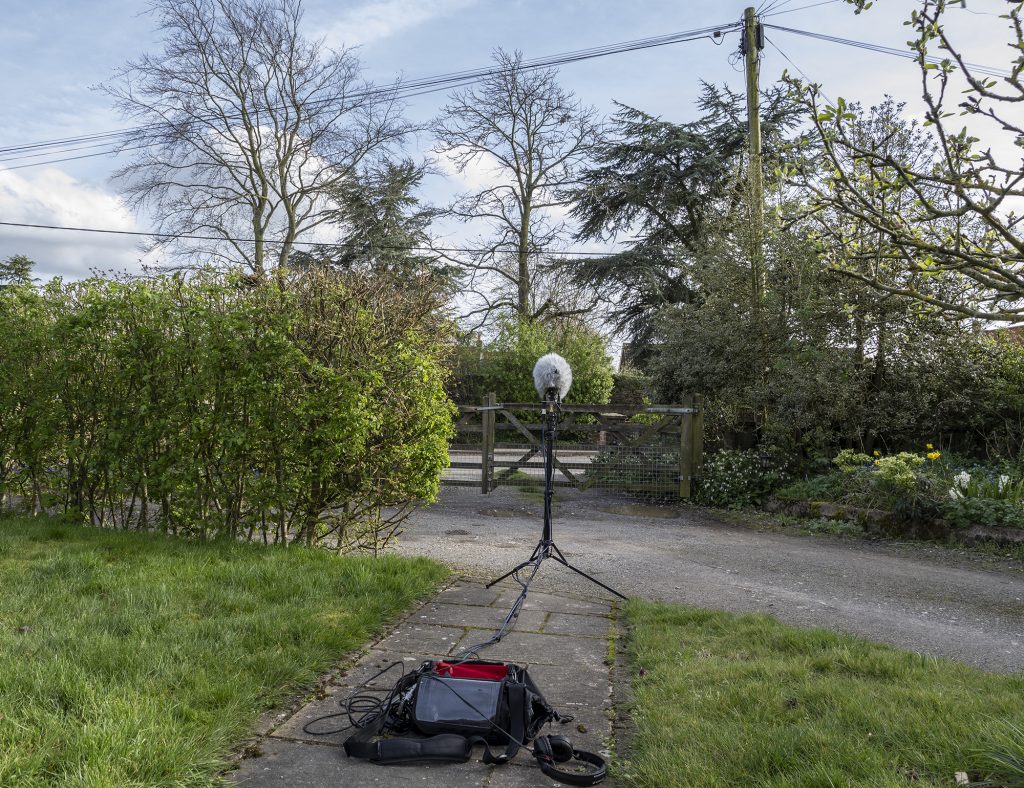
Blumlein recording in the field (or a field!): the horse that whinnies in the recording below isn’t the miniature Shetland seen through the gate, but out of view, at over ninety degrees to the right.
In this next sample recording I set up in front of a field gate (see photo above), and you can hear me open and close the gate and then a horse whinnies in the distance. The horse was located slight to the rear of hard right so, due to the reversal of the rear of the Blumlein pair, appears to come from the front left.
Blumlein recording under an oak tree.
This next recording is a quiet ambience of surprisingly subdued birdsong, along – as gain was cranked up, with the distant sound of traffic, recorded under an oak tree in a fragment of ancient woodland.
Ok, so nothing stunningly conclusive here, but, I hope, food for thought. The attractions of Blumlein (and mid-side with two fig 8s) recordings for music are well known – at least among those making recordings of acoustic music in decent sounding spaces – but the approach can work equally well outdoors, even for 360-degree ambiences. Given that a pair of SDC fig 8s is not hard to rig in a windshield, either end-to-end, side by side, or fore and aft, it is easy enough to try if you have – or can get hold of – a pair of fig 8s such as the BD-10s. And, for my part, I have an upcoming recording session that combines acoustic music and the great outdoors – recording a pipe band – so will be including a Blumlein pair in tests for that: more anon.
The final production version of the BD-10 with its laser-etched alignment markings on the end.
Back when I was testing the Rycote BD-10 pre-production version fig 8 mics with a Blumlein recording of Lucy Grubb’s band, my ageing eyes struggled rather with aligning the two black mics end-to-end at ninety degrees: what should have taken a couple of seconds seemed to take an age in subtle studio lighting. The fairly standard dot indicating the front lobe of the BD-10 is great for orienting the mic for mid-side recording, but I began to think how a few more discreet markings on the end of the mic body would help hugely with Blumlein or, indeed, mid-side with a pair of fig 8s. I sent off a quick Photoshop mock-up to the folks at Rycote and, a little to my surprise, they have run with the idea, laser-etching the four markings as shown in the photo above. I was so chuffed when a pair of the updated mics winged their way from Wilsonville, Oregon (where the Rycote mics are now made in the Audix factory) to rural Norfolk here in the UK. But I should say sorry, though, to those of you who had to wait a little longer for the BD-10 to start shipping as a result! A tiny detail, and a short post, but I hope others find the markings useful too.
Using the markings to rig a pair of BD-10s end-to-end.
NB see this post for my original review and tests of the BD-10
Two mid-side pairs for size comparison: MKH 30 and MKH 50 (left) with MKH 8030 and MKH 8050 (right).
This is turning into something of a marathon, with the latest installment of the Sennheiser MKH 8030 fig 8 mic tests comprising a comparison with its older MKH counterpart: the MKH 30. The latter was introduced back in 1987 and is still in production: quite what Sennheiser’s plans are for the mic, now that the MKH 8030 is starting to appear in retailers, I simply do not know, but some of the other earlier MKH range have dropped out of production (MKH 20 omni and MKH 40 cardioid). Whether the MKH 30 continues to be made for years or not, recordists will wonder: just how does the new fig 8 compare? As with all the MKH 8000 series mics there are the obvious physical differences of size; the new series being modular; and the earlier range having built-in switchable high-pass filters and pre-attenuation (vs this only being available via the additional MZF 8000 module – now just updated to the MZF 8000 II). And then there is the extended high-frequency response of the MKH 8000 mics. But just how different do the two fig 8 mics sound? I was certainly interested in this question, and have been receiving queries from others similarly wondering, so armed with an MKH 30 and, to allow some MS comparisons, an MKH 50 (still in production, by the way) sent by the folks at Sennheiser, I set to for some comparisons.
The sound of silence
First off to compare is the sound of the two mics recording nothing: their self-noise. Both are specified as 13dBa, but self-noise rarely sounds the same between different makes or even ranges of mics and with the known very different frequency response above 20kHz, there was every reason to suspect there might be subtle differences as, indeed, there are between the other MKH 8000 polar patterns and their older MKH counterparts. So into the airing cupboard, under duvets and towels, went the mics and off went the electricity for my usual home-brewed and very much not laboratory conditions for comparing self-noise. As for the self-noise tests in part 1 of the MKH 8030 tests, I used a 100Hz high-pass filter since it was impossible to keep out the very low frequencies.
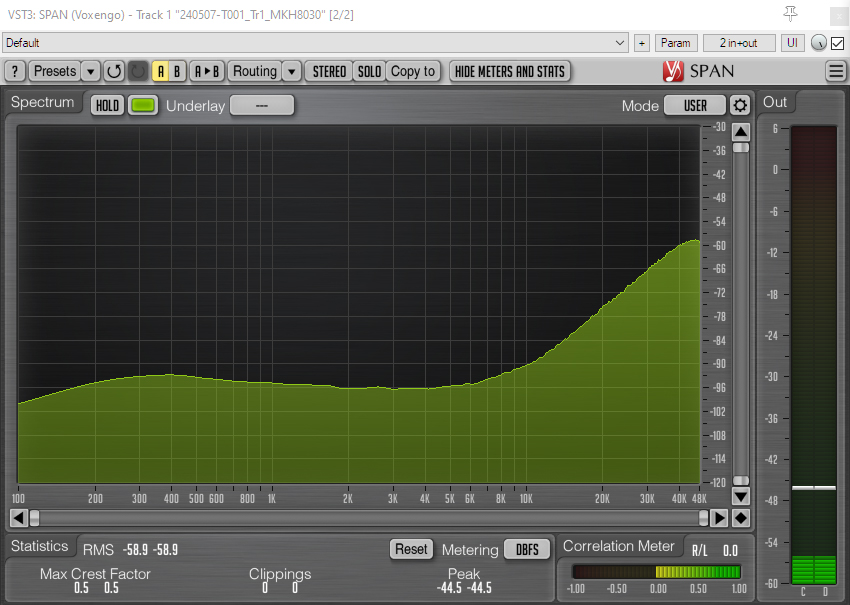
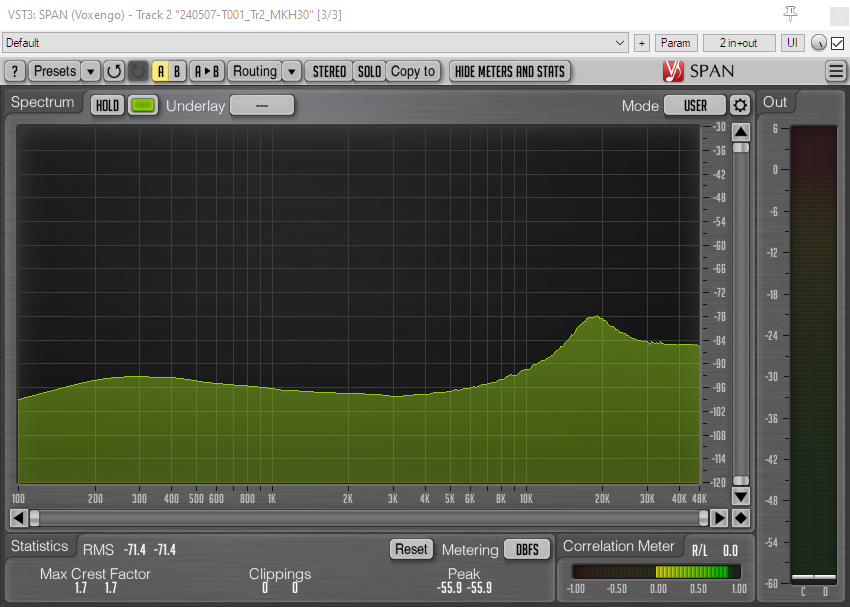
Here are the spectrum analyzer visualizations of the noise, with gain cranked up:
MKH 8030 with 100Hz high-pass filter: scale 100Hz to 48kHz.MKH 30 with 100Hz high-pass filter: scale 100Hz to 48kHz.
As expected, the self-noise looks wildy different, but, of course, most of this is the increased self-noise in the MKH 8030 over 20kHz (i.e. above human hearing). In the audible part of the spectrum, the two are pretty comparable, although the gentle dip between 1kHz and 6kHz is a little deeper (by a couple of dB) with the MKH 30, which translates to the self-noise of the MKH 8030 being fractionally more noticeable. But we are splitting hairs here: both mics have remarkably low-self noise for SDC fig 8s and there is nothing of concern with the new design vs the older one on this front.
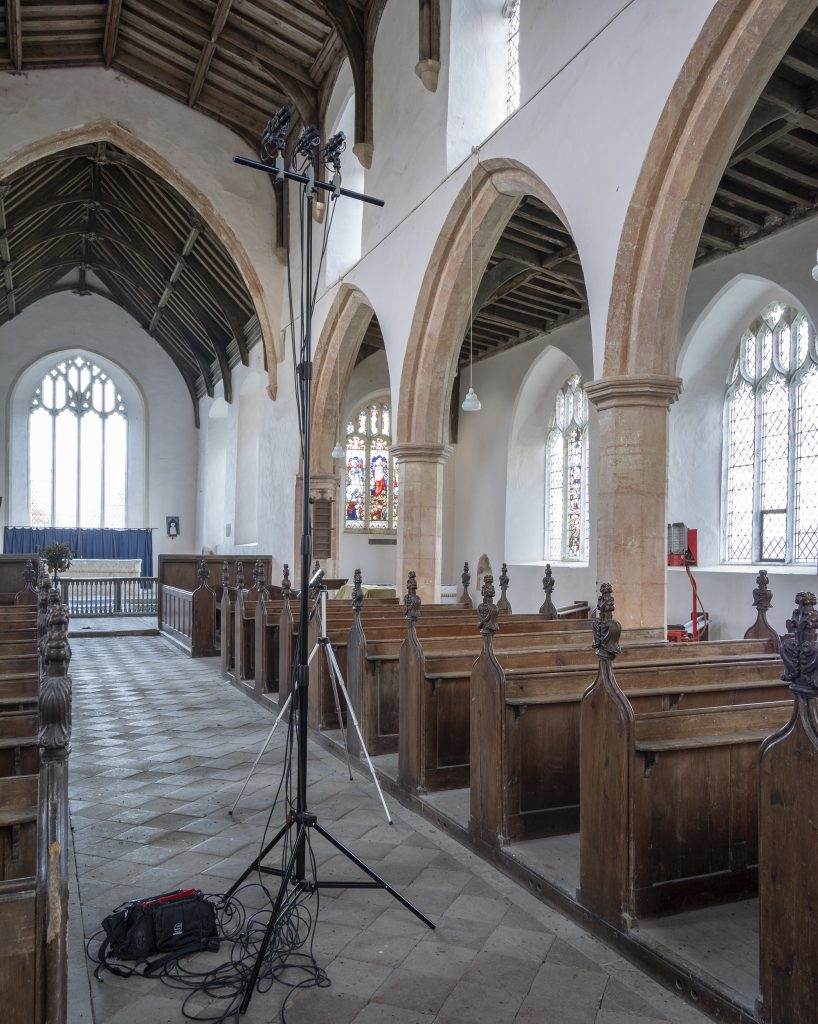
Bat recording at dusk in Guestwick Church.
Bats in the belfry…or not
One of the distinctive features of the MKH 8000 series is, indeed, the extended frequency range. You can see this in spectrograms of many a recording where frequencies above 20kHz are present: the specs cite a 50kHz upper limit vs 20kHz for the MKH 30. Taking this to extremes, I went with Norfolk-based ecologist, Danny Cotgrove, to Guestwick Church at dusk, comparing the MKH 8050/8030 and MKH 50/30 mics: obviously an unfair comparison, but it was an interesting evening nonetheless. I was particularly impressed by seeing Danny’s Batlogger M2 in action (evidently the right tool for the job), but that’s another story. There weren’t a lot (a ‘cauldron’?) of bats in action, but just the odd one: common pipistrelles and some Myotis bats (probably Natterer’s bats), apparently. Here are a few short clips, slowed down to 25%.
The bats are much clearer in the MKH 8050/8030 MS pair than in the MKH 50/30 pair, as expected, but the self-noise of the MKH 8000 mics at such high frequencies is distracting. Obviously, to get usable audio from such quiet ultrasonic sounds requires some hiss removal, so here is a very quick and dirty example using RX De-noise:
And here are the spectrograms for the two fig 8 mics:
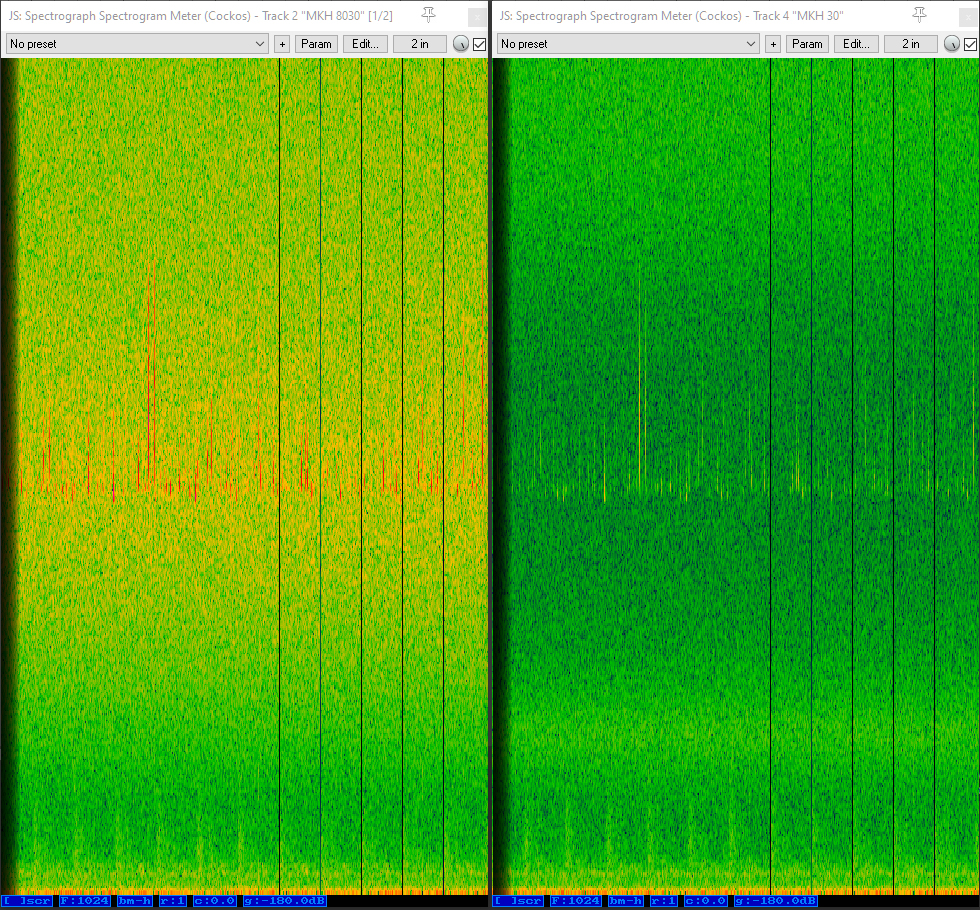
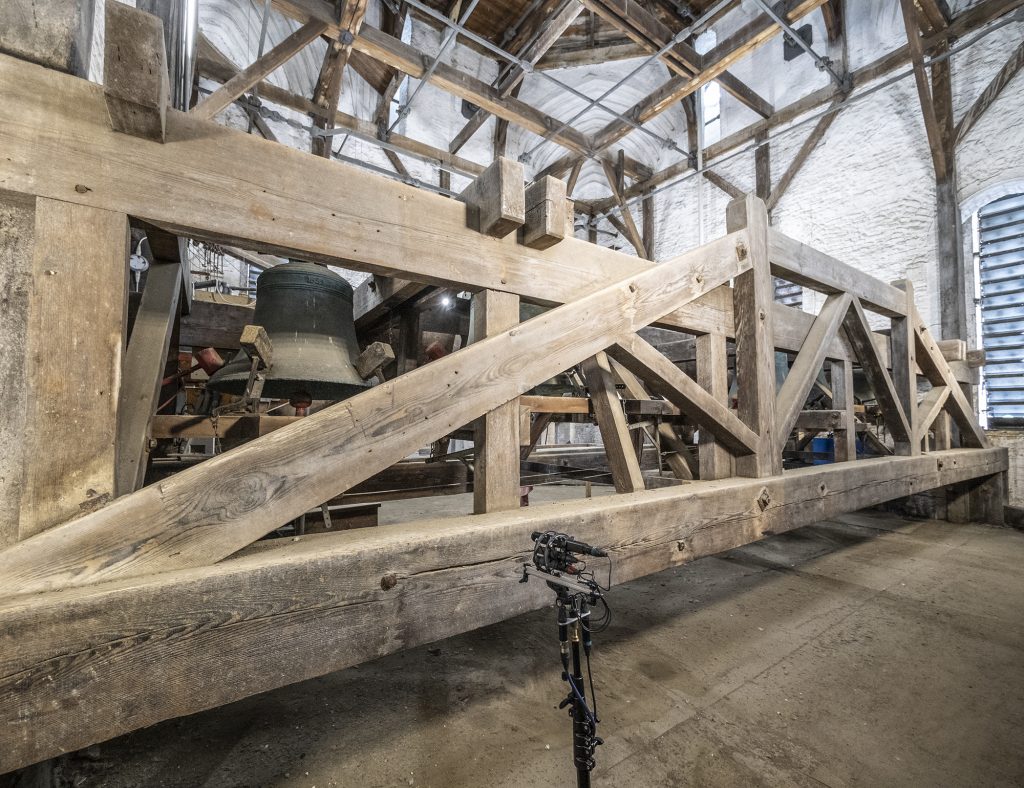
Spectrograms of a clip of the bat recordings (as originally recorded), with MKH 8030 (left) and MKH 30 (right): the vertical axis extends to 96kHz, and the clearly visible (red) spikes of the bat sounds in the upper halves of the spectrograms range from around 46kHz to 76kHz.Up in the belfry of Norwich Cathedral risking my eardrums…again.
At face value, the bat recording example might seem as if it leads to a dismal conclusion: i.e. the MKH 8030 has much higher frequency capability than the MKH 30, but the price of raised self-noise is too high to pay. But bear with me. With a touch of irony, I headed off to the cathedral belfry, not for more bats but for a (very) healthy signal of an audible sound with extended high frequency overtones: the bells, the bells! The spectrograms show that the sound extends above 48kHz, but of more use are the sound files.
Here we have the original unmodified (mono) recordings with the individual fig 8 mics:
And here we have the same two clips slowed down to 25% (just as I did for the bat recordings), as if playing around for sound design: reassuringly there is no distracting self-noise – a consequence of a healthy sound signal – and there is no need for noise removal.
So, yes, the MKH 8030, like its siblings in the same series, has extended high-frequency that can be useful and is something that the MKH 30 and its siblings don’t offer to this degree, but, with quiet signals, it will need much care and some de-noising. Whether or not this capability matters to the sound recordist is a different thing altogether: for many, if not most, a frequency response over 20kHz is simply not needed.
It’s all about that bass
Down at the other end of the frequency spectrum the specs for the two fig 8 suggest that the MKH 8030 goes a bit lower: the frequency response graph of the MKH 30 cuts off at 40Hz, though, so it is hard to tell from this how it compares with the MKH 8030 below this. Turning to my quick and dirty low-frequency source, I stuck the mics by the exhaust pipe of an idling car engine, and this showed that the MKH 8030 does indeed have more low end that its older counterpart.
Here are the sound files:
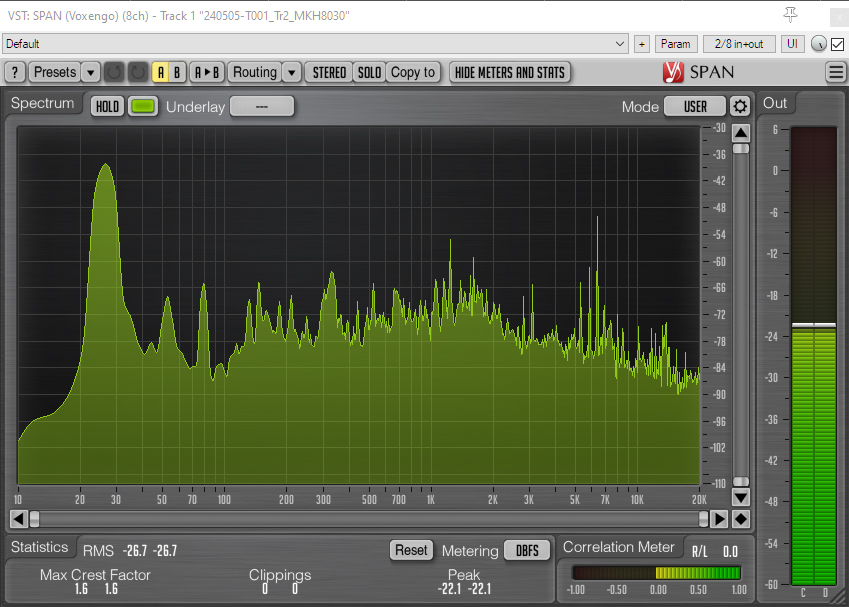
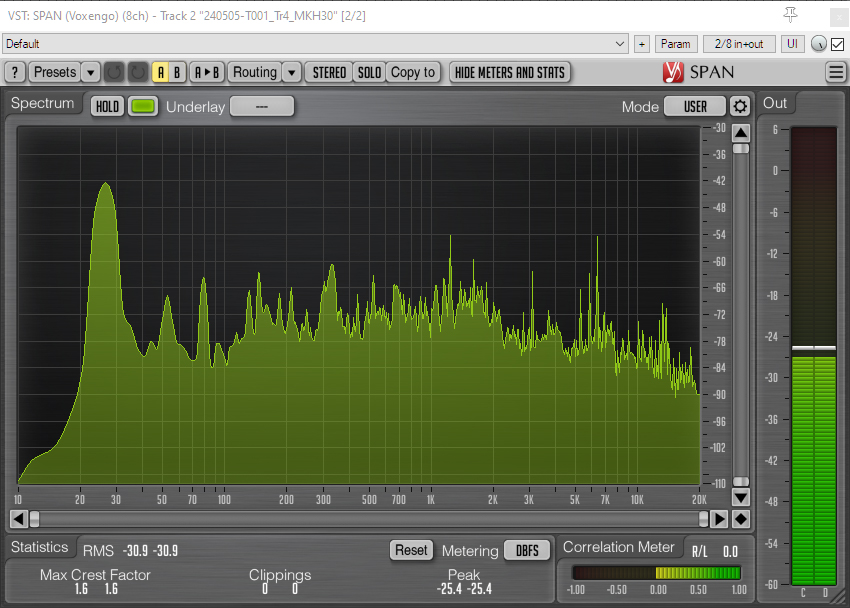
And here are the spectrum analyzer visualizations of the exhaust recordings:
MKH 8030 recording.MKH 30 recording.
The most distinct feature is the level of the fundamental (26.4Hz), which is c.4.5dB louder with the MKH 8030 vs the MKH 30. This is not to say that the MKH 8030 oddly emphasizes bass: as we saw in part 1 of the MKH 8030 tests, similar tests with another car exhaust saw the MKH 8040 measure 9dB more than the MKH 8030 at the 22.5Hz fundamental. Now, just as with the high-frequency extended range, some may not find the increased low end of the MKH 8030 vs the MKH 30 especially useful, but I suspect many more will, for music recording and bass-heavy ambiences and sound effects amongst other things. I’m certainly one of the ones who is glad to have a bit better low-frequency performance. And if you don’t want it, its easy to roll off with a high-pass filter in your mixer/recorder or via the MZF 8000 ii filter module.
I suspect this view is getting rather familiar to some readers of this blog…
In the field
The robust and, above all, humidity-resistant nature of the RF-based MKH mics has made them favourites for recording in the field, be that production sound or field recording, so I moved on to record some ambiences. As usual, nothing very adventurous: you don’t need a long-haul flight and a rare species to test a mic in the field (though doubtless a rain forest would provide some nice humidity), so, as I have done so many times before, I ventured a few yards further down my drive from the car exhaust test to record the sounds of early May in my quiet Norfolk village street. Sorry if you are getting bored of listening to my village street, but cheer yourself up with the thought of how environmentally friendly this is! And it always gives a good mixture of sounds: birdsong, passing cars, the odd sound of a distant shotgun (or is it a bird-scarer?), and whatever the neighbours are up to: a bit of landscape gardening this time.
There are two sets of recordings: first off, we have the two fig 8s together, rigged with back-to-back clips in a single Rycote Cyclone, and facing the road;
Then, second, we have two separate windshields each containing a mid-side pair with each fig 8 paired with its super-cardioid sibling. Obviously the different qualities of the two mid-mics comes into play, but as an MS side mic is how most field recordists use the MKH 30 and how most will use the new MKH 8030.
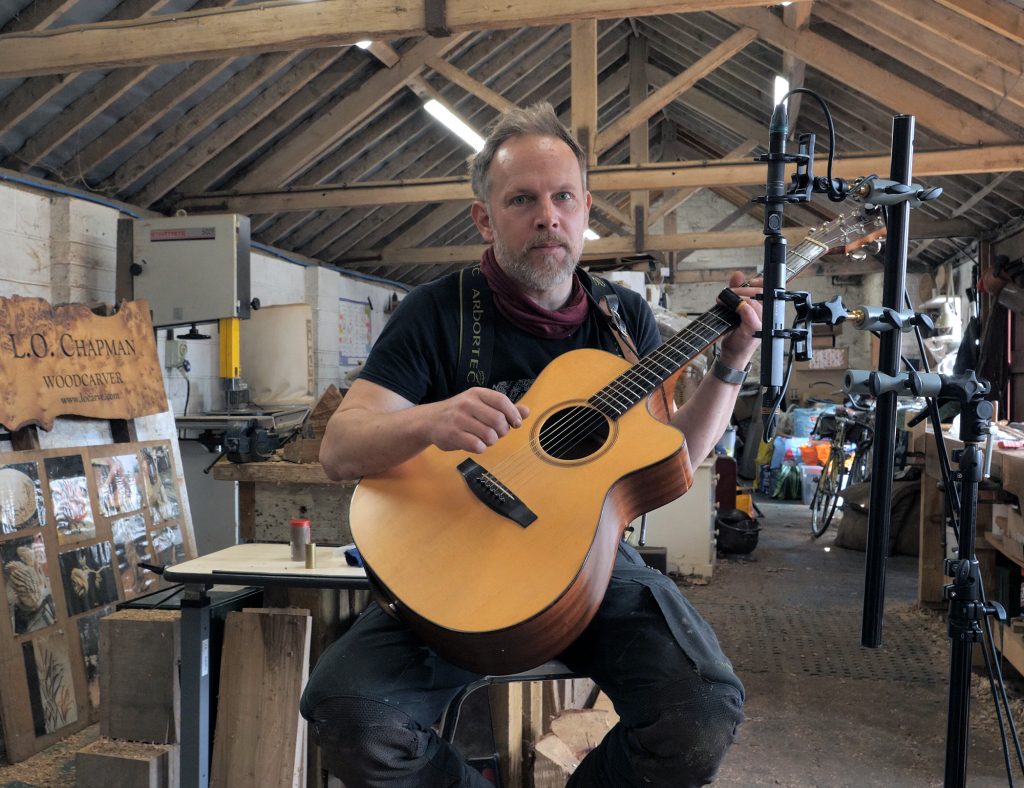
Luke Chapman in his workshop, playing a bit of guitar into an MKH 30 and MKH 8030.
Down in the workshop
Moving inside again for some musical tests, I tootled down the back lanes to the workshop of woodcarver and musician Luke Chapman. Luke was happy to put down his chainsaw (well, actually he was re-spraying his Land Rover chassis when I arrived) to oblige again with some guitar playing, and the sets of recordings comprise mono recordings with the two fig 8s (which I rigged end-to-end, pointing at the twelfth fret from about 600mm/2ft away) and then mid-side recordings with the MKH 8050/8030 and MKH 50/30 pairs, a little further back (to get a bit more ambience into the recording: you can really hear the rooks outside trying to join in). There has been no processing (compression, equalization, addition of reverb etc.) of the recorded sound. The mono recordings with just the two fig 8 mics aimed towards the sound source are perhaps the most informative, although, again, the MS pairs show how the two mics sound with one of their respective siblings as the mid mic. I’m sure some will hear (or at least imagine they hear!) significant differences, but, to me at least, the two fig 8s sound remarkably similar.
Here are the two recordings of the fig 8s on their own:
And here are the recordings of the two MS pairs:
And here’s a video of the guitar test recordings – both the mono comparisons of the two fig 8s, and then the two mid-side rigs – cutting from one mic/pair to the other.
Conclusions
These few tests just skim the surface of comparisons between the MKH 30 and MKH 8030. With the other polar patterns of the two MKH ranges of mics, there have been recordists who prefer one to the other: or one vs its equivalent for a particular purpose. Evidently there are some subtle nuances and preferences, with these varying in relation to a wide gamut of sound sources, that are beyond the scope of the necessarily simple tests here: such discerning recordists will want to get both mics in their hands to compare them in their typical uses. But with that caveat, my experience of using the two mics is that the MKH 8030 occupies a similar position to the other MKH 8000 mics compared to their equivalents in the older MKH series: as such it lives up to the well-deserved reputation of the MKH 30. Just as with the other MKH 8000 series mics, it doesn’t render the older MKH fig 8 redundant: far from it. If you need a very low noise SDC fig 8 with demonstrable ability in high humidity and that sounds top class, then both of the Sennheiser fig 8s are likely to be at the top of your list: if you also want a very small SDC and one where there is a full range of mics in the same series currently in production, then, obviously, your choice out of the two will be the MKH 8030.
A few months ago I started to think about upgrading my nearfield studio monitors. I’d been using Tannoy Gold 5 speakers for a couple of years and though the coaxial drivers gave a nice stereo image, bass was inevitably lacking and there was something not quite right about the higher frequencies either. Improving my microphones was also exposing the limits of the Tannoys too. All too often I was shifting to open-back headphones for editing and mixing, which says a lot. You get what you pay for, obviously. Buying new monitors is a bit of a gamble unless you happen to have the luxury of working day in day out with a variety of pairs, in treated control rooms/studios that you know well: even if you can find a retailer that stocks several models, the listening conditions are invariably poor and/or are a poor match to your studio. I gave some thought to some of the usual suspects in the £1000-£1500 price range, but teardown photos gave me little confidence of cabinet construction in relation to internal resonances and reflections, and a circuit board on the back of the cabinet just feels wrong to me, even putting aside the long-term issue of having all your eggs in one basket (amplifier and speaker). I’ve spent too long being aware of decent speaker design – which goes back to my upbringing in Steyning, where B&W had their research headquarters – to want to spend significant money on something that was a step up from the modern Tannoys, but still, ultimately, unsatisfactory, and to be followed by another step up in a couple of years. And I am a great fan of exponential absorbers, as per my DIY hifi speakers, built a few years ago – see the post here.
The logical answer to all this for me was to bite the bullet, open the cheque book, and go for a pair of Vivid Audio S12s. I’d seen construction of the cabinets a couple of years ago when they were built nearby at Wymondham (and had a tour of the factory there), had heard larger Vivid Audio speakers over the years (and, indeed, the famous B&W Nautilus designed by Laurence Dickie (aka Dic), who is the engineering brain behind Vivid), and had always hankered after a pair of the S12s since they were announced in 2020. The reviews and tests bore out my suspicion that the Vivid Audio website’s slightly throwaway remark that ‘the small footprint makes it the perfect studio monitor’ was likely to be spot on.
Here are my S12s (though tempted by the more interesting colours, I played safe and went for black) in my treated office/mixing studio. The large ex-MOD desk that I like (and need) for work is shown with a couple of slabs of 70mm Basotech, which take out desk reflections for those critical bits of audio work: and they have the benefit of forcing me to periodically remove the normal clutter of cameras, papers and other junk that accumulates on my desk. The dinky DAC and power amp are nestled under the computer monitor.
In preparation, I swapped out my Sound Devices MixPre-3 (an excellent small field recorder, but certainly not the world’s greatest DAC), for a much better Topping DX1 DAC, and made bases with in-built shock absorbers for my existing wall brackets. I’ve been running the S12s for several weeks now, off a small Class D amp, and I continue to be astounded. I haven’t touched my headphones for weeks. But there is little point in writing a blog post eulogizing these speakers: any reader would, quite rightly, take it with a pinch of salt. I don’t have the means of doing comparative tests and, unlike microphones, I can’t post meaningful WAV files etc. for others to consider. Besides, there are detailed tests and reviews by those with a wider knowledge of speakers out there to be read (such as this on AV Nirvana), albeit from a hifi perspective, along with some videos with Dic explaining the engineering behind the S12, such as this one with Doug Schneider and this one with Jeff Fritz. And, of course, for specs etc. there is the Vivid Audio website.
So what I thought might be more useful is to give the rest of this blog post over to an interview with Dic giving more background to the S12 and, along the way, his thoughts about the lack of differentiation between good studio monitors and good domestic speakers. I found it an interesting conversation, not least learning about John Dunkerley (he of Decca fame) being so involved with B&W, where Dic worked for many years (and where, in addition to the Nautilus, he invented the matrix enclosure system). We covered quite a bit more in our long and enjoyable chat, including how I could remodel my desk with a punched steel surface for acoustic transparency (Dic’s enthusiasm for, interest in, and knowledge of acoustic matters knows few bounds!), but what follows are the key sections relevant to using the S12s (and, indeed, other comparable speakers) as studio monitors.
Dic keeping very much hands-on at Vivid’s design studio and workshop in Sussex.
RH: Dic, could you sum up your approach to loudspeaker design and how, if at all, it differs for studio monitors?
LD: I sincerely believe in creating loudspeakers that have a reasonably flat response. My mantra has always been to create loudspeakers that are free of resonances and reflections because I have always believed that these are the things that our ears are particularly sensitive to as a result of living in a natural world and evolving in it: resonances and reflections give you a lot of cues and clues about the environment in which you’re standing, about what is coming up behind you and other such things that might cost you your life if you are not aware of them. I think we are very sensitive to these, so for all Vivid speakers, and indeed Nautilus before it, the whole point was to engineer those discontinuities out of the equation. And I think it applies whether it be a studio monitor or a far field domestic loudspeaker: those values are the same.
RH: Many will be familiar with your work at B&W, most obviously with the matrix and Nautilus, but it would be good to hear more about your experience with studio monitors and, especially, its influence on the development of your Vivid Audio drivers.
LD: When I left B&W my goal was to produce studio monitors, but I wanted to produce a studio monitor that had the fidelity, transparency and other lovely features of the Nautilus yet was capable of supplying the power that typically people need to monitor electronic music, pop music and whatever. I’d made some monitors out of B&W parts for Bowl Court Studios in London, for which I’d used nine 12” drivers, six mid-rangers and a couple of tweeters and we drove it all actively. Everyone was impressed by the sound level that people were able to monitor at and when I produced the Nautilus it was clear that it was utterly incapable of producing that sort of sound level. So my mission when I left B&W was to create a set of drivers which would be capable of handling the power and having the efficiency required to do the job.
So for two years that was more or less what I was doing between other little jobs. I came up with an array of drivers, but didn’t want to start a studio monitor company on my own. By chance these guys from South Africa contacted me saying they wanted to start a hifi speaker company and I said I just happen to have designed some drivers which although ostensibly for studio monitors will actually work perfectly well in a hifi loudspeaker. So the drivers that we use in Vivid Audio give a nod to the studio market. But the point here is that the only real difference between top-end domestic hifi and studio monitors that I could detect at that time was the ability to handle a great deal of power and to put out really high sound levels. But the fidelity part of it, the accuracy, the frequency response and other such things I believed to be exactly the same and I still largely do believe that. The perhaps biggest difference really was the ubiquity of soffit-mount studio monitors, and I’m a real believer in soffit mounts. A funny thing was around the time I had just finished the Nautilus I was at a show and I was speaking to someone from Genelec and I was looking at this Genelec and saying yeah that’s the right approach – to have the speaker in the boundary and I think if I were to design a soffit-mount speaker it would look something like that. And he said, that’s interesting because the designer of Genelecs said if he were to design a folded transmission line speaker he would have made it like the Nautilus. So we came from the same place: basically it’s about having smooth contours, and avoiding resonances and reflections again.
Another thing I learnt in my time at B&W when looking at studios was that classical studios like EMI [i.e. Abbey Road] and Decca were using B&Ws and they were very happy using a 4π [i.e. free-field, and not soffit mounted] speaker in a studio environment: B&W never felt any pressure to do soffit-mount speakers. Another thing I learnt in other studios, was the ubiquity of the [Yamaha] NS-10 and the little Aurotone, the little cube. I said why do you use these and they said well you’ve got to see what It sounds like on Joe Average’s transistor radio or mediocre hifi and the NS10 was taken to be a benchmark mediocre loudspeaker: if it sounds good on an NS-10 it will sound good on anything. And I thought well surely you need something in between that is not as big as the Westlake or whatever it was they might have had – two x 15” with a horn – and this NS-10. You need something that has a nice wide response that you can sit on top of the desk a bit like the NS-10. I very much wanted to contribute something to that part of the spectrum and the S12 is almost that. It has taken a long time to get there, but it is almost there.
RBH: It’s relevant to this point: there’s still a sharp distinction in the market between hifi speakers and studio monitors. Is that because people have tried hifi speakers and many of them are just not suited; is it prejudice; is it marketing; is it simplicity (most studio monitors are active); or is it something else altogether?
LD: I’m absolutely certain that marketing plays a great part in it. There will also be some biases and bigotry – ‘I’m not using that: it’s a hifi speaker’ sort of thing – and probably vice versa, and that’s all based on whimsy, there’s no foundation for any of that. Marketing is certainly going to have an important part to play as it does with everything. So clearly somebody like Genelec market themselves very strongly as being a pro audio brand, and I’m actually surprised that they don’t make an effort to promote their products as a domestic speaker.
You have to be careful not to blur lines. You are branded. You produce a thing and then you are branded and people will therefore dismiss you, ‘on that’s hifi’. I completely understand that. Perhaps that’s why we underplayed the studio bit because we want to be careful to not to blur the line or prejudice our hifi market. Yes, it is tricky. The psychology of marketing is a whole other world that’s not necessarily based on reality: it’s a simple truth.
RH: You touched on the larger studios and some larger studios, such as Abbey Road with its use of B&W loudspeakers beginning in 1988 with the Matrix 801 speaker and now with the 800 Series Diamond D3 speakers and there’s Skywalker Sound studio with its B&W speakers being used, and, of course, you mentioned Decca. Do you think these very large studios are just less concerned about speakers that are designed or marketed exclusively as studio monitors and that as you go down to the smaller studios (including home studios) that they have a less open view?
LD: Yes, absolutely. Specifically B&W were designed with the help of John Dunkerley who was one of the golden ears of the Decca studio. He still runs a masterclass in studio technique, the Tonmeister course [at the University of Surrey]. John had an excellent relationship with John Bowers [founder of B&W Loudspeakers]. John Dunkerley used to come and do listening tests with John Bowers and was an integral part of the development of B&W speakers and, of course, he took them back with him to Decca and monitored on them. And that spread as other engineers joined him: the choice was between that or, of course, there were BBC monitors, or otherwise Ureis, Westlakes and classic 15”s and horns. For the high-end classical engineers the best speakers were things like the B&Ws and there is snobbery again there: in their opinion the Ureis, Westlakes and things were alright for pop music, but if you were going to do serious music you needed something like the B&Ws. So even within the pro field I’m sure there are all sorts of divisions and bigotries, not all based on realities. As far as John Dunkerley was concerned there was absolutely no differentiation between the studio monitor and the domestic monitor: it was all part of the same spectrum. And as far as he was concerned the goal was the same – for reproduction for a flat response free from aberrations and imperfections. It was all the same. So I guess I’ve learnt from him that it is all part of the same spectrum.
RH: So it tended to be the larger studios having a significant amount of classical music recording that used such speakers. Do you get a sense that has continued and spread?
LD: Well unfortunately, Roland, I am not very close to that world at the moment. But I have always believed that our speakers should be perfectly useable in the studio. In fact, if there wasn’t such exclusivity going on between B&W and Decca and EMI, I would have thought our speakers could easily be contenders for that application. Now in fairness our funny-shaped speakers might be a bit off-putting: I don’t blame them for that. I have thought we should make a concession to a rather less ostentatious look for the professional field. I have actually produced a version of the G2, which you might have seen here, which is a square-box version with all the drivers on the front panel.
RBH: Thinking of form, the Kaya range are less curvaceous so are more adaptable and when you get right down to the S12, while more curvaceous than most nearfield speakers, you can put it on a wall bracket or stand as normal: in short, there are no particular issues arising from its shape are there?
LD: No, you’re right. The thing about the Kaya range was the watchword was ‘accessible’. It was to be a less challenging design and a more acceptable cost. The cost drove the driver line, which went from four-way to three-way (and two-way with the S12), but I am very happy with the result. The Kaya series tends to have a slightly narrower beam pattern as a result. The reason for the waveguide we have around the tweeter is because you are crossing over from a 100mm cone to a tweeter and the acoustic centre of the 100mm cone is a little bit set back from the rim, so to be truly time-aligned the tweeter must also be set back a little. Now if you set the tweeter back you are going to have a little bit of a slope between it and the lip of the bass driver: that surface might as well be swept around the tweeter and then you’ve got a bit of a waveguide.
Now the advantages of having a wave guide are, first, it slightly controls the dispersion of the tweeter, which means it matches the dispersion of the mid-range so that at crossover you don’t get this jump in polar response, and, second, you get an improvement in efficiency – you’ve effectively got a bit of a horn, which benefits the signal significantly – about 4dB at 3kHz – which means less power is going into the tweeter so it has an easier life, the voice coil will be cooler, the power compression will be less, so all rounds it’s a winning combination. The other thing we notice with the Kaya range is that because it has this slightly controlled pattern dispersion, it’s a little bit less fussy about the room acoustic. If you are trying to keep the room out of the equation it’s a good result, so we find for home theatre and possibly for mixing it’s a better solution.
RH: Coming back to crossovers, which you mentioned, so many studio monitors are active and using DSP, and you are beating a different path – for studio monitor use of the S12 – by being passive: what are the pros and cons of the two approaches?
LD: Right. When I first started working for Bowers it was because I had been messing around with active speakers in my free time. I had built myself some active speakers and I went for that job interview and as I started to describe what I had been doing the chap interviewing me his ears pricked up and his eyes lit up and he said you’re the man for the job because they were, indeed, just about to start developing an active loudspeaker. So that was perfect. And at the time when I looked at my colleagues designing passive filters, I thought that is old school, welcome to the late 20th century – active is the way to go! And Nautilus was only available in active. When I started working with my new partners in South Africa I fully intended to launch only with a fully active loudspeaker, but Philip [Gutentag], who’s feet are firmly planted on the ground (he had been owner of a distribution company, so he knows the field: knows people; knows the market) said ‘Dic, we’re a new small manufacturer in a country with no reputation for technology, making a funny-shaped product and you want to make it active? Honestly, we might as well burn the money and go fishing! It’s really stupid. At the very least people will want to be able to connect these speakers to their existing amplifiers.’
There were three partners at the time and the other chap, Bruce [Gessner], who was an excellent engineer, invested in a copy of LEAP, the loudspeaker enclosure analysis program that also had a crossover design program, and grudgingly I got into designing passive crossovers. And actually very quickly I started to appreciate – with this new tool at my disposal – designing passive crossovers was quite good fun. For the next 16 years we quite happily produced a whole range of speakers.
Nevertheless, at the back of mind I thought it would be instructive to do an active version of a G2. It was catalyzed in 2012 because we met some Swedish guys who were producing a new two-in eight-out digital processor, which was actually quite sophisticated, so we got this thing. To cut to the chase, at the first listening test we did it really didn’t sound as good as a passive G2. And I thought that’s ridiculous, it must sound at least as good as a passive: bear in mind I still thought instinctively that ultimately active has to be better. So I then went through each driver with a microphone right close to the drivers doing nearfield frequency response tests, and then I went into the DSP and tweaked it until the response of the individual drivers absolutely overplotted the passive plots. So we had the system up and running again and we did an ABX test and we couldn’t tell the difference, we really couldn’t tell the difference: we listened to a lot of music, switching backwards and forwards, with the person doing the switching not knowing what the two things were, somebody else deciding what A and B were. It really was very thoroughly blind and we really couldn’t tell the difference. And at that point I said, ‘do you know what, Philip, this is a waste of time. We don’t make amplifiers and the only people who benefit from active loudspeakers are amplifier makers. Sod it. There’s no point.’ And that was it. So that was 12 years ago.
Since then I’ve had a bit of a thought about all this, and you could do some little solid state pair of class Ds for remarkably little money and probably less resources are used to make one of those than just the one inductor in our S12s, which use about a kilo of copper: there’s an environmental thing here too. But if you build electronics into the speaker, when those electronics goes wrong – and inevitably with 1000 tiny parts something is going to go at some point – you have more of an issue, and the cycle to landfill will be shorter. Whereas with a passive loudspeaker and a separate little blob of amplification – you can pick up some remarkably good Class D power amps – then what’s the difference in the end? You’ve got two speaker wires instead of two power leads. Really, what is the difference: why are people so obsessed? There is in fairness the fact that a dedicated built-in amp does allow you to do EQ tricks and compression and limiting and all that sort of thing, not that compression and limiting are words that pass easily through my lips!
I’ll leave you with this photo of Dic as a good reminder that top-end audio shouldn’t be po-faced, fractious and tediously serious, but fun: Dic certainly embodies that!
NB Thanks to Jake Purches for the photos…and for encouraging me to buy the S12s.
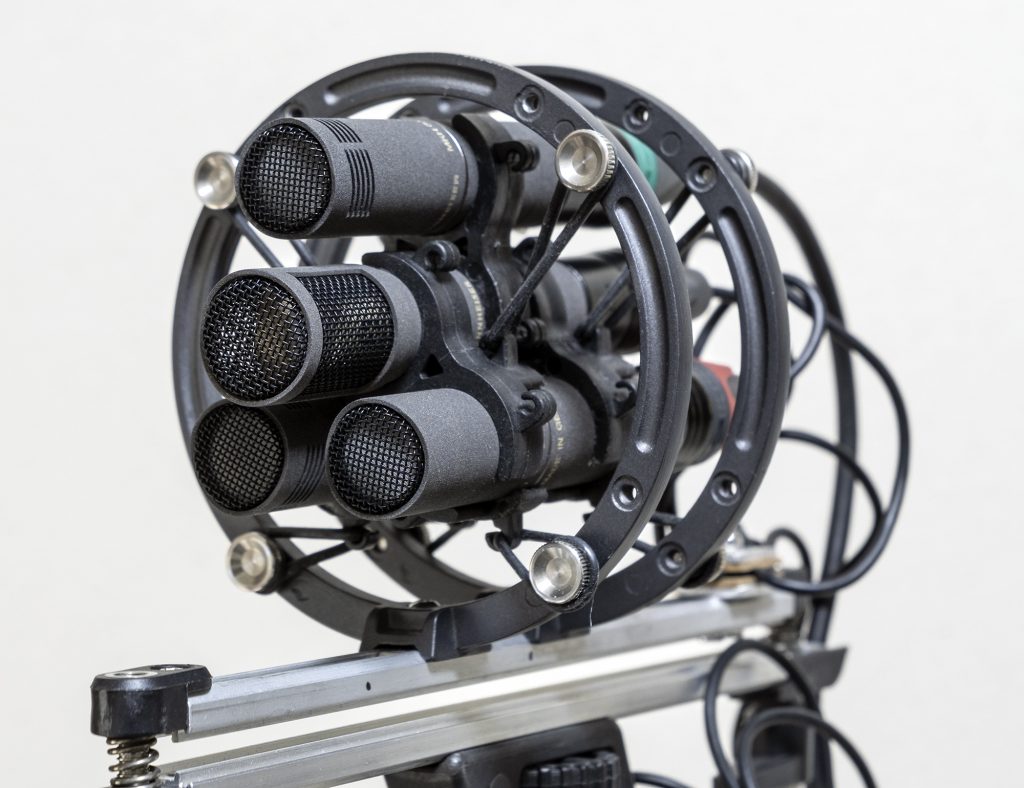
Squeezing four mics into a blimp suspension for mid-side testing. Top to bottom: MKH 8040 (cardioid), MKH 8030 (fig 8), MKH 8020 (omni: right), and MKH 8050 (supercardioid: left). The acoustic shadowing (which is inevitable to some extent in coincident pairs) of this cluster of mics near each other has very little effect in reality, and is largely a concern of the theoreticians out there: much more important is the ability to be able to compare different flavours of mid-side recording at the same time. Despite some snazzier options, my old Rode Mk 1 blimp again proved the best bet for accommodating such a number of mics.
Introduction
Part 2 of the Sennheiser MKH 8030 (fig 8) tests involved recording a bluegrass band with a mid-side set-up, focused on the Sennheiser MKH 8040 (cardioid) and MKH 8030 pair, but including the Rycote BD-10 (fig 8) and CA-08 (cardioid) mics. For the next series of tests I was keen to hear how the MKH 8030 sounded with other mics from the MKH 8000 series in a mid-side pair. There are, of course, five other mics in the series, ranging from omni to long shotgun, but, to make things manageable, I wanted to focus on three mid-mic options: the MKH 8020 (omni), the MKH 8040 (cardioid) and the MKH 8050 (supercardioid). The MKH 8090 (wide cardioid) has much to commend it for a mid mic, but I suspected that the difference between it and the omni and cardioid mics might be a bit nuanced for my tests. Mid-side with shotgun mics is possible, of course, but it’s not something I’m hugely keen on. Besides, I needed a practical rig to be able to test different combinations at the same time, so four mics of similar size was my limit for a blimp. Similar practical matters also ruled out including mid-side with a second MKH 8030 (which would require a different orientation): that, and the fact that I don’t yet have a second MKH 8030! So tests of a fig 8 as the mid mic, and of a Blumlein pair of MKH 8030s, will have to wait until another time.
It has been very clear from the outset that the MKH 8030 is a superb fig 8 mic, condensing much of what is loved about the MKH 30 into a smaller form, so testing its performance in mid-side rigs might seem superfluous: it could be assumed that the mic will deliver excellent mid-side recordings when used with the other MKH 8000 series mics. Well, there are two angles to this: first, it’s good to check that theory and expectations are matched by reality, not least as the MKH 8000 mics are not cheap, and provide samples of this; and, second, I was intrigued by the on-line comment of another tester of the pre-production MKH 8030 mic as part of a mid-side pair, who said ‘the 8050 is too narrow and creates holes in the stereo image and other weirdness when decoding‘. This was for recording nature so narrowness may well have been an issue for desired wide ambiences, but holes and other ‘weirdness’ seemed surprising since the MKH50/MKH30 pair has long been used to good effect. And, of course, a supercardioid or hypercardioid mid-mic choice is an obvious one for production sound recordists (i.e. heavy users of mics with these polar patterns) who want the scope for a bit of mid-side stereo when the occasion arises.
So to these latest tests. Given the comment about the MKH 8050 as a mid-mic, and the previous musical test for the MKH 8030, I have this time focused on field recording – both natural and man-made sounds, and including sounds that cross the stereo field: hopefully, these will allow consideration of any holes in the centre of the stereo image, or other ‘weirdness’. In each of the samples below, the recordings are as straight off the recorder, albeit with levels adjusted in post so that the mid and side mics are mixed at a ratio of 50:50 (I recorded all four channels with the same gain) to reflect the slightly different sensitivities of the mics: i.e. MKH 8020 at -30dBV, MKH 8030 at -30.8dBV, MKH 8040 at -34dBV and MKH 8050 at -34dBV.
Mid-side test rig in blimp, recording the not-quite-as-quiet-as-you-might-think village street sounds.
‘The Deserted Village’
First up, is my old and unadventurous stalwart: mics at the front of our garden, at ninety degrees to the street in this quiet Norfolk village, with birdsong and the odd passing car or tractor.
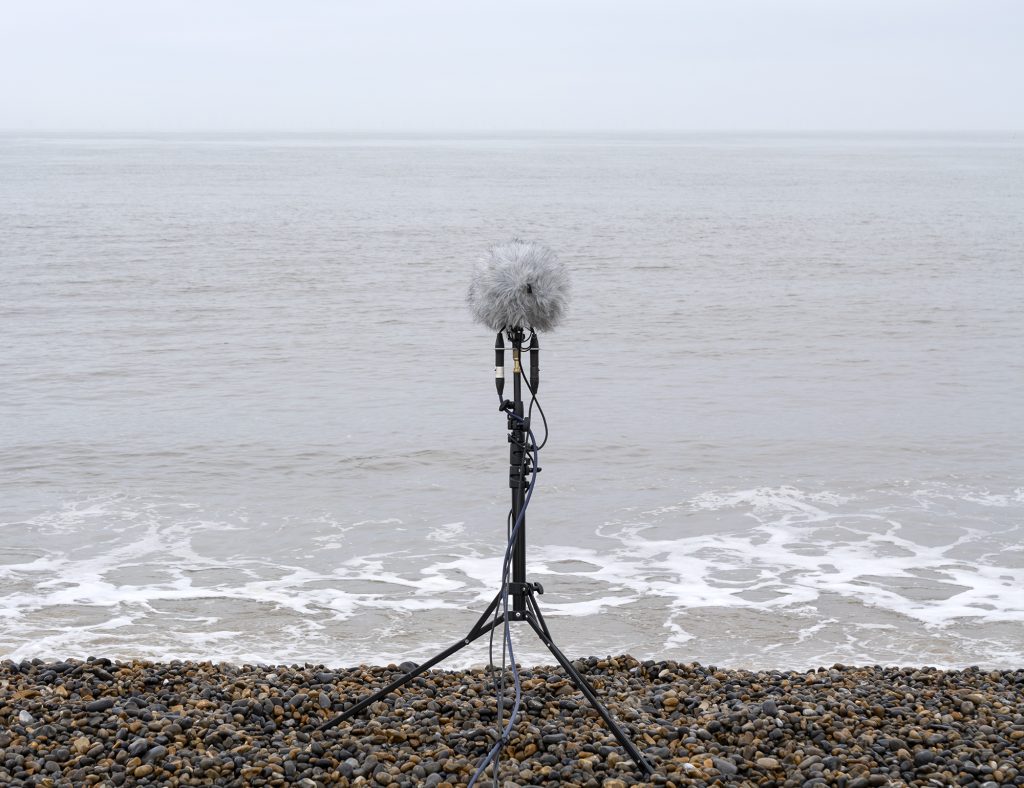
On the shingle beach at Salthouse.
‘Sea-Fever’
Next I took the four-mic MS rig up to the coast. There was a gentle offshore wind, but the shingle beach shelves steeply, so there was some wave action nonetheless. Waves break onto the beach at different times, naturally, so the sound often moves across the stereo image. For this first series of recordings the mic stand was rather near to the sea than in the photo: it was right at the water’s edge – so much so that a couple of times I had to grab the stand and stagger backwards to avoid a clutch of Sennheiser mics taking a dip in the North Sea.
And then, while on the beach, but, say, 30ft (10m) from the water’s edge, I recorded myself walking past the mics, angled downwards a bit, again with the intention of exploring the ‘hole in the middle’.
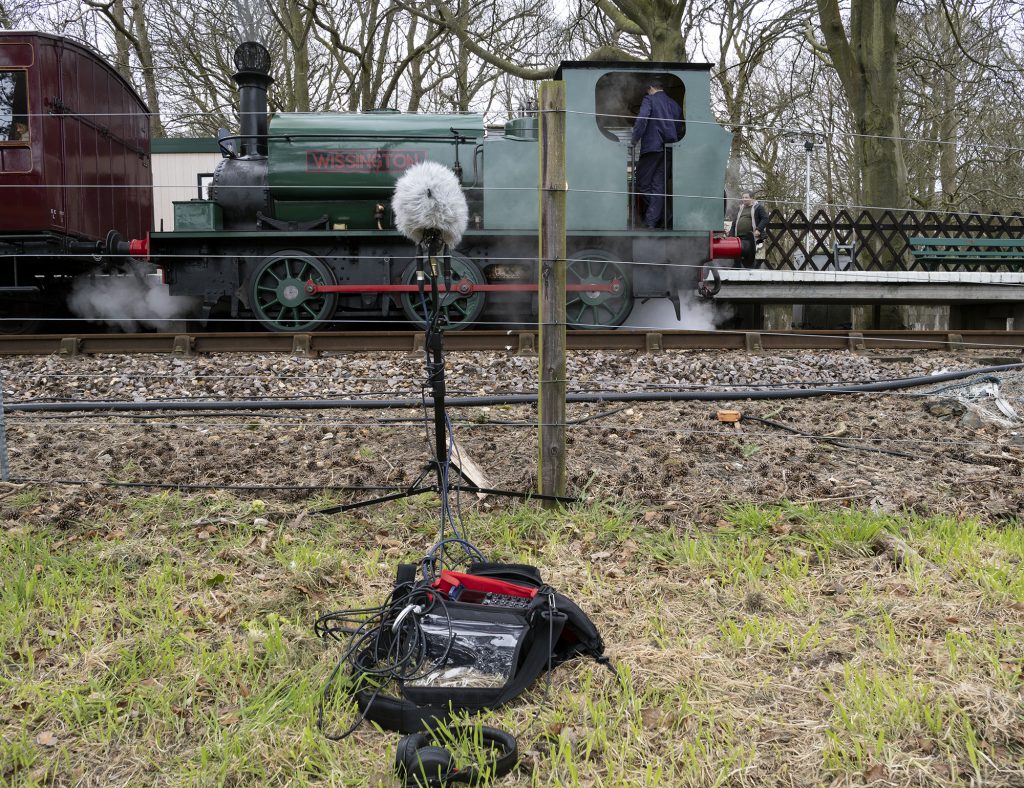
At Holt station, on the North Norfolk Railway, set up opposite a little saddle-tank locomotive built for, and named after, the British Sugar Corporation’s factory at Wissington (near Downham Market): this is still sugar beet country.
‘At The Railway Station’
A few miles away, the season was was well and truly underway at the North Norfolk Railway, with trains bustling between Holt and Sheringham over the Easter weekend. Setting up lineside opposite a small saddle-tank locomotive, with the station platform beyond, I recorded its departure and the rattle of its carriages as it headed off backwards.
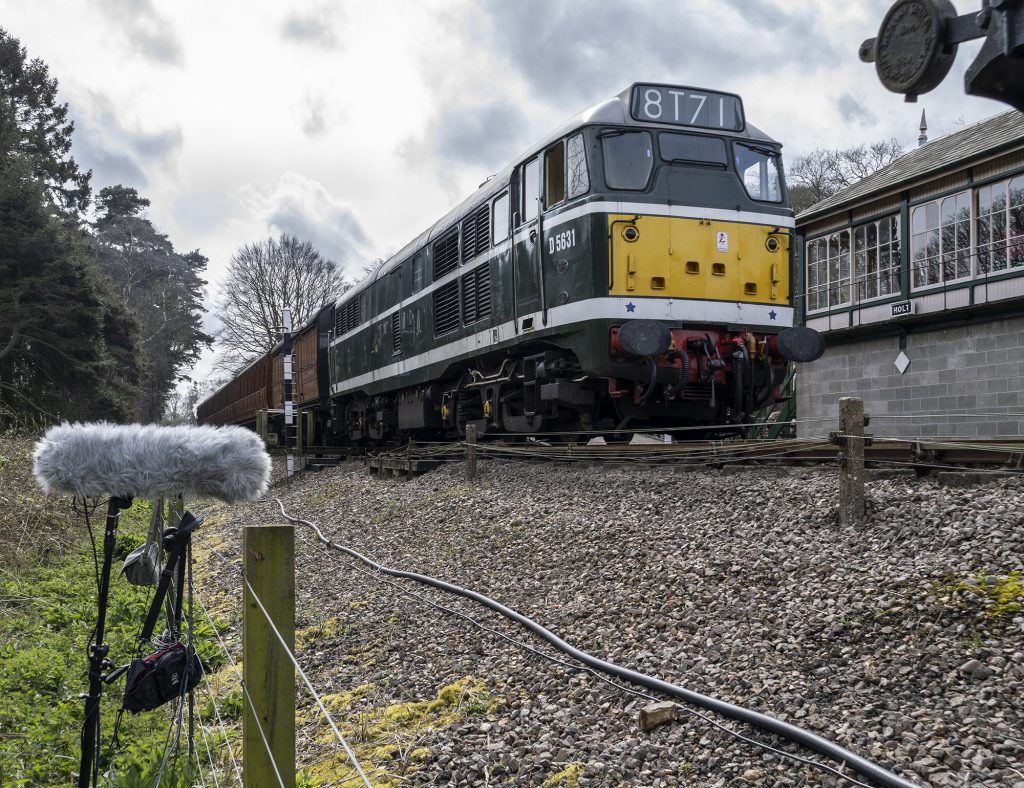
Diesel locomotive at Holt station. Nice to be at the level of the track for the clatter of the wheels, or is that bogies?
After this small train pulled out, I became very visible to anyone on the platform so perhaps it wasn’t surprising that a chap pointed me out to his toddler grandson, who in response gave a nonplussed shrug way beyond his years. With headphones, a furry blimp and a camera, I must have looked like an über-trainspotter: a fair cop perhaps, but, seeking a less conspicuous position, I moved along the fence by the lineside to a point just beyond the station. There were practical advantages of a less visible location too: chatter from those at the station was reduced, I was further from the car park, and I was next to the signal, with its occasional clunking movements. I settled down to wait for the next train, which then took me unawares as there was no whistle or chuffing to announce its arrival: it was a diesel. Well, it may have lacked the nostalgic charm of steam, but it was a different sound, so I pressed record.
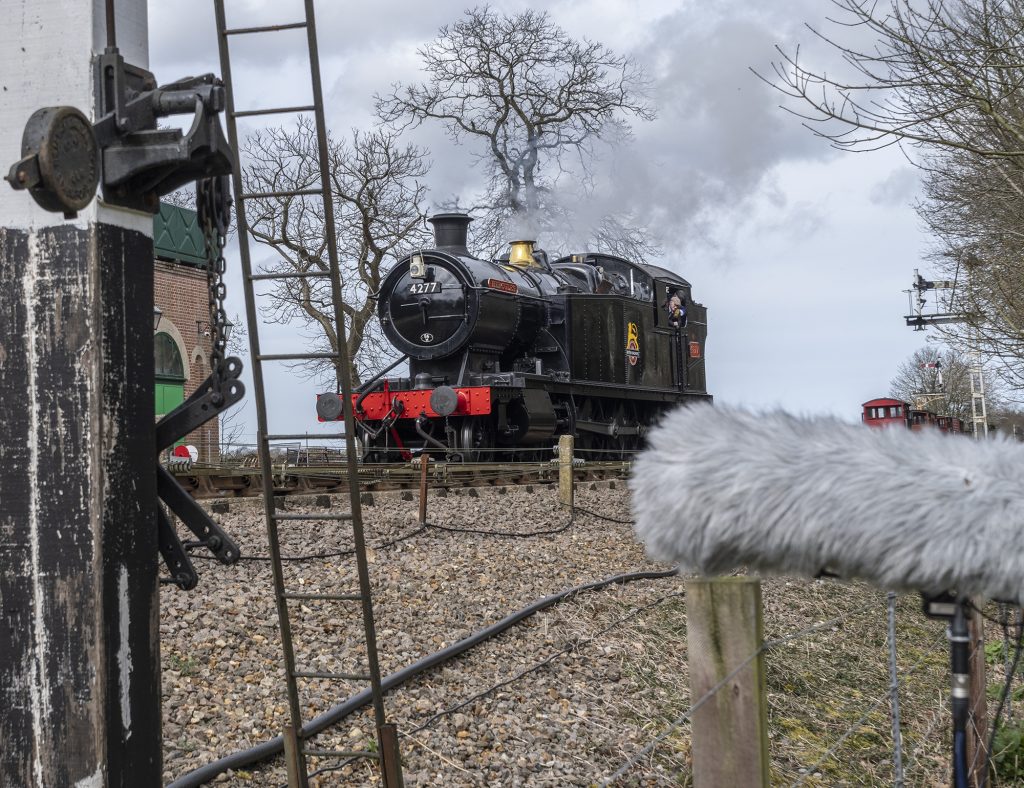
‘Hercules’, a 2-8-0T from the Great Western Railway, visiting Norfolk for the season. It’s doing the whizz around the run-round loop that the locomotives do at Holt (a terminus) to get to the front of the train again for the return trip, so it hasn’t got its carriages attached at this point. The manoeuvre makes for more recording options.
Working on the principle that the locomotive types must be alternating, I waited for the next one to arrive, hoping for another steam engine and perhaps something a bit larger than the little saddle tank. Sure enough, after another 15 minutes or so, along puffed a much larger tank engine, pulling a longer train of carriages. OK, not one of the biggest locomotives on this railway, but noticeably different in sound: a lot bassier, and, as expected, this comes across especially well in the omni mid-side recording. In this case I had the mics angled at forty-five degrees towards the departing train, which, of course, sees the greater emphasis from the omni mid mic on the disappearing sound around 130 off axis..
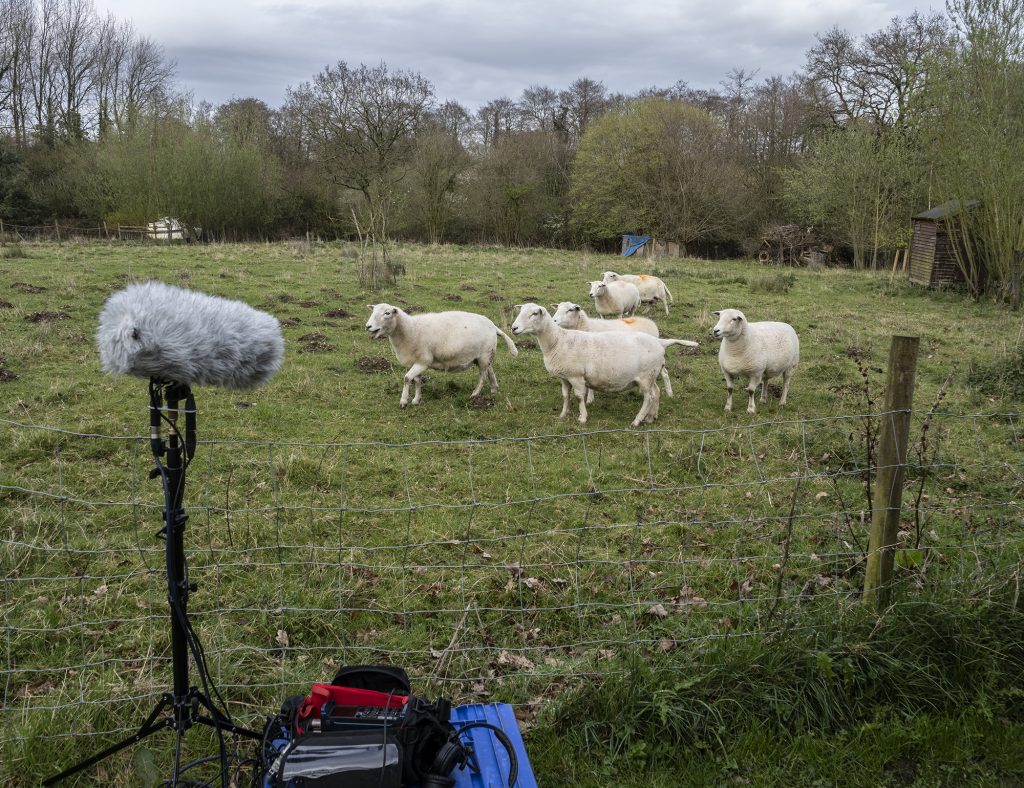
Sennheiser MKH 8000 mics meeting half-a-dozen Easy Care sheep (yes, that has got to be the most unlikely and unattractive name for a breed of sheep, even if it describes them well!).
‘The Manor Farm’
Perhaps it was thinking about farming round here when waiting for the little sugar beet ‘Wissington’ loco to set off or perhaps it was thinking about lunch on Easter Day, but for my final set of recordings I popped over to a friend’s house to record his sheep. No lambs yet, but despite the small size of the flock they put in a good performance for the mics: it’s amazing what the appearance of a feed bucket can do. Listening back, I’m surprised at the amount of natural reverb: far from anechoic. In this case the omni mid-mic brings in some less desirable low-frequency background noise and more traffic from the road (a B road, about 120 yards/metres away), but otherwise does a good job: that said, with the principal sound sources in front of the mics, I prefer the MKH 8040 and MKH 8050 mid-mic recordings.
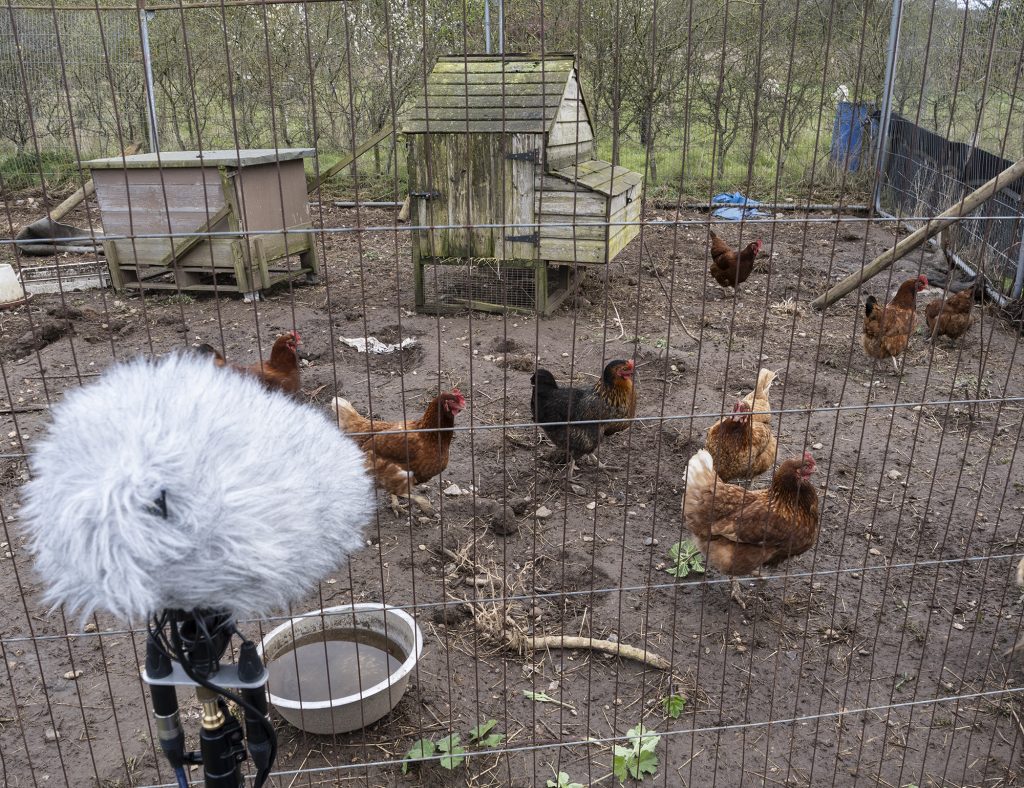
This becomes more obvious still in the following series of recordings: some fairly quiet chickens in their pen scrabbling around and clucking quietly, while a distant road (more line 200 yards/200 metres away) and some distant agricultural machinery (a drier of some sort I think) add some less wanted background noise that is least evident – naturally – the MKH 8050 mid-side pair. Not the most exciting field recording ever made, I know, but it illustrates the point!
Conclusions
The main purpose of this post – as with so many of the other tests – is to provide the reader with a few samples to draw their own conclusions. But, beyond that, what is crystal clear to me is that there is no oddity with the MKH 8050 and MKH 8030 mid-side combination: the pair perform exactly as one would expect – and hope – of a mid-side pair with a supercardioid mid mic.
As well as demonstrating the MKH 8030 as the side mic with a range of other MKH 8000 series polar patterns (arguably those that will be used most frequently in mid-side recording), I hope this post also provides some useful examples of the impact of the different mid-mics on the stereo field, which, of course, give rise to different virtual mic patterns: the omni mid-side pair is nominally equivalent to an XY pair of cardioid microphones oriented back-to-back (180 degrees); the cardioid mid-side pair is nominally equivalent to a pair of supercardioid (often incorrectly cited as hypercardioid) microphones at an included angle of about 130 degrees; the supercardioid mid-side pair is nominally equivalent to a pair of hypercardioid microphones at an included angle of about 120 degrees. I say nominally since the equivalent microphone patterns don’t exactly match definitions for existing microphones and sound directly in front of the pair is on axis to the mid mic and, therefore, suffers less colouration than with its XY equivalent. Normally one would make mid-mic choice before recording, giving a simple two-mic mid-side pair rather than something like the clunky and impractical four-mic rig that I used for these tests.
And these tests are, perhaps, a reminder to those not so familiar with the idea, that the mid mic need not be a cardioid. In particular, the sound samples show that an omni mid mic can be an effective choice, certainly if you want, or need, the bass response of an omni mic. For field recording in particular, it offers this bass response in a much more compact form than most spaced pairs (typically involving two windshields and a stereo bar).
Indeed, you can use a mid-side pair of the MKH 8000 series mics in a small blimp: below, for example, is an MKH 8040/MKH 8030 pair in the small Rycote Nanoshield NS1-BA, which is only 220mm long. Obviously it would be much better with purpose-built MS lyres, which I hope we will see before too long, to bring the mic pair into the centre more and, thus, make wind protection much more effective. And while not a full blimp, Cinela are promising a compact COSI windshield for an MKH 8030 mid-side pair, having demonstrated a prototype at IBC 2023. In short, small and light windshield options will be available to take advantage of the small size of the mid-side pairs, for those occasions when larger windshields – with their better wind protection – are not needed or wanted.
How small and light can you go? MKH 8040 and MKH 8030 mid-side pair in a full blimp 220mm overall length: the Rycote Nanoshield NS1-BA.