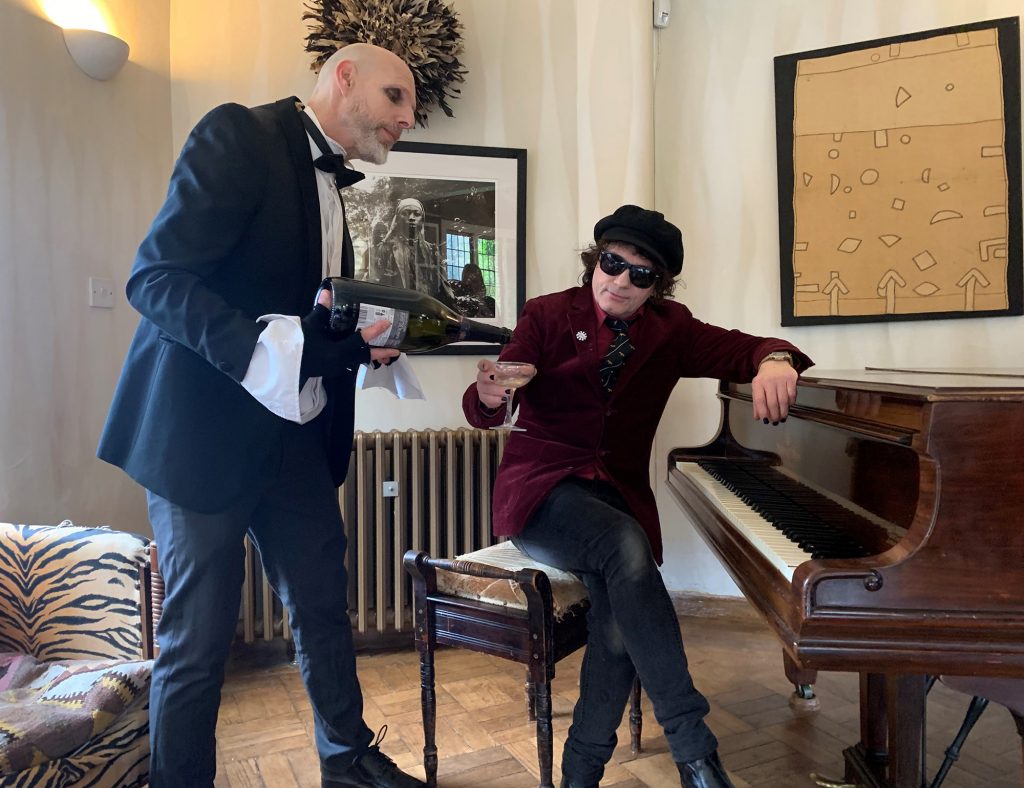
British singer-songwriter Marc Valentine – erstwhile frontman of cult British power-pop outfit Last Great Dreamers – asked me to make a video for one of his singles, ‘Tyrannical Wrecks’, from his upcoming album ‘Basement Sparks’, to be released on 22nd March by Steve Van Zandt’s Wicked Cool Records. Marc had managed to wangle the run of Voewood for a day: Voewood, for those not familiar with it, being the wonderful, bombastic Arts & Crafts country house near Holt, in Norfolk, designed by Edward Schroder Prior.
Marc had sketched out an ambitious shoot, involving a country-house party, a minstrel-like band suffering to play to – and be ignored by – the guests, a host who demonstrates his avarice by selling the world to a passing alien, and a put-upon butler driven to spiking the drinks, all leading to a wilder gig in the basement and so on. A quick chat over a pint at my local, and many emails later, we rolled up for shooting on a nippy – and thankfully overcast – day in January, to meet the band (as well as Marc on vocals and guitar, Richard Davies on guitar, Rik Pratt on drums, and Richard Poynton on bass) and some of the principal members of the cast. The latter included a butler with strong shades of Riff Raff from The Rocky Horror Picture Show, albeit with less hair, and a host that seemed to have a hint of a former president of the USA, though Voewood, thankfully, has little of Mar-a-Lago about it.
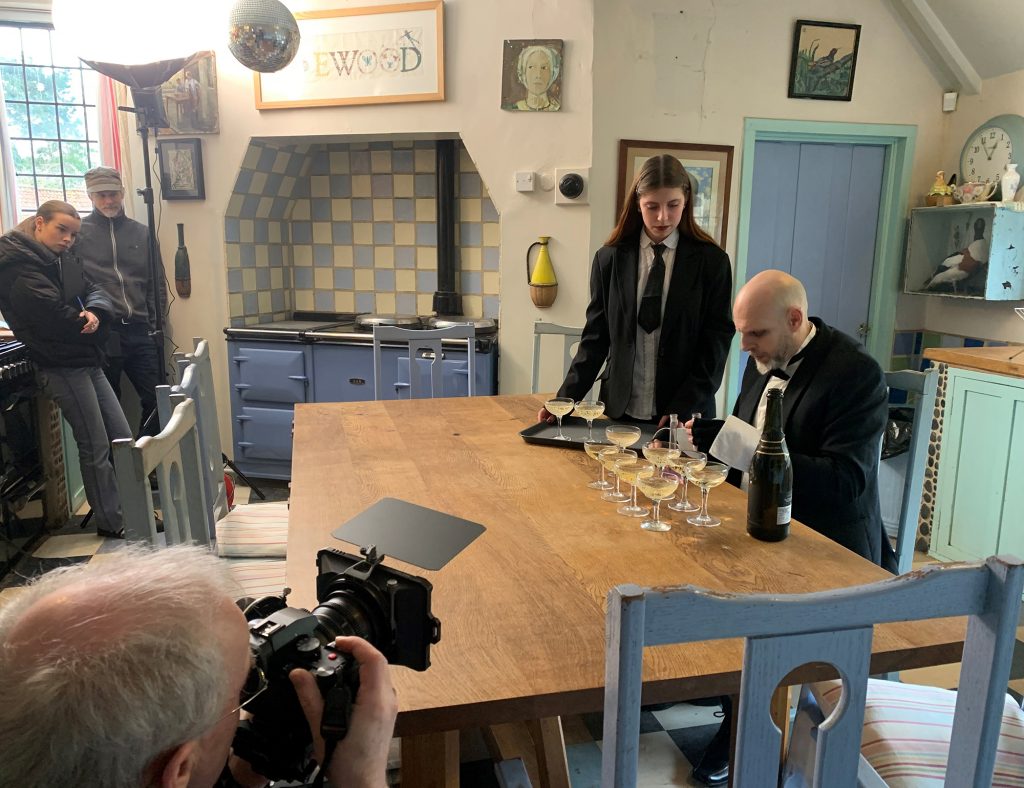
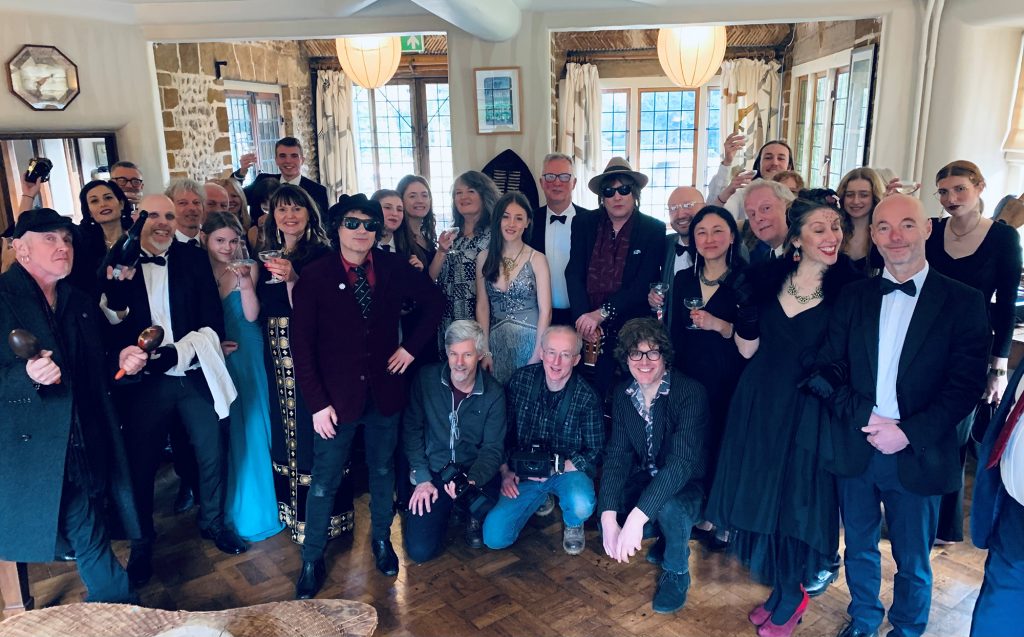
After a quick drone shot of the band’s van arriving, shooting went handheld, with a Lumix G9ii and Meike T2.2 16mm cine lens, filming all the shots of the band on their own, then the host in bed, bathing etc. And with with the extras arriving en masse we moved on to filming busier scenes. With a total cast of around 25, this was far more than I have had to direct before, but they were switched on and willing: a delight. We only used a fraction of the house – this was to be no Country Life feature – but, even so, we needed to be nimble to stop the unpaid cast and crew flagging and just to get everything done in about five hours. This meant using natural (and practical) lighting wherever possible, and only bringing in a lantern or two when necessary. Quick shots of guest arrivals were followed by the main drinks party in the drawing room: this was a sedate affair with a bored band in the background. Rob Moore was my main crew throughout (his daughter Esme acting as 1st AC to keep us on track), and for this part moved on to second camera: a Lumix G9 and Meike T2.2 35mm cine lens. After lunch (real) and after being spiked by the butler (fictional) things got a little livelier, with the band – now electric (or at least miming so) – playing in the basement bar through to the denouement (so needing syncing to the pre-recorded track). We had a few technical issues: that alien outfit that someone had bought off Amazon for £25 was probably overpriced (you try filming an alien with a two-dimensional face, and grey socks and shoes sticking out the bottom of his too-short dress!); and Marc panicked when momentarily he lost his shades (yes, indoors on a grey winter day, but you’ve got to live the rock’n’roll life!). But that was all part of what was a fun shoot.
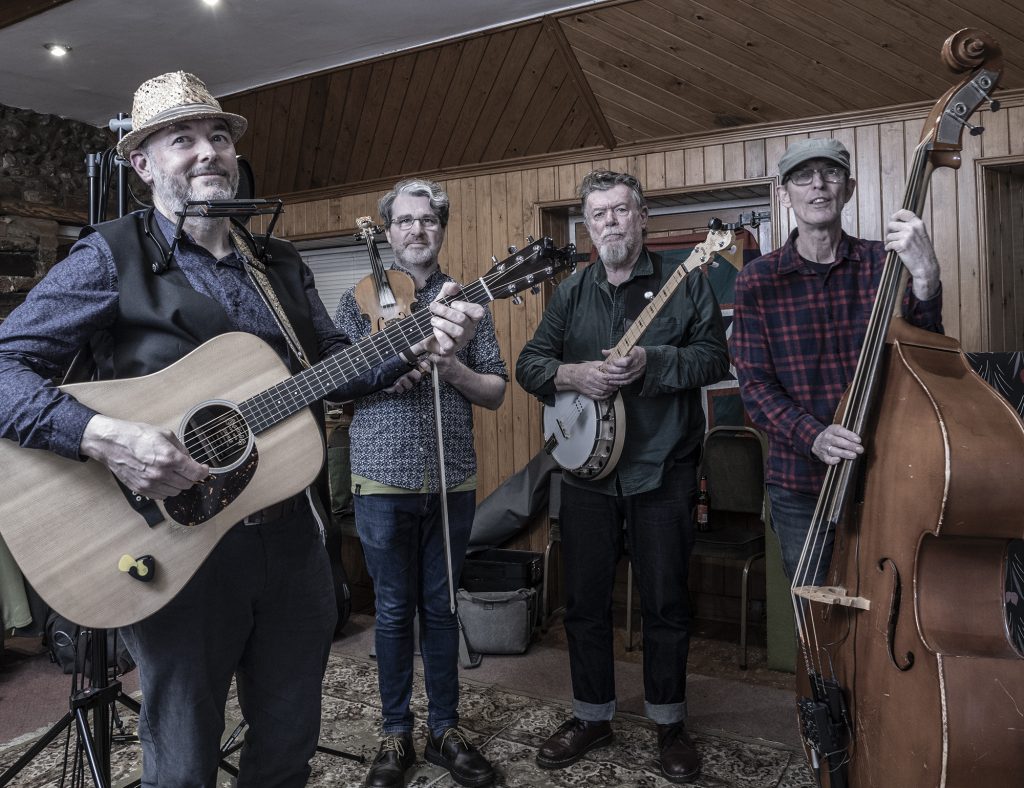
The Time and Mercy Band, comprising (left to right) Richard Ward, Jason French, Rob John and Kevin Burton.
Thursday evening was an inauspicious time to be heading out for a recording of a bluegrass band: it was a soggy wet evening here in rural Norfolk, with the narrow roads full of potholes lurking below rivers. It didn’t feel much like the Appalachian Mountains. Was it left, right, left, right, left and right again on the maze of roads around Mannington and Wolterton, or the other way round? And if I didn’t remember my left from my right, how on earth would I remember how to connect up the mics for some more mid-side recordings, building on my earlier comparative tests of the new Sennheiser MKH 8030?
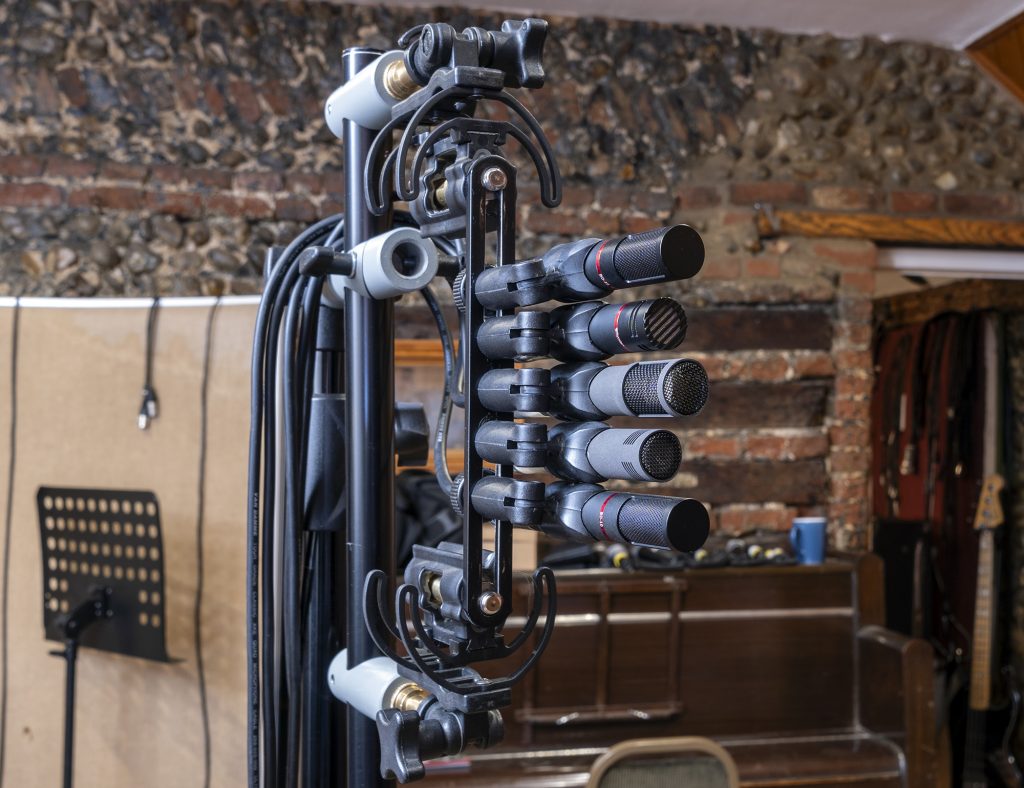
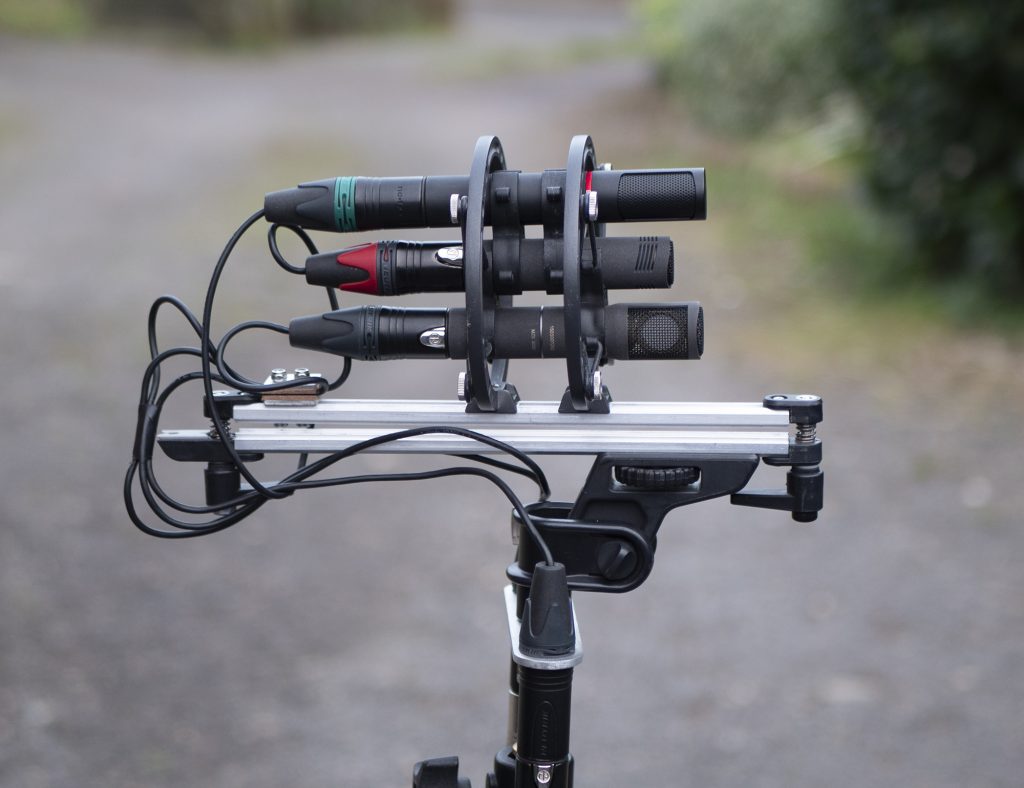
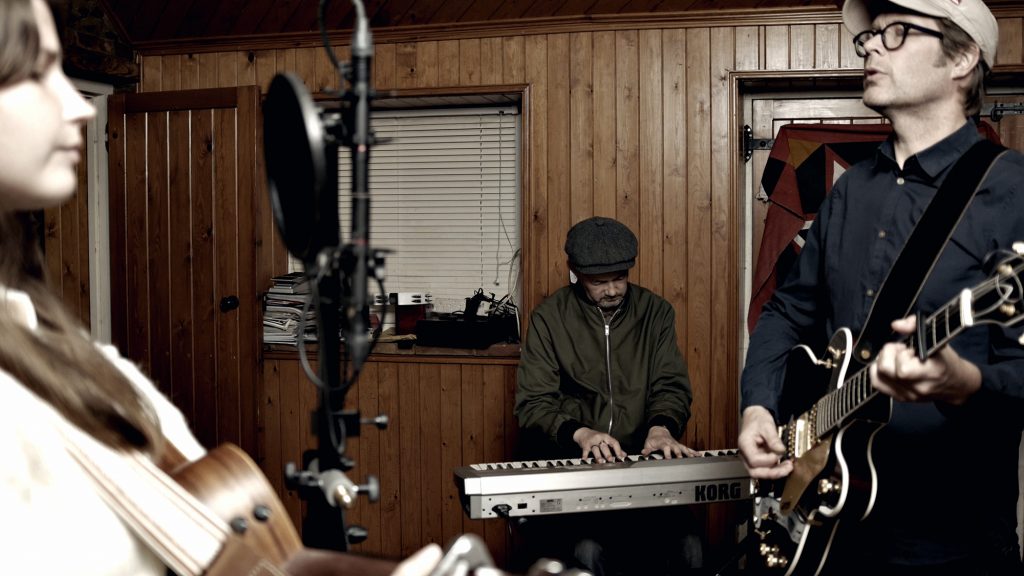
I was heading back to The Forge, the studio of Kev Burton, where, a few months ago, I recorded Lucy Grubb and her band using a Blumlein pair of Rycote BD-10 fig 8 mics. This time it was a similar venture: a different band (albeit with the common factor of Kev on bass) – the Time and Mercy Band – and with a mid-side pair instead of a Blumlein pair. This was partly driven by only having a single pre-production Sennheiser MKH 8030 fig 8, but, also, because I wanted to test further the MKH 8030 in combination with the MKH 8040 cardioid as the mid mic, and throw the new Rycote BD-10 fig 8 and its cardioid (CA-08) sibling into the mix. Back at base, I’d decided that to compare the four mics in a mid-side array and allow any combination (but always using an immediately adjacent pair as mid and side mics), I needed a vertical array of five mics: that was BD-10 top and bottom, MKH 8030 in the middle, and the two cardioids between the three fig 8s. Getting them close together (I managed 4mm apart, which is better than many a back-to-back clip) was tricky and meant I couldn’t use individual shock mounts: but still wanting some isolation from a wooden floor and anticipated tapping feet, I then bolted the whole array to a pair of hefty (Duo Lyre 68 shore) Rycote Invision shock mounts, and, for belt and braces, put the stand on foam pads.
Heath Robinson would have been proud of this…
It was a little easier setting up than with the Blumlein recording, this time having all the musicians on one side of the mics and having no drum kit to manage in a fairly compact studio, but the principle remained very much as before – needing care to balance the different instruments and voices – for which having the studio’s control room, with its wonderful Midas desk (originally made for Frank Zappa) feeding into Logic, and Kev’s experience with it, was invaluable for reviewing each take. The primary feed from the mics was, again, to my field recorder.
We recorded three songs, but, for the purposes of this post I am going to focus on one, which the band call ‘Sugar Honey Babe’. It’s a traditional bluegrass song and has been recorded with many similar titles (and, of course, variations in the lyrics), and perhaps is most well-known nowadays as ‘Red Rocking Chair’.
OK, that’s more than enough preamble: to the results! First off, here’s a very quick and dirty video: one camera stuck on a tripod pointing towards the band and with the mics largely blocking the view of Rob on banjo. My excuse is that the focus was on the audio. The video switches between the various mic combinations and, as the previous tests showed that the two Rycotes are lighter in the bass department than their MKH 8000 series counterparts, a few options where the BD-10 and the CA-08 have some EQ: imperfectly applied, no doubt, but it reduces some of the more obvious differences between the mics. Other than the EQ on these few clearly labelled snippets, all the sound is as it was recorded: no reverb, no compression etc.
For those wanting to listen to the sound files without whatever YouTube does to them, here they are. I’ve not included the EQ’d versions as I am sure others can do better, or would at least want to try. These LR stereo files can, of course, be decoded back to the original mid and side channels, should you so wish (I’ve enabled downloading permissions on SoundCloud for them).
I’m not sure all the versions of the tracks with the Rycote mics given some EQ (as used where flagged up in the video above) merit inclusion, but here is just the one – the recording with the MKH 8040 and the EQ’d BD-10: although the EQ is fairly rough and ready, it does show the potential, should you wish it, to bring the mic nearer the MKH 8030.
And, finally, for a bit of fun, here’s a version of the video with the MKH 8040 and MKH 8030 pair throughout, rather than chopping and changing mic pairs. I’ve added a little reverb to this version.
So the verdict this time? As with the Blumlein pair recording, that’s one for others perhaps. The balance of the recording is far from perfect: we didn’t have endless time to fiddle around with placement, and, even if we had spent hours on it, it would have been hard to balance, say, Rob’s backing vocal and his (much louder) banjo. On a different note, rain can be heard on the studio window too: so not ideal. But putting the MKH 8030 into more real-world action with a largely acoustic band (there was a little bit of amplification for the bass) was useful, not least seeing how it performed with the MKH 8040 and just how much difference was noticeable when swapping out to different (and less expensive) mics, and what a bit of EQ might do to that. As before, my take is that the MKH 8030 is a first-rate mic, pairs well with the excellent MKH 8040 (as entirely expected), but that the considerably cheaper BD-10 is decent too and that, with some EQ, comes much closer to the MKH 8030 – especially when used as the side mic in a mid-side recording. As I’ve said before, it’s good to have these two new choices in the limited field of SDC fig 8 mics: happy days!
It’s like the old saying: you wait for ages for a bus, then two come along at once. In the last year we have seen Rycote (well-established in terms of shock mounts and windshields, but fairly new to making mics themselves) announce a small figure-of-eight mic in the form of the BD-10 (which I have tested previously), to form one of a family of seven mics; and Sennheiser soon followed with its announcement of the MKH 8030. The Rycote mic is starting to ship about the time I write this, and the Sennheiser mic is due to become available to buy in the second quarter of 2024. Of course, new mics are being announced all the time, but what is interesting about both these mics is the polar pattern and size: there are relatively few figure-of-eight SDC mics, with many well-known mic manufacturers having no such offering (for example DPA, Rode and, since the demise of the Blueline range, AKG). While the BD-10’s selling point lies in it being an excellent sounding fig 8 in the largely unpopulated mid-price range (albeit arguably boxing above its weight), the interest in the Sennheiser MKH 8030 is rather different: it is a member of the successful Sennheiser MKH 8000 family of mics, which have already established themselves as first-rate and robust workhorses of sound recordists across a range of disciplines including production sound, effects recording, nature recording and music recording. The company launched the first three of the series back in 2007 and the promised fig 8 model has been highly anticipated since, albeit with hope fading somewhat to resignation that it would never appear: there had been no additions to MKH 8000 series since 2012 until this new mic . Indeed, the first photos of the MKH 8030 in the wild last autumn led some to cry out ‘fake’! Fortunately, such cynicism (or, more charitably, self-protection against false hope) was ill-founded and the mic is a reality.
And why does the arrival of the MKH 8030 matter? Well, first off, it makes the MKH 8000 series mics a pretty complete family at last, with polar patterns comprising omni (MKH 8020), wide-cardioid (MKH 8090), cardioid (MKH 8040), super-cardioid (MKH 8050), short shotgun (MKH 8060), long shotgun (MKH 8070) and, now, fig 8. Given a straight choice many would rather use one range of mics for consistent sound, and this is especially significant when dealing with fig 8 mics, so often used for mid-side and double mid-side in combination with other polar patterns. Second, it means Sennheiser provides users wanting a fig 8 all the advantages of the rest of the MKH 8000 range – small, modular mics with extended high and low frequency response and with the legendary humidity resistance of all Sennheiser’s MKH mics: the latter being common to their radio-frequency (RF) design. It isn’t going to take over from the larger MKH 30 mic (launched back in 1987) for many users, any more than users of the MKH 40 cardioid mic automatically swapped to the MKH 8040, but for those wanting a smaller mic without giving up low self-noise (the new mic matches the 13dBA of the MKH 30), then this will be so welcome. Small size, of course, is as relevant to using mics on the end of a boom pole as it is for discreet micing in the concert hall, church or theatre, and as it is for creating complex (double mid-side and beyond) arrays in windshields for field recording. And, finally, with the MKH 8030 offering the advantages of the MKH 30 – not least RF design and low self-noise – it has a significant edge over the few alternative small SDC fig 8 mics currently available.
A word about these tests
Oh, a quick word about the tests below, less you expect too much and then feel disappointed, or, worse, chastise me! There is no substitute for putting a mic through its paces yourself, and nothing I can do will do that for you. Those from classical recording engineers with more refined ears and years of experience of working in the best concert halls, to production sound recordists working with the pressures of a major movie set, to wildlife recordists out there in extreme conditions that most us couldn’t handle even without a microphone in hand will need to see if the mic works for them and, critically, how it compares to whatever they have been using hitherto: that might be a Schoeps MK8 + CMC or the smaller CCM8, Sennheiser’s own MKH 30, or another fig 8 mic. I can’t replicate these different uses, and I don’t have every fig 8 mic on the market. So what follows will be, as ever, a series of recording tests relevant to my uses, a consideration of the mic on its own merits and, where useful, comparing the MKH 8030 to other mics I have here: this includes two other fig 8s that readers of this blog will know that I have used extensively – the old AKG CK94 (now discontinued) and the, much better sounding, new Rycote BD-10. Hopefully, something in what follows might be of interest and use to at least some others. The embedded audio clips are as recorded straight – no equalisation (unless I specify that a high-pass filter has been used: usually on the recorder), no added reverb, compression etc. – although levels have been matched in relation to mic sensitivity.
A look at the mic and its specifications
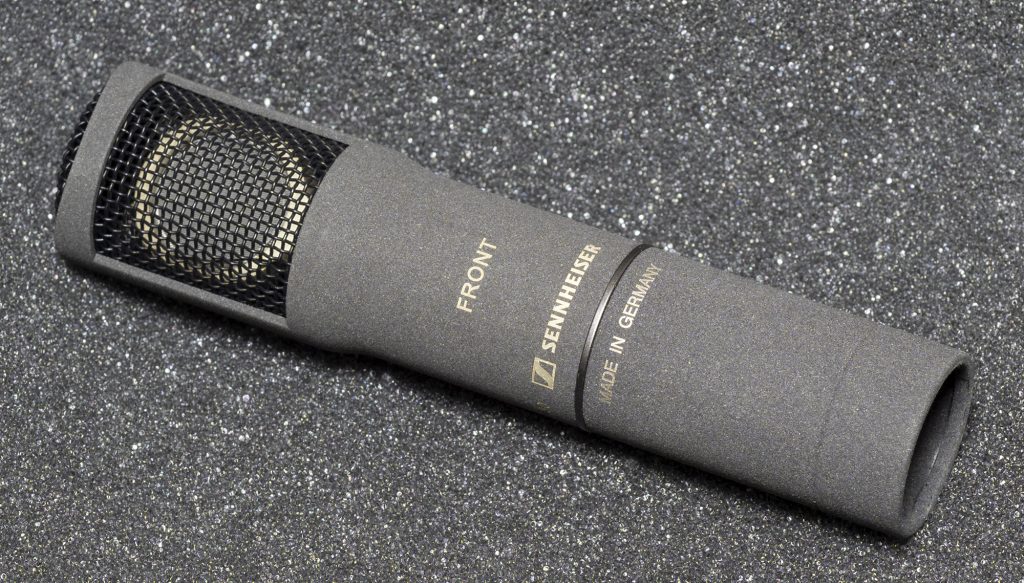
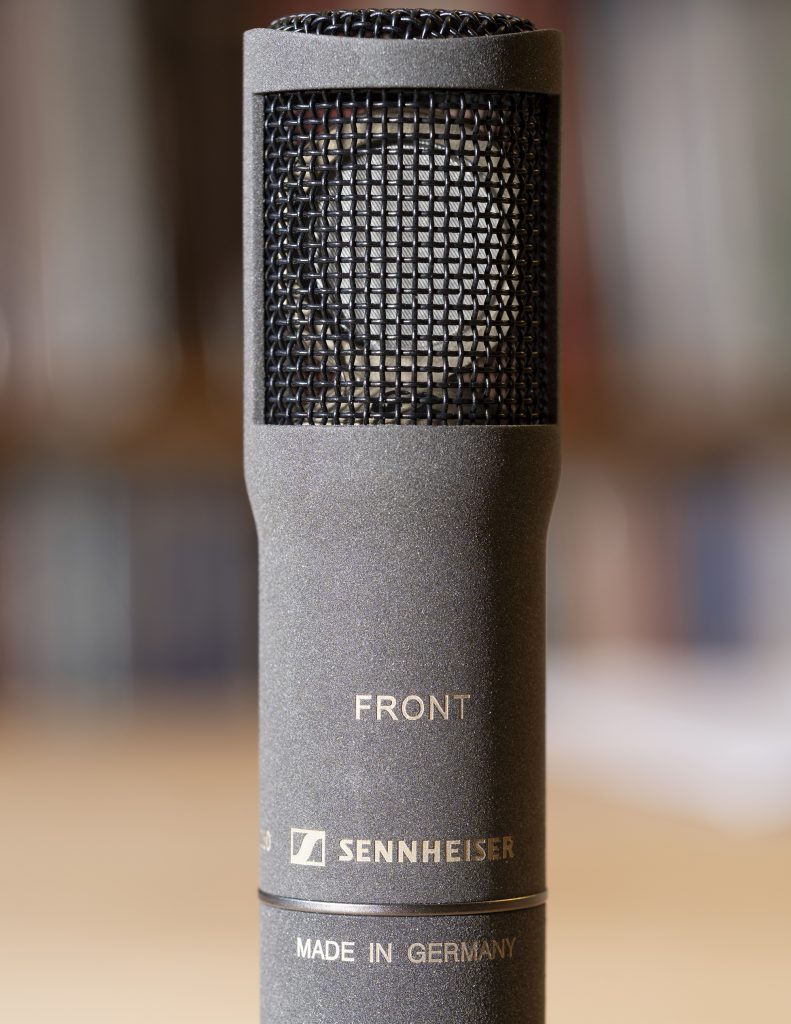
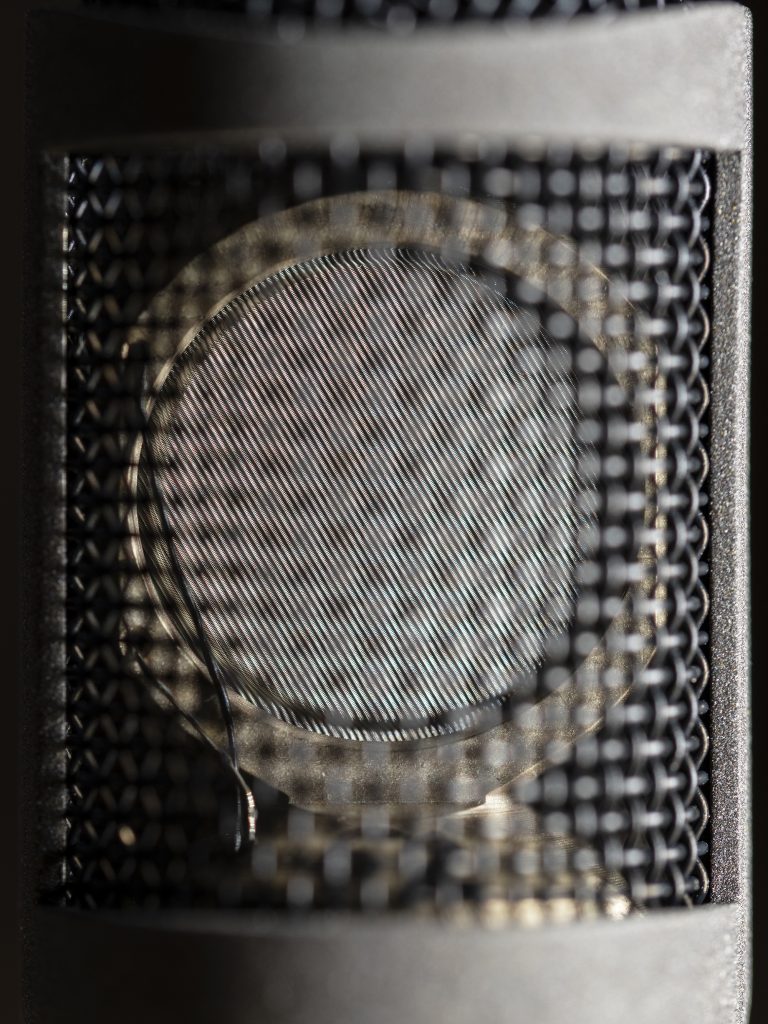
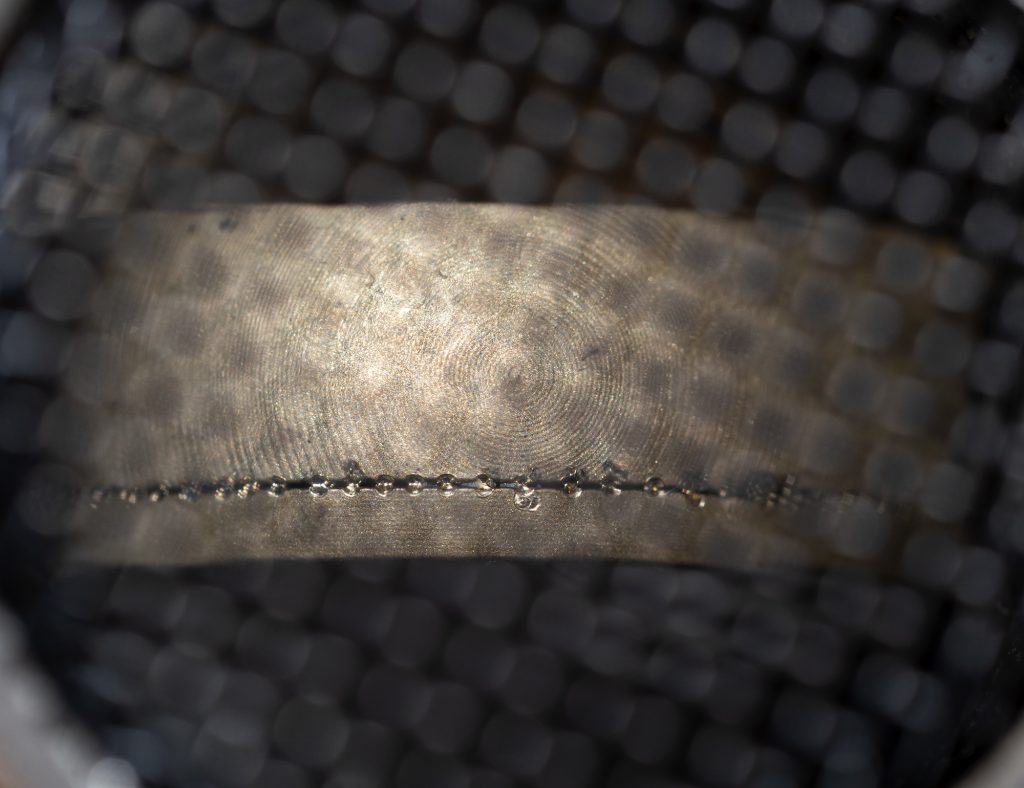
Well, first to the mic itself. The copy I have been sent by Sennheiser for field-testing is a pre-production model, although I understand that any changes before launch are likely to be limited to cosmetic matters. Peering through the fairly open weave of the basket (as on the other MKH mics) it is possible to see quite a bit of the capsule: as with the other MKH 8000 series mics it has a 16mm-diameter diaphragm (which Sennheiser has clarified in the press-release is the usual MKH symmetrical push-pull type, and evidently is a single diaphragm model), although its side-address orientation in this case means that the housing widens out from 19mm to 21mm to accommodate it. At 92mm long (with the XLR module) and weighing 71g (as measured here: Sennheiser give it as 83g in the press-release), the mic is only 33% of the size (by volume) of its MKH 30 counterpart and 65% of its weight. In short, it is small, but with some reassuring heft!
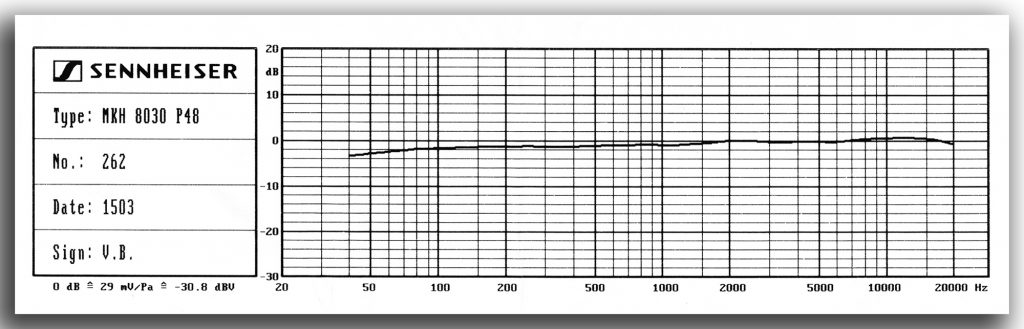
Performance-related specs published in the press-release of 15.9.2023 were limited to max SPL (139dB), frequency response (30-50,000 Hz), and self-noise (13dBA), but the individual calibration sheet supplied in the box with the sample mic usefully adds sensitivity (29 mV/Pa, -30.8dBV) and a plot of the frequency response curve (see below). These specs seem very much as anticipated. The 13dBA self-noise figure matches that for the larger MKH 30, which was expected, but is a relief all the same: most manufacturers produce fig 8 mics with self-noise significantly above their other polar patterns, but both Sennheiser’s fig 8s match their cardioid, super-cardioid and wide-cardioid counterparts in this regard. What does differ, though, is the sensitivity of the MKH 8030: this is 3dBV less than the cardioid, super-cardioid and wide-cardioid mics, close to the omni mic (1dBV more), and very different to the MKH 8060 and 8070 shotguns. This contrasts with the larger MKH 30, which, at 32dBV, matches the mics most likely to be used with it for critical MS recordings: namely, the MKH 20 omni, MKH 40 cardioid and MKH 50 super-cardioid mics. A small matter, perhaps, and certainly not relevant to all users, but it does make exact matching of gain on a mid-side linked pair a fiddle on many, if not most, recorders. Evidently more details – such as a polar plot – will follow in due course.
A close-up of the side-address capsule of the MKH 8030, showing the stainless-steel filter over the diaphragm common to the MKH 8000 series mics.View of the capsule through the end grille of the MKH 8030: rest-assured, the diaphragm sits centrally within its machined housing,
RFI
Looking at radio frequency interference (RFI) on the MKH 8030 is nothing to do with its RF design (which, in the words of the MKH designer Manfred Hibbing in his The MKH Story white paper), means the mic essentially has ‘a transmitter and receiver that are directly wired together’), but is about its resistance to external RFI. As I’ve said in posts on other tests, I am interested in the impact of RFI on mics since, as living in rural Norfolk, much of my life is outside or on the edge of mobile phone reception, where some models of phones transmitting at full power can cause notable interference on mics at up to, say 1m/3ft: not a problem with mics on a stand, but I’ve had this become a real issue with handheld shotgun mics and a phone in my jacket pocket (on those rare occasions when I forget to turn my phone off). And this could be a problem with ENG work too (not least from the phone of an interviewee). So I was glad to find that in testing, as before, with several different phones on the absolute fringe of reception (i.e. working at highest power) the MKH 8030 showed no sign of RFI even at close distances (100mm): for control I recorded the mic alongside a known problem mic (to check that the intermittent issue was occurring: it was) and the Sennheiser MKH 8040 (no RFI issue either). A good start!
Self-noise
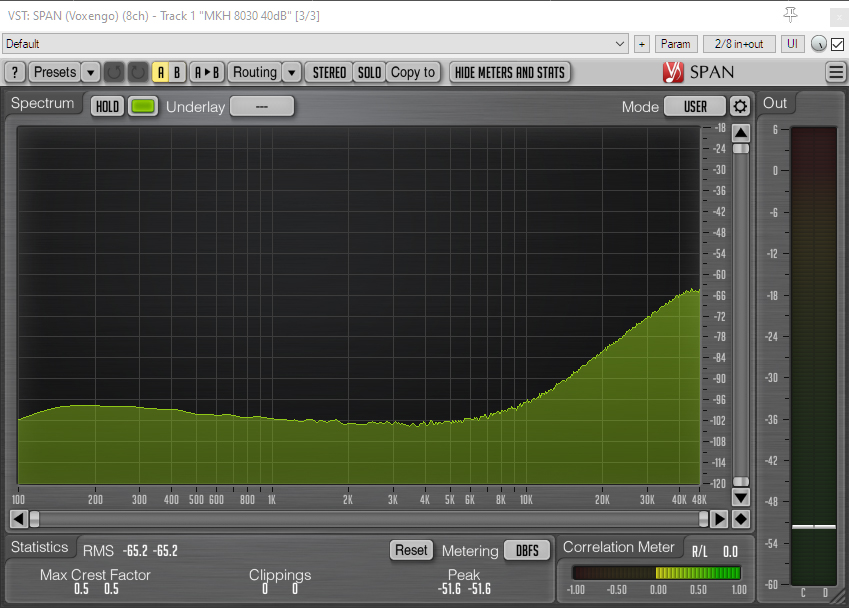
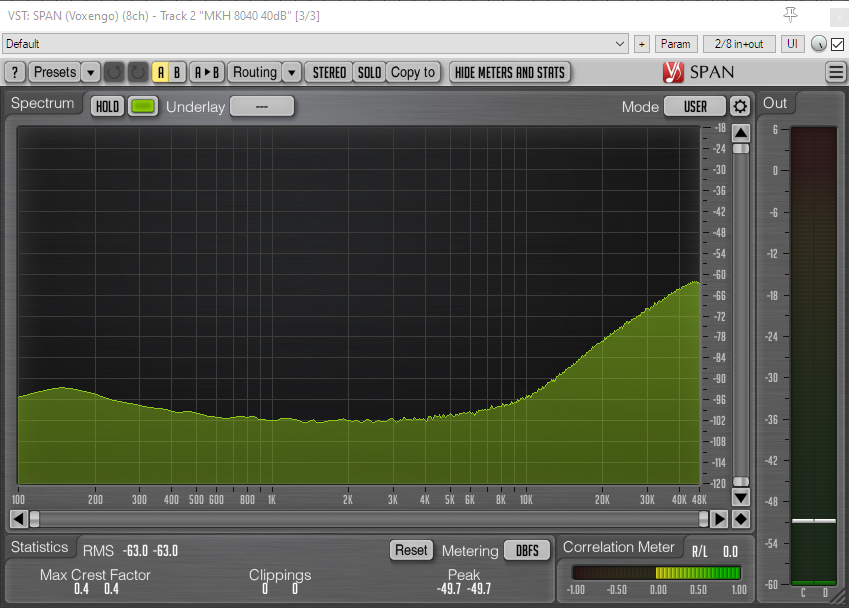
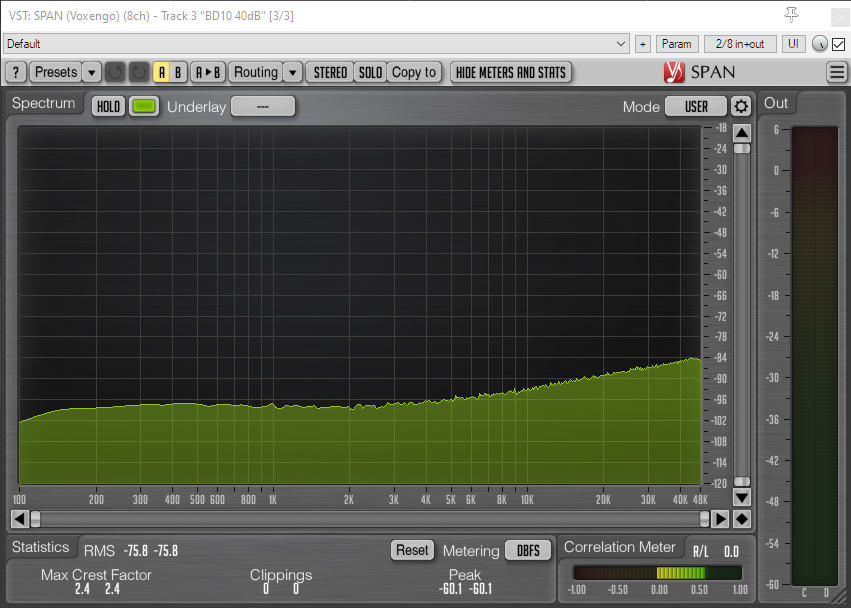
The 13dB-A self-noise figure for the MKH30 and, now, the MKH 8030 mic is excellent for an SDC fig 8. The Schoeps MK8, for example, has self-noise of 17dB-A and the Schoeps CCM 8 is fractionally noisier at 18dB-A. Given that listening to the hiss of a mic on its own isn’t hugely instructive, I compared the MKH 8030 with two other 13dB-A mics that I have – the cardioid Rycote CA-08 and, more relevant to prospective users of the new mic, the cardioid Sennheiser MKH 8040 – and the 18dB-A Rycote BD-10. First off, I checked that the manufacturer’s sensitivity figures were broadly correct, recording a 1kHz tone and measuring that with a tight band-pass filter applied at 1kHz: all was evidently in order. So, l in the absence of an anechoic chamber, I then did my usual by recording the sound of nothing with the mics buried deep in duvets in the airing cupboard, with all doors and windows closed and the mains electricity turned off, recording into a Sound Devices MixPre-3 [EIN -130dBV/-128dBu]). There was a bit of low-frequency sound still permeating, so I applied a 100Hz high-pass filter at the recorder. Normally, I wouldn’t bother including the sound of madly cranked-up mic hiss (the MKH8030 has been given a whopping 70dB of gain, and the other mics even more – reflecting their different sensitivities) in a test/review, but in this case it is quite interesting, so here goes with the audio files for the two Sennheiser mics and the BD-10. Just remember, and don’t panic: all three mics are very quiet in normal use!
And here are the spectrum analyzer visualizations of the noise:
MKH 8030 with 70dB total gain and 100Hz high-pass filter.MKH 8040 with 73.2dB total gain (to match MKH 8030 sensitivity) and 100Hz high-pass filter.BD-10 with 79.4dB total gain (to match MKH 8030 sensitivity) and 100Hz high-pass filter.
BD-10 with 79.4dB total gain (to match MKH 8030 sensitivity) and 100Hz high-pass filter
The sound files and the spectrum analyzer visualizations show that the two Sennheiser mics are broadly similar, although the MKH 8040 cardioid mic has more low-frequency noise: I suspect strongly that this is external noise resulting from my imperfect isolation, and a consequence of the different polar patterns. The spectrum analyzer also shows the increase in self-noise levels of the Sennheiser mics at very high frequencies – largely above human hearing, although relevant if pitching down (e.g. some effects, or bat recordings etc.). The BD-10 lacks such a significant rise in self-noise levels in frequencies above human hearing, but, in the realm of normal hearing has a higher-frequency hiss, which is also a little louder and more perceptible, especially if the level is reduced from these extreme gains: the greater self-noise is in accordance with the different specs [note: these tests use the revised BD-10 sensitivity of 9.8 mV/Pa/-40.2dBV, which differs by -3.25dBV from the specification published by Rycote in 2023]. Self-noise is unlikely to be the determining factor in deciding between using or buying these mics, and perhaps this also applies to the choice between the MKH 8030 and the similarly expensive 17dB-A Schoeps MK8 + CMC or the 18dB-A CCM8.
Frequency response
The frequency response curve and sensitivity measurement supplied with (and for) the MKH 8030 example tested here.
The press-release for the MKH 8030 gives the frequency range for the mic as 30Hz to 50kHz, and, in this regard, the fig 8 follows the rest of the MK 8000 series mics, with the upper frequency range extended compared to the earlier MKH mics and, indeed, most mics on the market. As discussed in previous posts, extended high-frequency response might seem entirely academic outside those recording at high sample rates and pitching down in post (e.g. for bat recordings, or for sound effects), but there are those that argue frequency response over 20kHz is important for high-resolution recording (such as David Blackmer of Earthworks mics in this article). Anyway, for a field test, I though the overtones of some church bells would be an interesting sample, so up I clambered to the belfry.
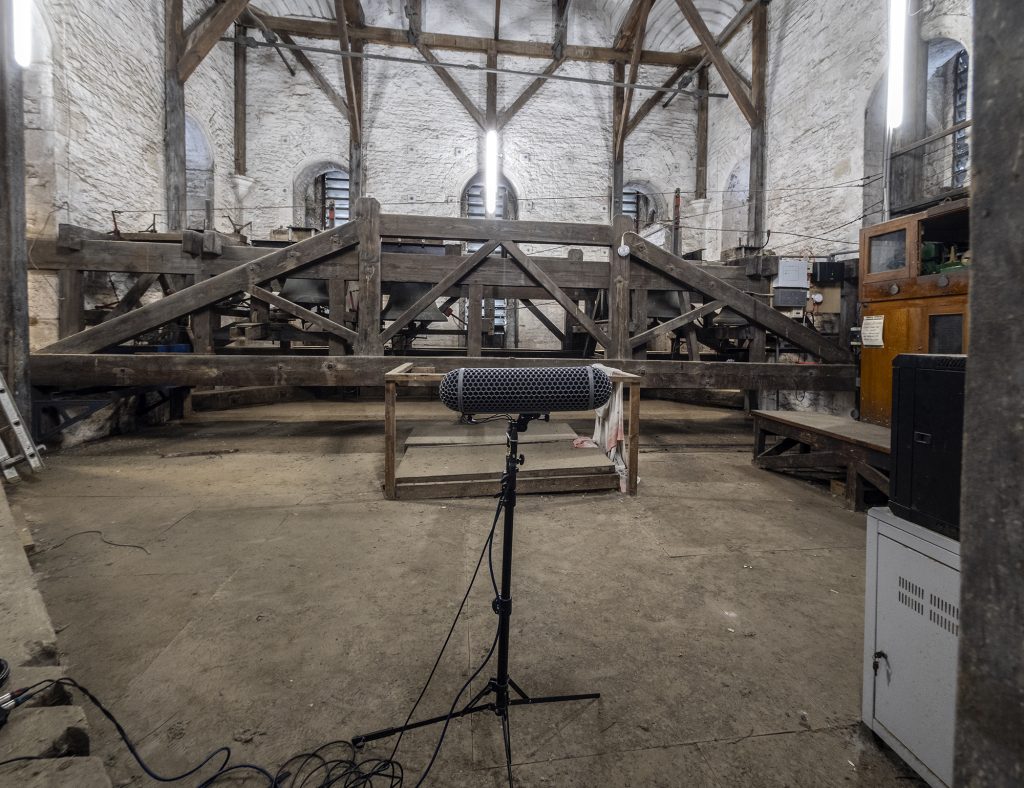
A bit of recording in the belfry at Norwich Cathedral: wind-protection was essential.
For the recording I set up three fig 8 mics (the MKH 8030, the BD-10 and AKG CK94) in a windshield (there was quite a breeze inside the belfry) facing the bell-frame. Here are the sound files.
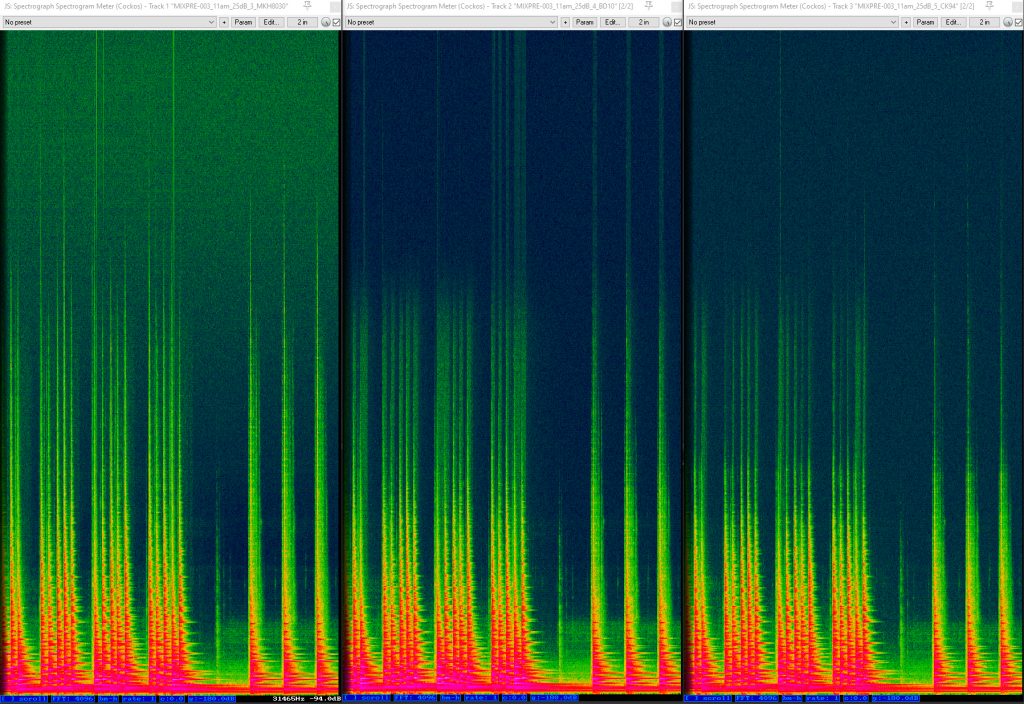
And here is a spectrogram of part of the recording, showing the chimes. The high-frequency capability of the MKH 8030 is certainly in evidence, with much stronger signals up to 48kHz (the limit on this spectrogram), albeit with more self-noise at such frequencies. The BD-10 does reasonably well, but with lower self-noise over 20kHz, and, as expected from previous tests, the CK94 comes in third in this test.
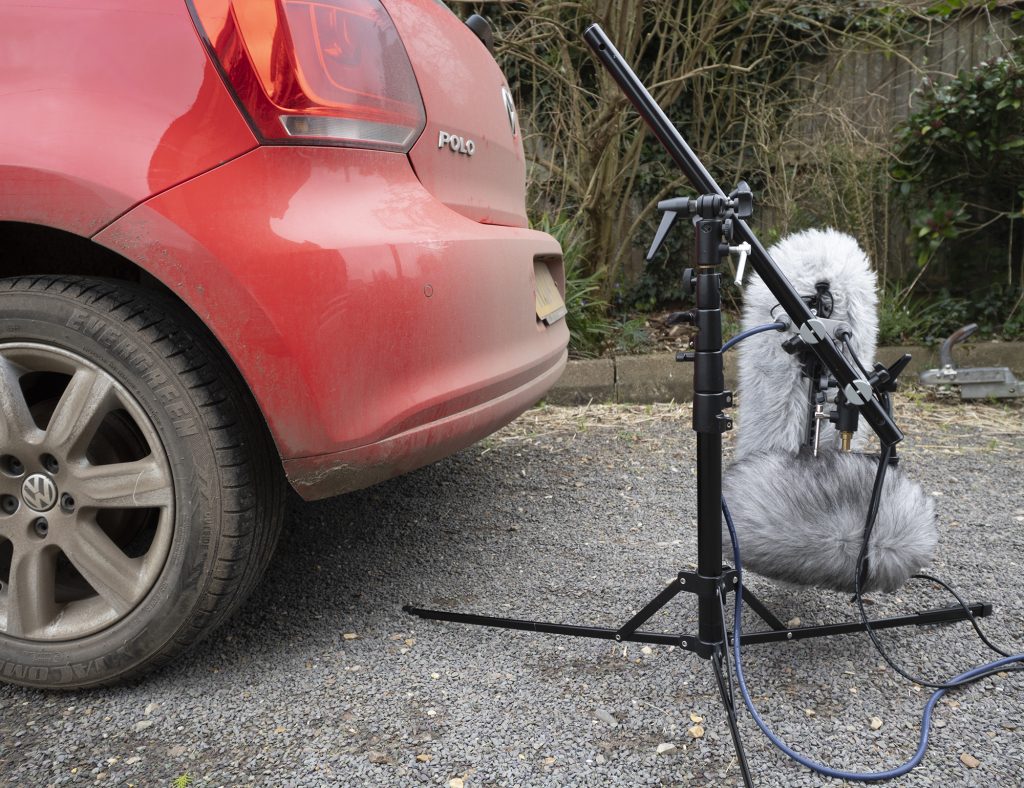
Spectrogram of the bells tolling, with MKH 8030 (left), BD-10 (centre) and AKG CK94 (right): the vertical axis extends to 48kHz.Testing bass response with a car engine idling: yes, I know the car needs a clean, but the roads in rural Norfolk are seriously muddy!
Turning to the other end of the spectrum, fig 8 mics generally have a poorer bass response than omni, wide cardioid, cardioid and super-cardioid polar patterns, although the Sennheiser MKH 30 has long demonstrated that it is unusually capable at lower frequencies. The MKH 8030 specs promise similar performance. In this case I took three fig 8 mics (the MKH 8030, Rycote BD-10 and AKG CK94) and oriented them so that in each case one of their lobes faced the exhaust pipe at the rear of a parked car and, in a separate blimp immediately adjacent, set up the cardioid MKH 8040 likewise facing the car, which was then started and left idling.
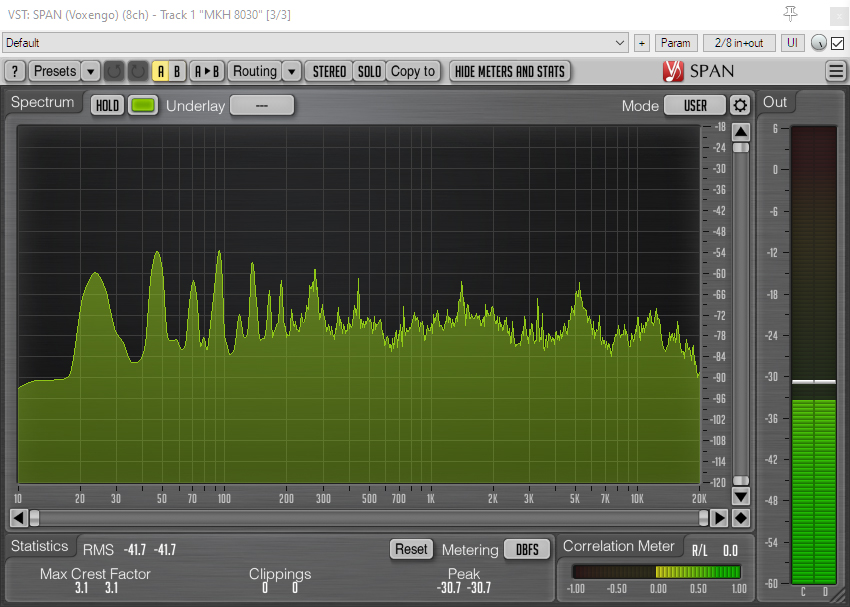
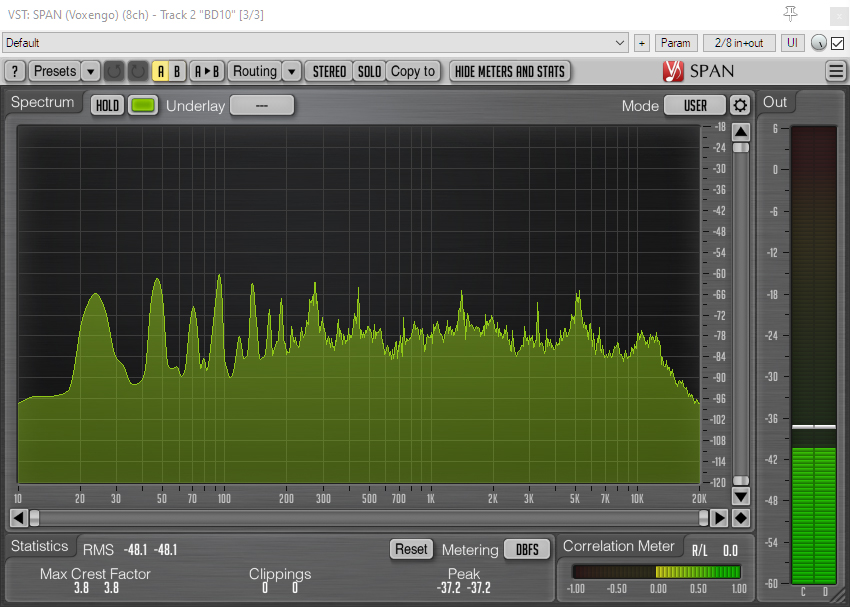
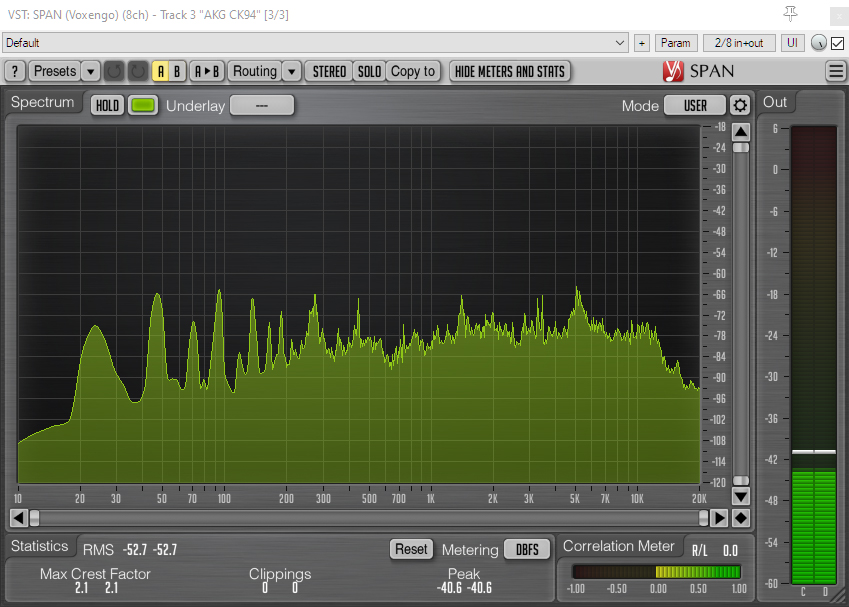
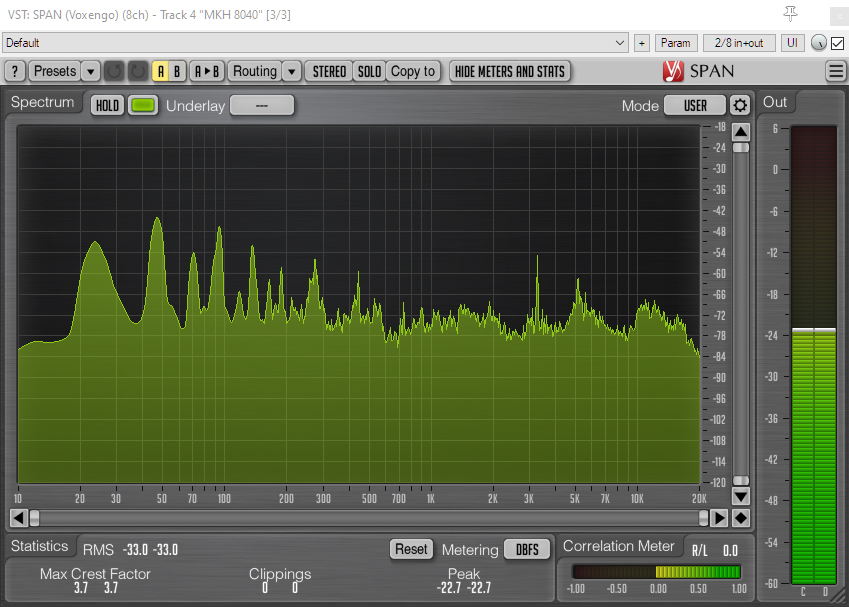
And here are the spectrum analyzer visualizations:
Car exhaust test with the MKH 8030.Car exhaust test with the BD-10.Car exhaust test with the AKG CK94.Car exhaust test with the MKH 8040.
The tracks show all four mics capable of rendering the lowest fundamental, with the MKH 8030 showing a better low-frequency response than the Rycote BD-10, and the latter showing a much better low-frequency response than the AKG CK94. At the lowest fundamental of around 22.5Hz the MKH 8030 was about 6dB louder than the BD-10, and the BD-10 about 9dB louder than the AKG CK94. The MKH 8040 has an unusually good bass response for a cardioid, and the peak at 22.5Hz was 9dB louder than that with the MKH 8030: in truth the low-frequency content of the cardioid mic is a little overwhelming in this test. Such a low frequency as 22.5Hz is beyond the quoted specs of the MKH 8030, and sticking mics by a car exhaust is hardly the most scientific test, but the general point is well illustrated by the audio files and the peaks in the spectrum analyzer visualizations: that is, the MKH 8030 has a good low-frequency response, but, as I have found previously when testing fig 8s, in the field at least this falls short of a decent cardioid or, obviously, an omni mic. This fuller low end of the MKH 8030 compared to the other SDC fig 8 mics I have to hand is evident through any of the recordings I made during these tests that have lower frequency content. It will be for others to see how this compares to the MKH 30, the Schoeps fig 8 etc., or even whether such very low-frequency response matters in a fig 8.
The nulls
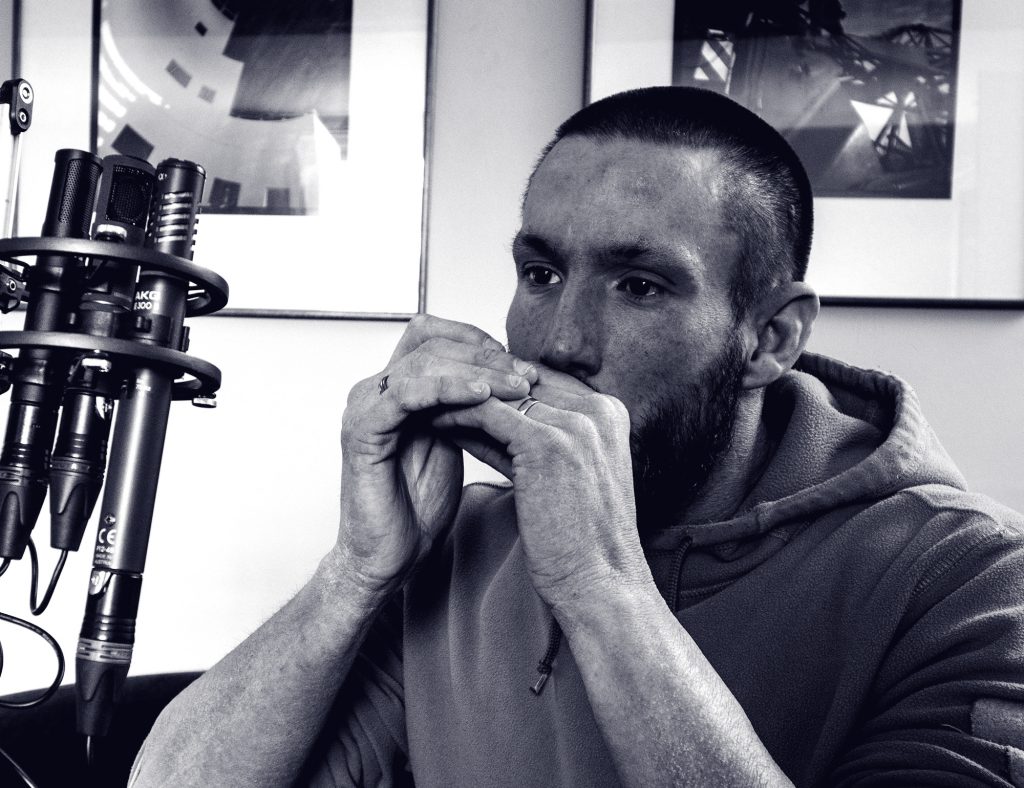
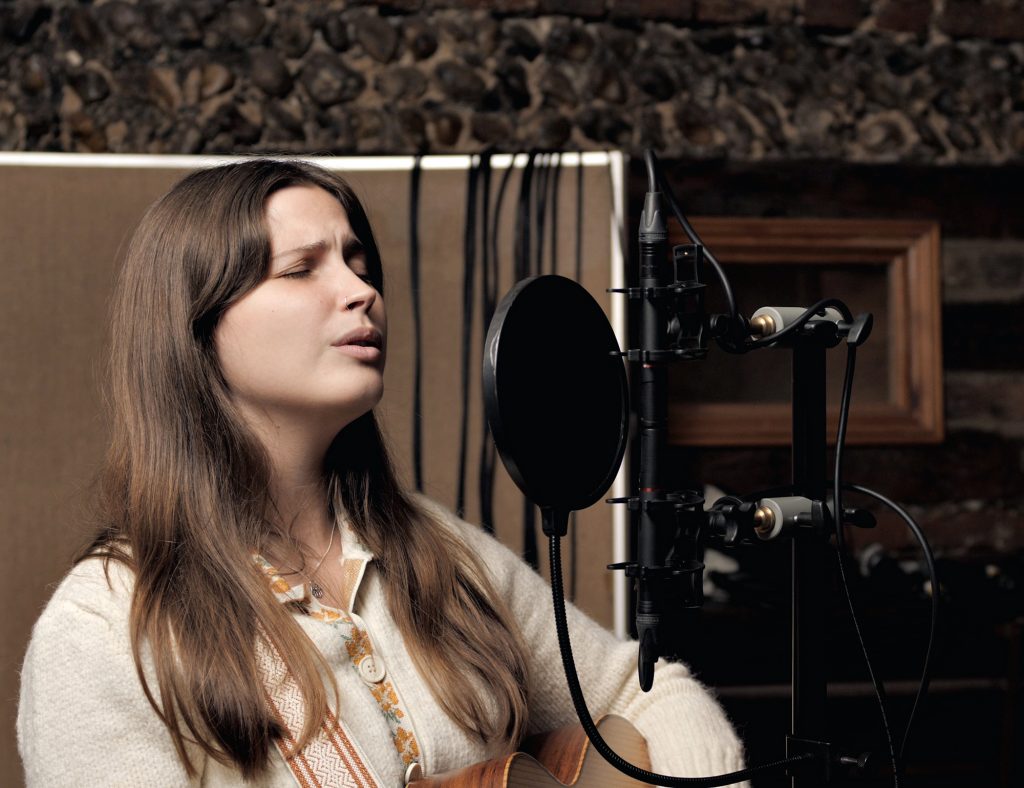
A bit of blues harp playing from Andy Chinn: testing the on-axis and off-axis (i.e. null) sound of the MKH 8030, along with the BD-10 and AKG CK94.
At this stage there is no available polar plot for the MKH 8030, but – from the MKH 30 – expectation is high that the new mic offers similarly deep nulls, which are an essential characteristic of a fig 8 mic. It is hard to test this accurately in the field, as opposed to in an anechoic chamber, so what you have here is a bit of a rough and ready test: some blues harp playing courtesy of Andy Chinn at about 400mm from the MKH 8030, along with the BD-10 and CK94 fig 8s. This snippet is then followed by a brief silence, after which is another recording with the mics rotated 90 degrees: Andy’s playing and position remain unchanged.
Not hugely conclusive, I know, not least given that the sound was reflecting around the modest-sized living room – so not doing the nulls justice (although something of a real-world reality check) – but, nonetheless, there was a measurable difference in the effectiveness of the nulls: the MKH 8030 produced a 12.5dB drop in LUFs; the BD10 an 11.2dB drop in LUFs; and the CK94 a 10.7dB drop in LUFs. Of course, the on-axis and null recordings were not simultaneous (or identical) so these figures are only indicative, and I strongly suspect that the differences will be more substantial – certainly against the CK94, which doesn’t have the deepest of nulls (but is still effective in this regard) – in a larger space or, of course, outdoors. Anyway, nicer to listen to a bit of blues harp than a car exhaust!
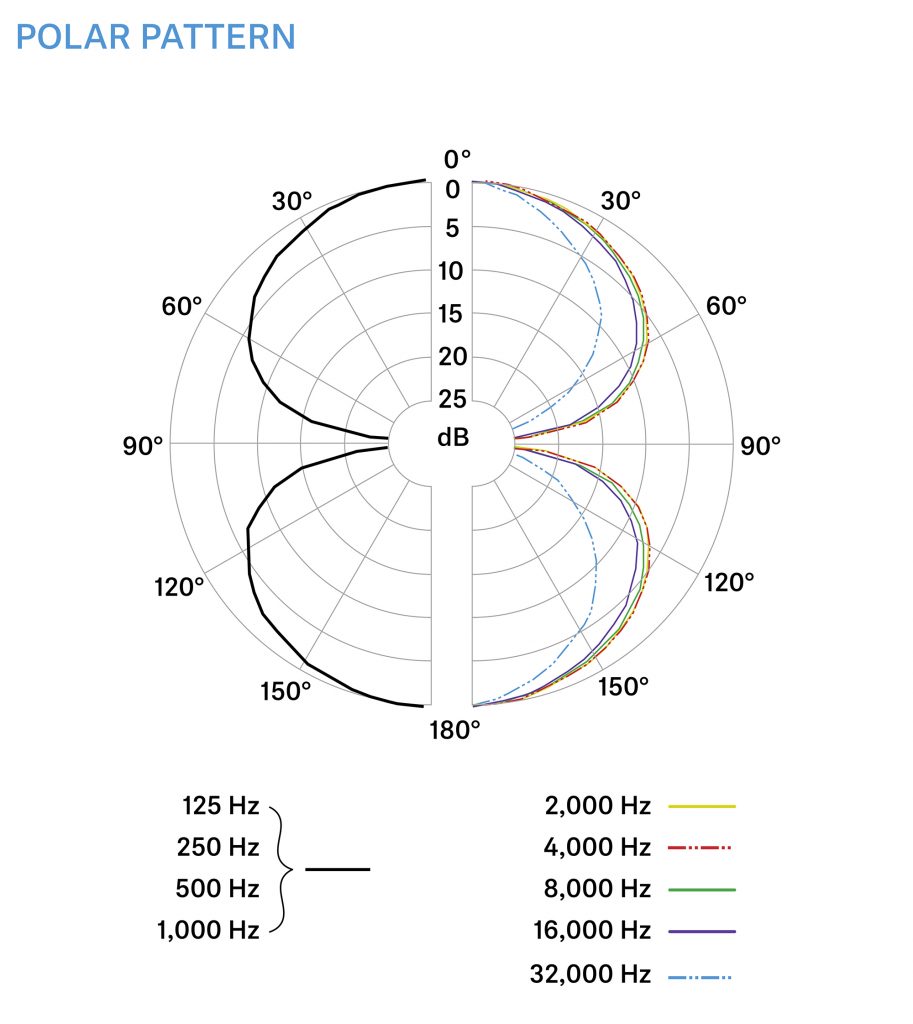
EDIT (9.4.2024): Sennheiser have now produced a specs sheet (in advance of publication at NAB 2024), which includes the following polar pattern and confirms that the MKH 8030 measures similarly to the MKH 30 – excellent news:
Handling noise
The MKH 8030 is likely to become a regular fixture in windshields on boom poles or on a pistol grip, such as for those times when a bit of ambience is required during production sound recording, or perhaps to get closer to a difficult to access source during field recording. In short, while it may not be swinging around as fast as in some cases of mics used for booming for dialogue,the MKH 8030 is likely to be handheld at times and also to be used on a boom pole. So, with that in mind, I put the mic through some boom-pole handling tests.
All other things being equal, fig 8 mics are the most susceptible to handling noise. Three mics were included in the test (i.e. rigged in Rycote Invision suspensions on a short stereo bar on the end of the boom pole) to allow comparison: the MKH 8030, the MKH 8040 and the Rycote BD-10. Gain levels were adjusted for relative sensitivities.
When holding the boom pole statically (extended and horizontally) all three mics showed some handling noise, with the MKH 8040 being the most significant, peaking at -26.1dB, with LUFs at -55.8dB; the MKH 8030 was significantly better, peaking at -32.2dB, with LUFs at -61.3dB; and the Rycote BD-10 was better still, peaking at -35.5dB with LUFs at -67.0dB. Evidently this was trembling/vibration from the boom operator’s muscles holding a steady stance, and was all low-frequency energy below c.50Hz: a high-pass filter of 80Hz – a pretty essential adjunct to booming – removes such energy. In the second series of sound files, the mics were held as previously, but the boom pole was tapped with at the grip point to test transmission of louder handling noise. As expected, the results are similar to the static hold test, with the cardioid MKH 8040 performing least well (-51.2 LUFs), followed by the MKH 8030 (-56.4 LUFs) and then the BD-10 (-57.9 LUFs). Doubtless the extended low-frequency capability of the cardioid MKH 8040 is the reason why it is outperformed in this handling test by the two fig 8 mics. The MKH 8030 should offer no problem to the user given, in addition to use of a high-pass filter, a suitable suspension and experienced boom operation (not forgetting that capture of stereo ambiences on a boom pole is usually for incidental B-roll, camera perspective stereo etc., not whilst executing complex and rapid boom pole movements for dialogue recording!).
Wind noise
Fig 8 mics are especially susceptible to wind noise, so it is interesting to explore this aspect of the MKH 8030’s performance. To get a base line, a triple rig of MKH 8030, MKH 8040 and BD-10 was used, again with the mics in separate Invision suspensions, spaced along a stereo bar so that no mic was shielded from the wind by the others, and mounted on a boom pole. Fast boom swings were made to generate wind noise in a controlled fashion, not to represent typical usage of a fig 8. Gain was set as for the handling noise tests (see above). Swinging the bare mics produced overwhelming rumble, as would be expected: the MKH 8040 cardioid was easily the most sensitive in this regard, which again goes against what one might expect with a cardioid vs a fig 8. Of course, such use is unrealistic: even with a modest amount of boom movement indoors (or the gentlest air movement around a static mic indoors) at the very least a foam windshield would be used, so the test was repeated with the manufacturer’s original foams on all three mics (NB the foam for the MKH 8030 is specifically made for the mic, and is much wider than that for the MKH 8040, reflecting the different orientation of the capsule). The boom was swung in vertical and horizontal arcs, with very little difference in the results: the sound files below are for horizontal arcs, which, usefully, could be rather longer. In this case an 80Hz high-pass filter was set on the Sound Devices MixPre-3 recorder.
Again, and very much as expected given the boom handling experience, the cardioid MKH 8040 fared less well, with peak levels at -20.9dB and -38.2dB LUFs; while the two fig 8s performed very similarly – the MKH 8030 giving a peak of -27.2dB and LUFs of -44.5dB, and the BD-10 a peak of -27.1dB and LUFs of -45.4dB. I have been using the BD-10 in the field for some time now and it is reassuring that the MKH 8030 is very closely matched in terms of performance (at least once an 80Hz high-pass filter is applied: the ambient mid-side test, below, reveals a little bit more wind susceptibility when no filter is applied, as would be expected given the fuller lower end).
Now back to some more musical tests…
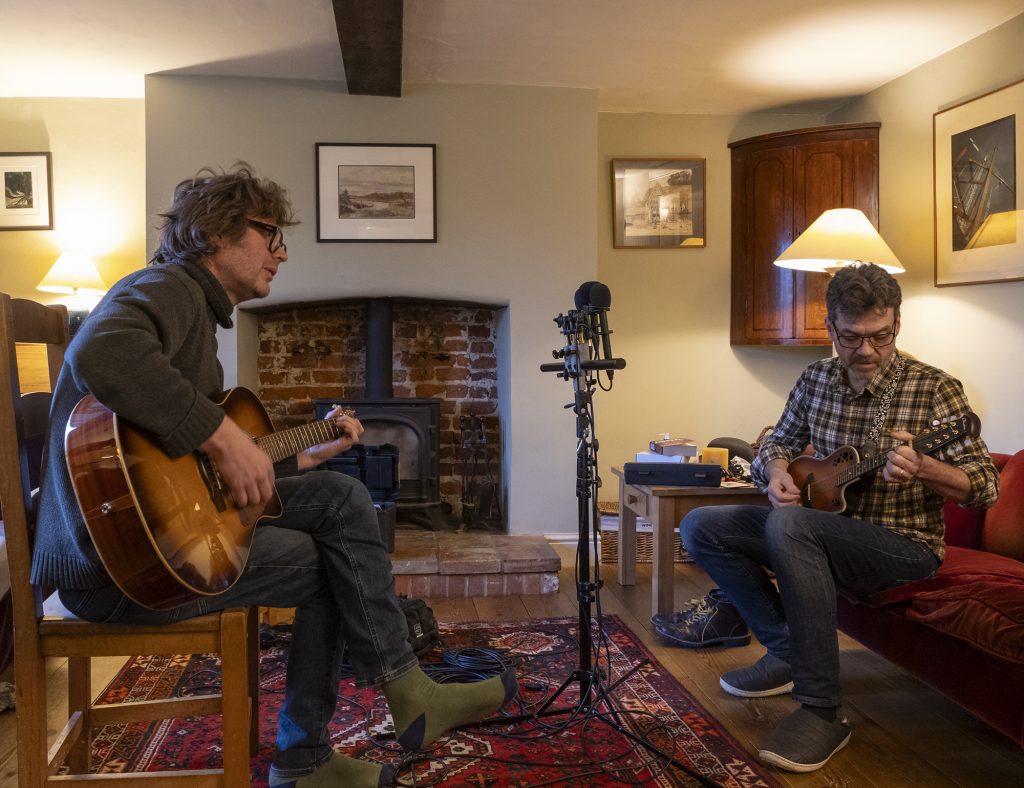
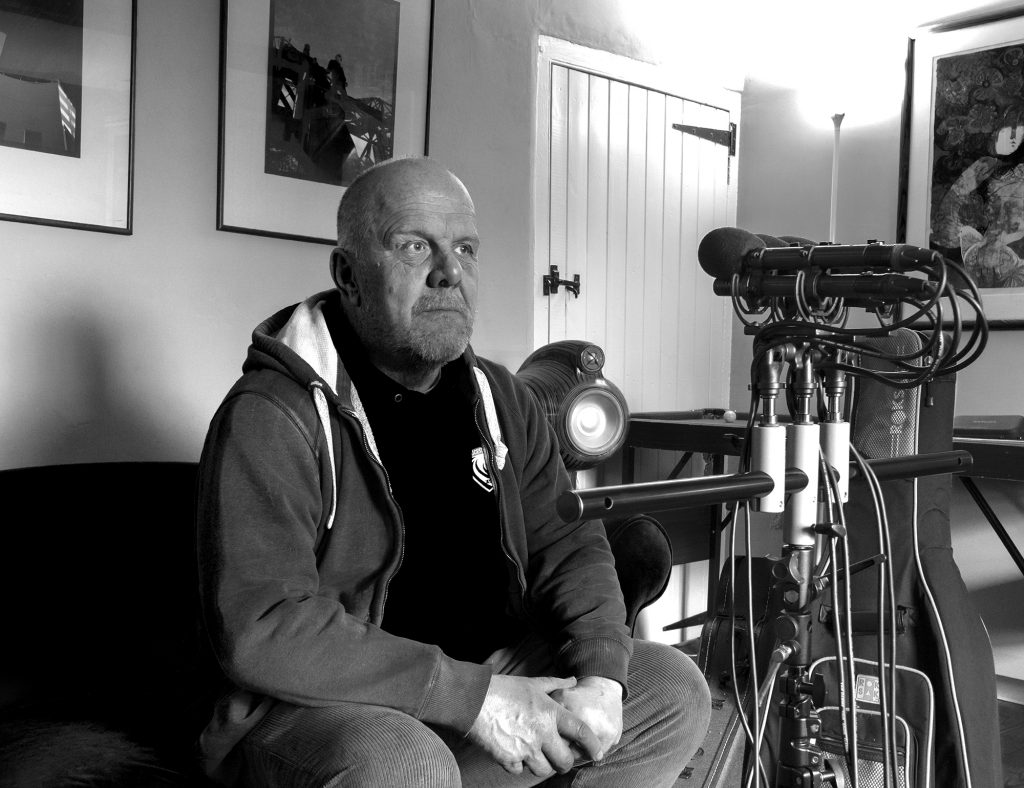
A bit of mic testing with Richard Poynton (guitar) and Jo Kerham (mandolin and vocals) taking advantage of the front and rear lobes of the fig 8 mics.
While it is useful to explore some aspects of the performance of the MKH 8030 in isolation, of course it is vital to get a sense of how the mic actually sounds: deep nulls, low self-noise etc. don’t necessarily mean you want to use the mic!
In this test, the two musicians first chat about how to play the song , so this provides a useful voice test on-axis to the mic: they are sitting one in front and one behind the mics, so on axis to the two lobes of the mic. Then the two start to play: Jo on mandolin and vocals, Richard on a bit of gentle guitar backing to what is an unfamiliar song to him. Maybe not the ideal way to mic two instruments and a vocal, and certainly not the ideal room, but it is a not a serious studio recording and gives a flavour of the mics.
This is pair of tests certainly shows up the difference between the two mics. How much that is the different frequency response, how much is increased detail resulting from a push-pull symmetrical capsule etc. – well, I’ll let you decide!
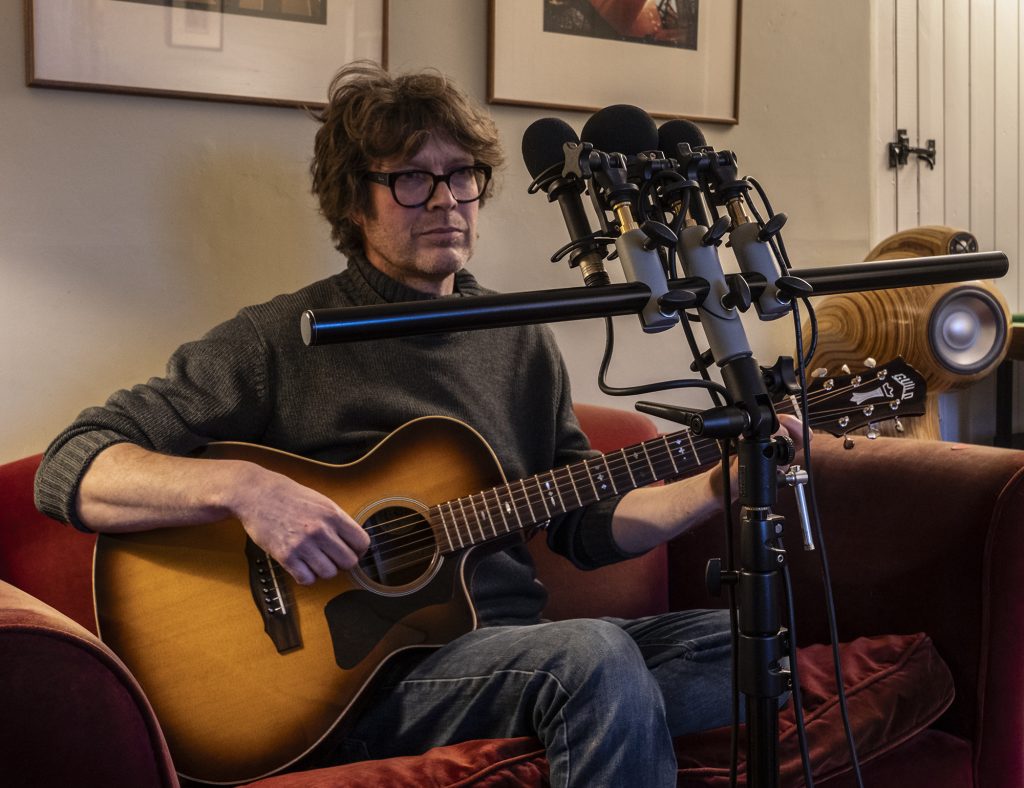
It’s always good to choose the right stereo bar for the job…but somewhere behind it, Richard plays guitar to three fig 8s.
Focusing now on a bit of steel-strung acoustic guitar by Richard, the mics were moved a little closer, so with a bit of proximity effect coming to play, here are the sound files for the recordings with the MKH 8030, Rycote BD-10 and AKG CK94:
How does the MKH 8030 sound compared to the other MKH 8000 series mics?
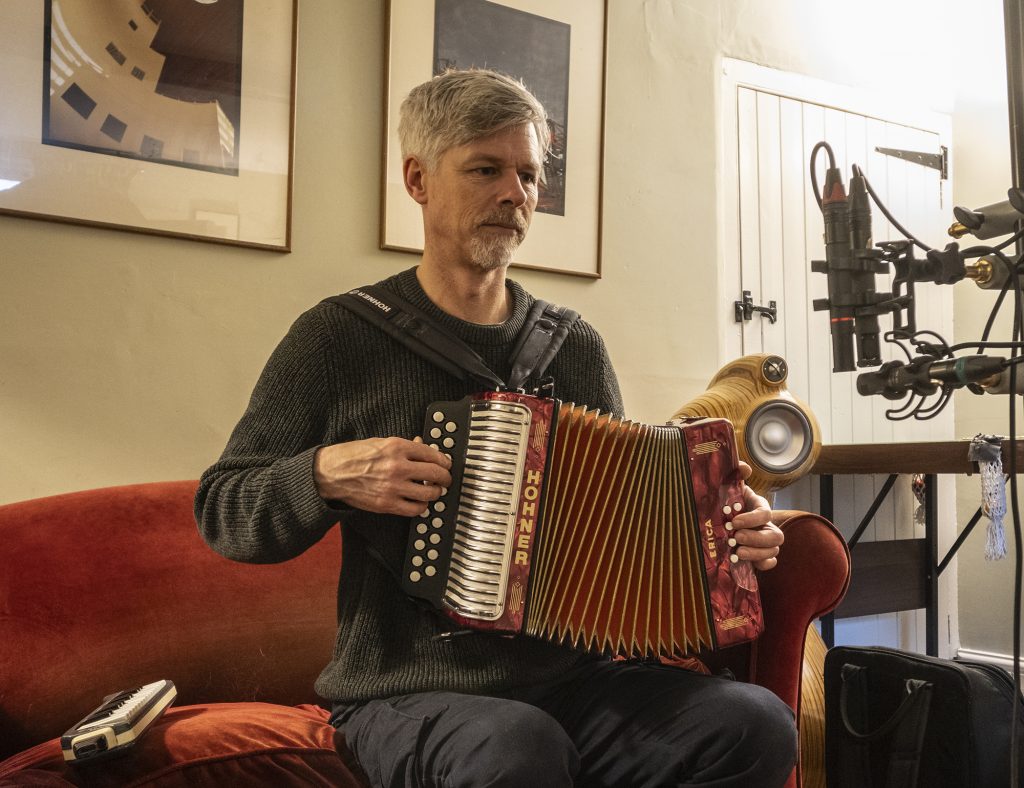
Rob Moore over to help test the sound of the MKH 8030 vs the MKH 8040, along with a melodeon, a melodica and his lungs.
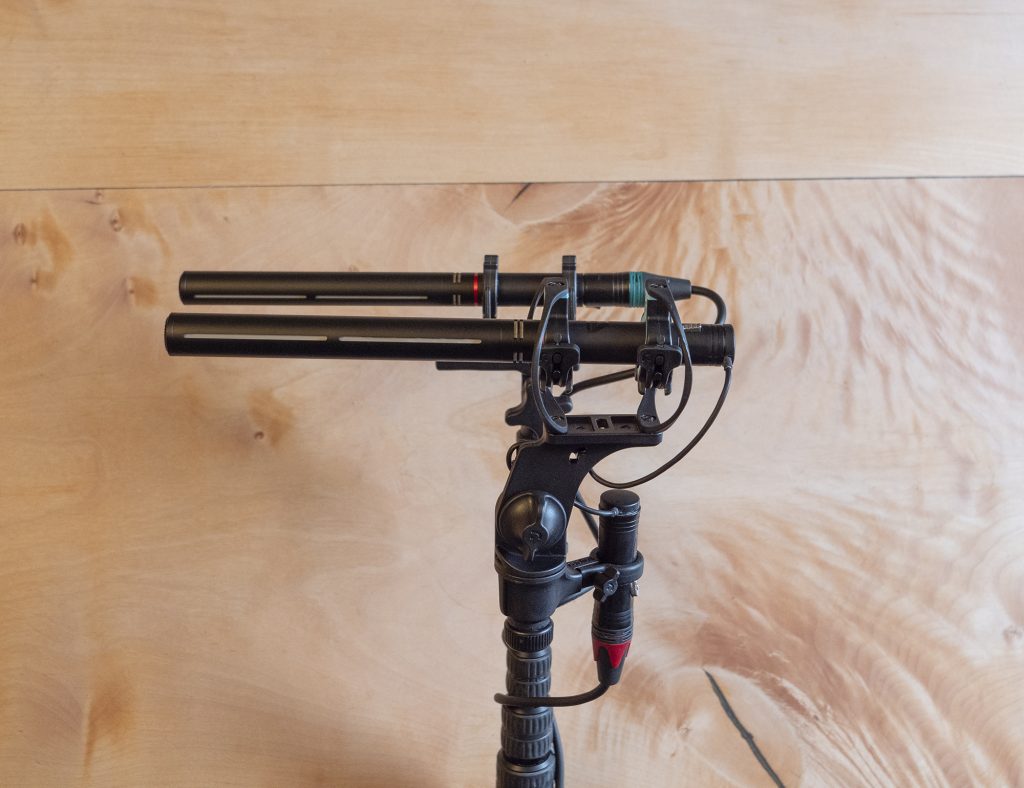
Comparing the sound of mics with different polar patterns is not easy, and the fig 8 offers particular challenges in that regard, what with its front and back lobes. But I had a stab, setting up the fig 8 with an MKH 8040 cardioid mic, so both were aimed directly at the musician. To reduce the impact of the rear lobe of the fig 8, I placed a pair of tall gobos about 800mm behind the mics. As you can see from the photo, I also included a Rycote BD-10 in the recording, so here are three files for a bit of melodeon (from Drink Up The Cider):
The different low-frequency responses of the mics is evident: the MKH 8040 is a little fuller than the MKH 8030, but they are fairly consistent; the BD-10’s lighter low end means it sounds rather different.
Turning then to something with less low end, I then recorded Rob playing a bit of melodica (a bit of Raggletaggle Gypsy):
As would be expected, the differences between the three mics are more subtle and, at least, are not just limited to the fuller low end of the MKH 8030.
And, finally, a bit of unaccompanied singing (a snippet of North Sea Holes), as before, but with a pop filter placed in front of the mics:
Again, the frequency range of the singing (mainly above 150Hz) means that the difference between the mics is not as exaggerated as with a bass-heavy source, and the two Sennheiser mics sound pretty well matched, with the BD-10 a little less full.
And what about mid-side?
There is no denying that one of the key uses of the MKH 8030 will be as the side mic in a mid-side or even a double mid-side set-up. Obviously a mic of any pattern can be used as the mid mic: when used for production sound, to give a stereo option on set, the mid mic is likely to be a super-cardioid or, even, a shotgun mic; for some effects recording a super-cardioid may again be a good option; but by far the most regular mid mic in MS is the cardioid mic. With equal gain (or with the gain tweaked to compensate for different mid and side mic sensitivities) the mid and side mics in the latter case give, when decoded to LR stereo, a stereo recording angle that matches a pair of cardioid mics used as a 90-degree XY pair, although the mid-side recording often sounds rather different with the mid-mic typically being on axis to the main sound source.
Bringing a bit of London music hall to you courtesy of Matt Phelps.
I kicked off mid-side tests on vocals with a bit of unaccompanied music hall – What a Mouth (What a North and South) – recorded with the MKH 8030 as the side mic and a Rycote CA-08 as the mid mic : for comparison I recorded this in parallel with a Rycote BD-10 and Rycote CA-08 MS pair. Obviously, the same mid mic takes the main source – Matt’s voice direct to the mic – so that the difference in the side mics is subtle: some ears may hear the difference.
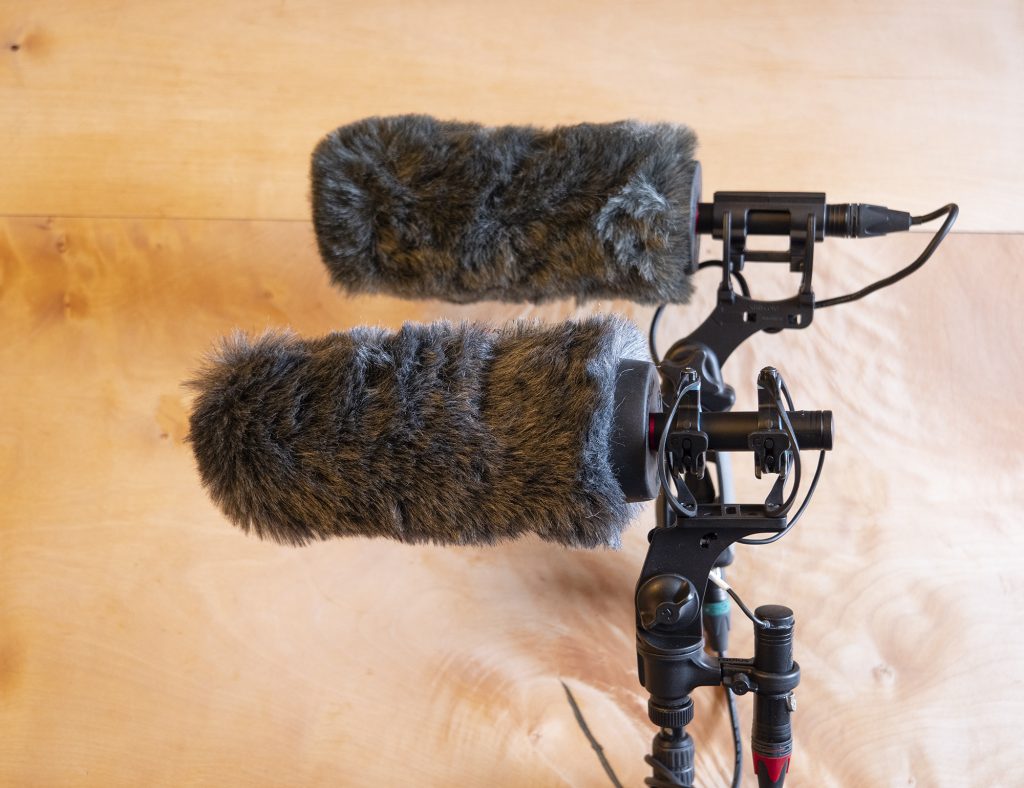
The MKH 8030 and BD-10 fig 8s flanking the MKH 8040 cardioid, before the windshield basket and fur were added, for a bit of ambience recording.
At the opposite end of the spectrum, I took the an MS rig outside for some ambience recording, where the sounds came from all around. For this, I did one of my regular test recordings in this nominally quiet Norfolk village, with birds a-singing, a pheasant squawking, the odd shotgun going off (perhaps the pheasant had good reason to squawk), cars driving past etc. In this instance I set up a triple mic array as in the photo above, with a cardioid MKH 8040 centrally, with fig 8 mics above and below – that is, the MKH8030 and the Rycote BD10.
The differences are subtle, but discernible. Most noticeable is the increased bass response of the MKH 8030 vs the Rycote fig 8, which doesn’t always work in the mic’s favour: the effect of the fairly fresh wind is more noticeable on the MKH 8030 MS recording, despite the use of a full blimp and fur (admittedly, with the two fig 8s fairly near the edge of the basket – so hardly ideal). And the greater bass response of the fig 8 mic increases the side mic output, so makes for what might be perceived as a very slightly wider stereo image, but is, in reality, a more consistent stereo image into lower frequencies (say 150Hz-200Hz and lower).
Conclusions
Well I’m a fan of fig 8 mics, using them routinely for their deep nulls (e.g. when recording singer-guitarists, and wanting some separate control over vocals and instrument) and, especially, for mid-side recording. And recently I have begun to enjoy the delights of Blumlein pairs. I had high hopes for the MKH 8030 and it hasn’t disappointed: so impressed have I been that during the time I have spent with the mic, I splashed out and bought a new cardioid MKH 8040 so that I could use the MKH 8030 with one of its siblings (rather than mics from other manufacturers) for these tests and for future mid-side recording .
The MKH 8030’s match with the MKH 8040 is excellent, so it is hard to think that it will disappoint anybody used to the MKH 30, although, course, some will prefer to use the larger mic, just has been the case with the MKH 40 vs MKH 8040 etc. previously: at the top end, engineers pick mics on subtle distinctions that they – with their different preferences – feel best suit the source and the application, and this will include other makes of SDC fig 8, such as Schoeps’s options. Looking further down the scale, the MKH 8030 is a massive jump from the mid-priced (and now discontinued) AKG CK94, and has a discernible edge over the Rycote BD-10. This does such more budget-friendly mics no disservice at all: at over twice the price of the BD-10, for example, the MKH 8030 should be expected to outperform it. If you are in the market for a fig 8 SDC mic and have a budget in the region of £1500, then there is no doubt that you should give the MKH 8030 careful consideration (and a listen): in addition to its sonic and size attributes, in common with all the MKH RF mics the MKH 8030 promises very high resistance to humidity, which may be a key feature for some recordists. If such prices are out of reach, then the Rycote BD-10 presents an excellent proposition, and, for alternatives, it might well be worth exploring whether MBHO still produce the KA 800 fig 8 capsule (the MBHO website has long since failed to list the capsule), whether the Ambient Emesser ATE 308 meets your needs (e.g. if combining with a shotgun mic), and whether other options, such as B9 Audio’s CM180, might be of interest. Fig 8 SDC mics don’t grow on trees, but there are options out there from around £600 upwards. Below that, dual diaphragm LDC multi-pattern mics may well provide what you need: indeed, a high-end LDC multi-pattern mic might be what you prefer when wanting a fig 8 for a particular application. The MKH 8030 is at or very near the top end of SDC fig 8 mics, but the important thing is to have one or two, three or more fig 8s in your mic locker!
NB Stayed tuned if interested so far: on Thursday I’m due to be recording a bluegrass band – The Time and Mercy Band – in a studio, ranged round the MKH 8030 and MKH 8040 MS pair, and I’ll include the Rycote BD-10 and CA-08 cardioid too, to allow a range of MS combinations. There will be a write up, with sound files and video too: this post is already long enough, so I thought a follow-up would make more sense.
I’ve long been a fan of simple set ups for music recording, often using a mid-side pair only. That’s partly due to the fact that I like the idea of a stereo capture (rather than close-miced instruments and vocals panned across the left-right field), but also reflects the nature of what I do: location recording, with no studio and the natural tendency there – since the 1970s – to use multi-mic and multi-track recording, overdubbing and tinkering for as long as you wish. This is not to deny that there’s a hugely creative side to the typical studio recording approach, and it allows you to record instruments in ways just not possible without it. Of course, a simpler approach has remained the case with much recording of acoustic and classical music, although, even there, the number of spot mics can be vast these days. But recording of bands – with drum kits, electric guitars etc. – has been largely the province of the multi-mic and multi-track approach in recent decades, with only the occasional exception.
One such exception I have enjoyed has been John Cuniberti’s OneMic series of recordings. John is a hugely experienced engineer, with years of the studio multi-tracked approach under his belt, so it has been fascinating to see and hear his journey into a simpler approach: in his case using a stereo pair of ribbon mics, arranged as a Blumlein pair, in the form of the single stereo AEA R88. John has an excellent YouTube channel with examples of his recordings and videos, as well as behind-the-scenes videos, which are invaluable for others attempting something similar.
With a pair of the latest pre-production Rycote BD-10 fig 8 mics in hand, I was keen to try something in this vein: that is, to capture a whole band at the same time just with a Blumlein pair. Besides, what’s the point of a fig 8 mic without a good Blumlein work out? With a fraction of the skills and resources of a Cuniberti, expectations were much lower, but that’s not a reason not to have a go!
For anyone not familiar with the approach – which, like so much in stereo, goes back to the work of the brilliant engineer Alan Blumlein in the 1930s – a Blumlein pair comprises a pair of fig 8 mics usually arranged directly one above the other, so that the two mic capsules are angled at 90 degrees to each other: in that sense, like an XY pair. This gives you a stereo field in front of the mics and, with the rear lobes of the mics, to the rear: the stereo field to the rear, of course, is flipped. There’s plenty of signal at the sides of the pair, but it’s not the place for a direct sound source: at right-angles to the pair a source would be, say, on the left from the perspective of the front lobes, and on the right from the perspective of the rear lobes. Quite evidently, a recipe for a phasey mess. So, a Blumlein pair isn’t the answer to micing a group ranged in a circle around the mics, but does let you spread them in an arc of 70 degrees in front of the mic and a similar arc to the rear. Setting relative levels of different instruments and vocals is, needless to say, a question of adjusting loudness of the sources and/or distance from the Blumlein pair.
So much for the theory: the task is to translate that into action. With Lucy Grubb and her band willingly volunteering for the exercise, choice of venue was largely dictated by the need for good monitoring: with ‘mixing’ created in the setup, it was essential that the band and I could listen back and adjust the set up as necessary. The bassist, Kev Burton, happily let us use his studio – The Forge – where the band has previously recorded their multi-track releases: the wonderful Midas desk (originally made for Frank Zappa) was reduced to monitoring duties (from a passive split and feeding Logic), while the primary feed from the Blumlein pair was to my Sound Devices MixPre-3 recorder. Kev’s experience with his studio and the expert ears of the band were crucial to getting the balance right.
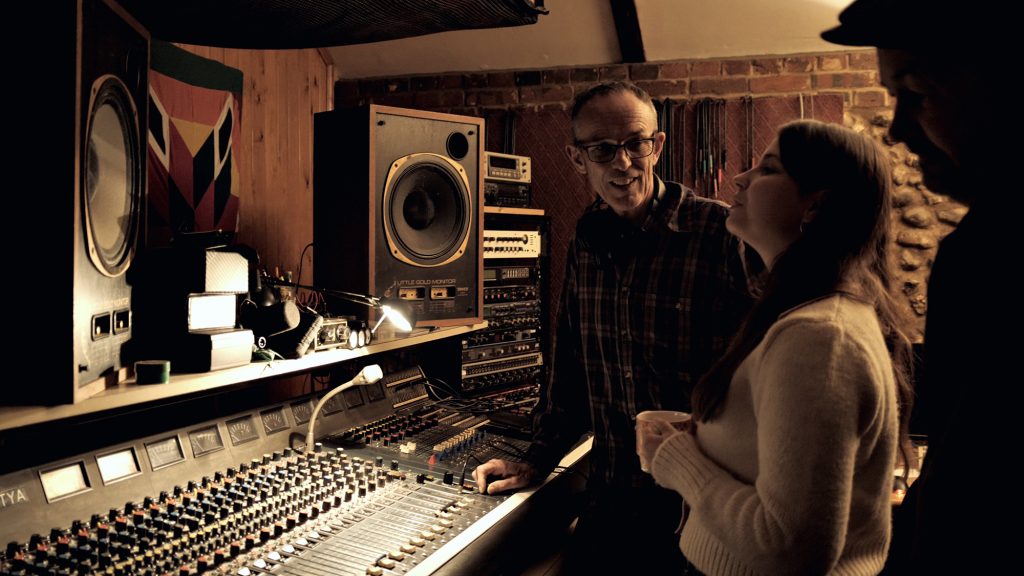
Monitoring in the control room, through the Midas desk, Logic and some Tannoy Little Gold monitors.
It was a tight squeeze in the small studio, with the hardest thing controlling the level of the drums, even with brushes and a special kick-drum beater: there was only so far we could move the drums away from the mics, so the drummer, Paul Weston, detuned his snare to great effect, and we put a gobo in front of the kit. The electric bass amp was placed on a chair in front of that (to get the bass central and nicely balanced with the kick drum), with Richard Poynton, on electric guitar and singing backing vocals, nearer the mic, and a little to one side. Closer to the mic, but centrally on the other side, was lead singer (and song-writer) Lucy Grubb, playing acoustic guitar (with a little amplification behind her). Left and right of her amp, were amps for Richard’s guitar and for the keyboard of Piers Hunt: all three were on chairs/beer crates to get them off the floor. Placement of the keyboard and the bass players themselves didn’t matter: it was all about the position (and volume) of their amps.
Getting distances and angles from the mic pair for lead and backing vocals was essential: Richard’s guitar amp (a Fender Champ) was at the same angle to the mics as his guitar, but on the other side of the mics, behind Lucy.
There was precious little room for any lights or cameras, but, nonetheless, a rough and ready film of the recording seemed worthwhile, so here – with a video of one of the three songs we recorded – is what I managed. The sound has seen no processing other than addition of a little reverb: there is no compression, EQ etc.
So the verdict? Well that’s one for others perhaps. But from my perspective and, more importantly, that of the band, what we got was a very faithful sound of the band in the room. Everyone was engaged in the idea of balancing or ‘mixing’ at source and I suspect we’ll be back having another go before long. Oh, and the BD-10s faired rather well as a Blumlein pair, I thought!
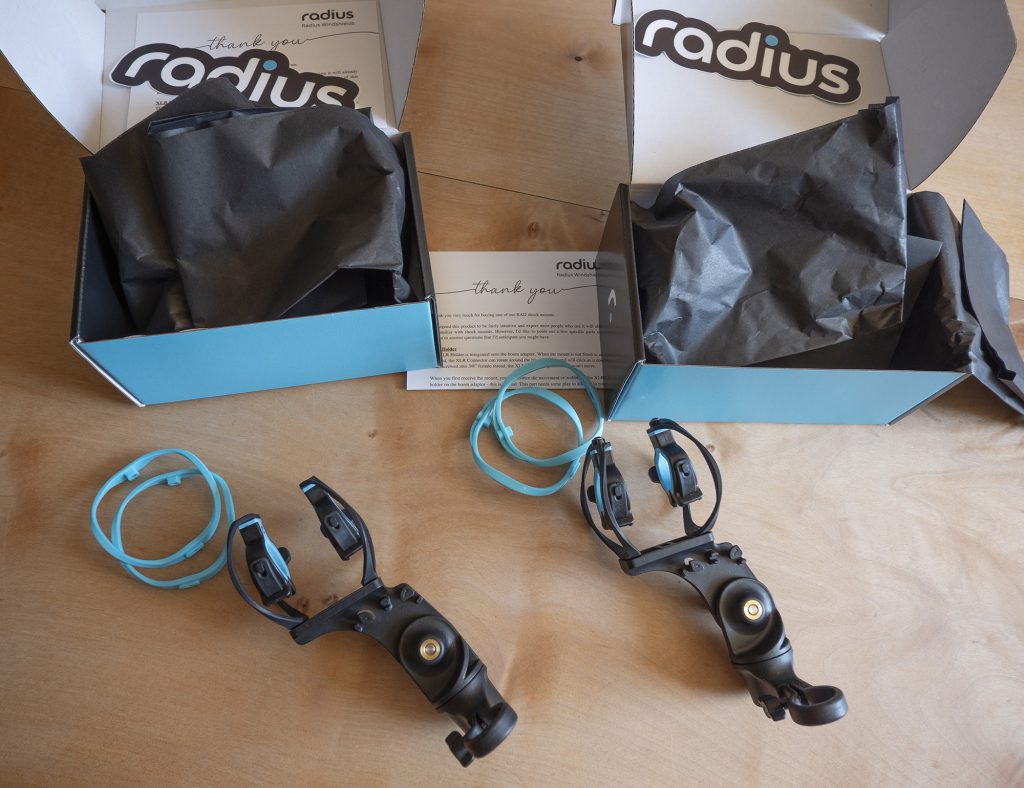
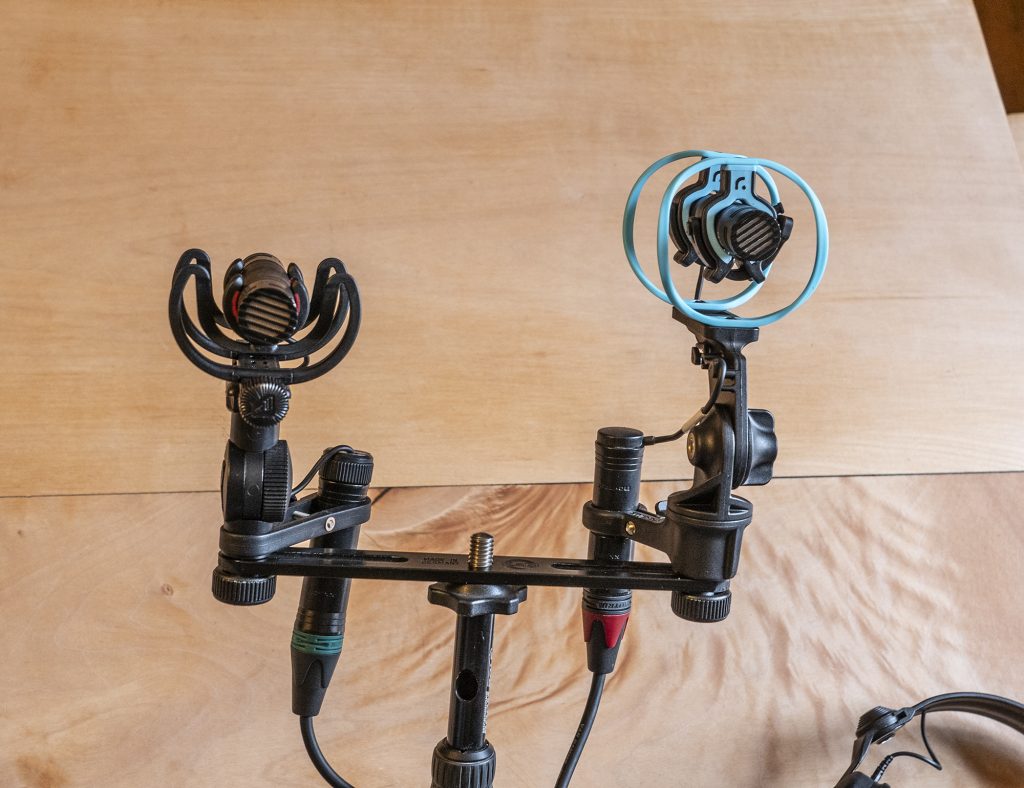
The RAD-1 (interior) suspension (right) and the RAD-2 (exterior) suspension (left). Both suspensions come with pairs of hoops of different compliance: the ‘lite’ (62D shore) blue hoops, and the standard (72D shore) black hoops.
I first became aware of Radius Windshields this spring, and a bit of delving showed a familiar figure at the helm – Simon Davies, formerly of Rycote (and whose mother, Vivienne, had succeeded the founder, John Gozzard, as owner). Evidently Simon hasn’t lost the bug for designing and manufacturing shock mounts and windshields, and, along with his wife Odette and daughter Megan (both with strong Rycote credentials) and a small team, has tantalized many of us with details about the nascent business, its ethos and, increasingly, the steps on the road to its first products. As I understand it, the new company is focused on making its products locally (Radius is based in Devon, with some production in Stroud) and on working closely with its customers: it very much sounds as if the plan is to stay small, so I doubt if we will see another company offering the huge range of Rycote’s products – at least in my lifetime!
After all the social media updates on the fledgling company it was good to receive examples of the first two products and put them through their paces. These are a pair of microphone shock mounts geared for the end of a boom pole, one – the RAD-1 – being for interior use and the other – the RAD-2 – being for exterior use. Both come with two pairs of suspension hoops: 72D shore standard hoops in black, and more compliant 62D ‘lite’ hoops in a light blue. The hoops can be mixed and matched, and can face either way (but – the included notes say with obvious reason – always opposing). The mic clips hang from the top of the hoops – so are inverted compared to a Rycote lyre – and have rubbery straps: as the (comprehensive) instructions note, these are primarily designed to retain mics in the clips when in transit, so optional when in use. The hoops fit to the mount that is evidently designed for use with a boom pole, and which has an integrated XLR holder. The angle of the shock mount can be changed by a pivot knob that does not just rely on friction. The injection-moulded thermoplastic construction feels very precise and good quality. So far, so good: they look great (OK, perhaps the Cambridge-blue of the lighter hoops isn’t everyone’s cup of tea…) and feel great. And, the details, such as the retaining O-ring on the pivot knob, the cable cleats, and the boom pole mount, all show careful – and experienced – design. But, and this is the crux, how do they perform? On to some tests then…
RAD-2 exterior shock mount
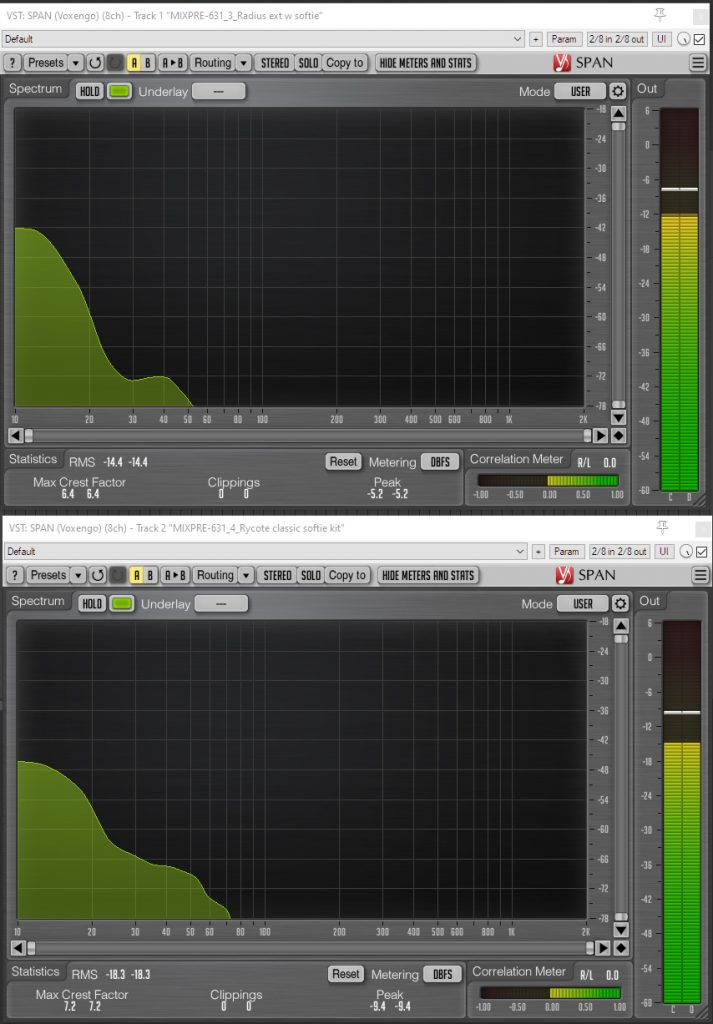
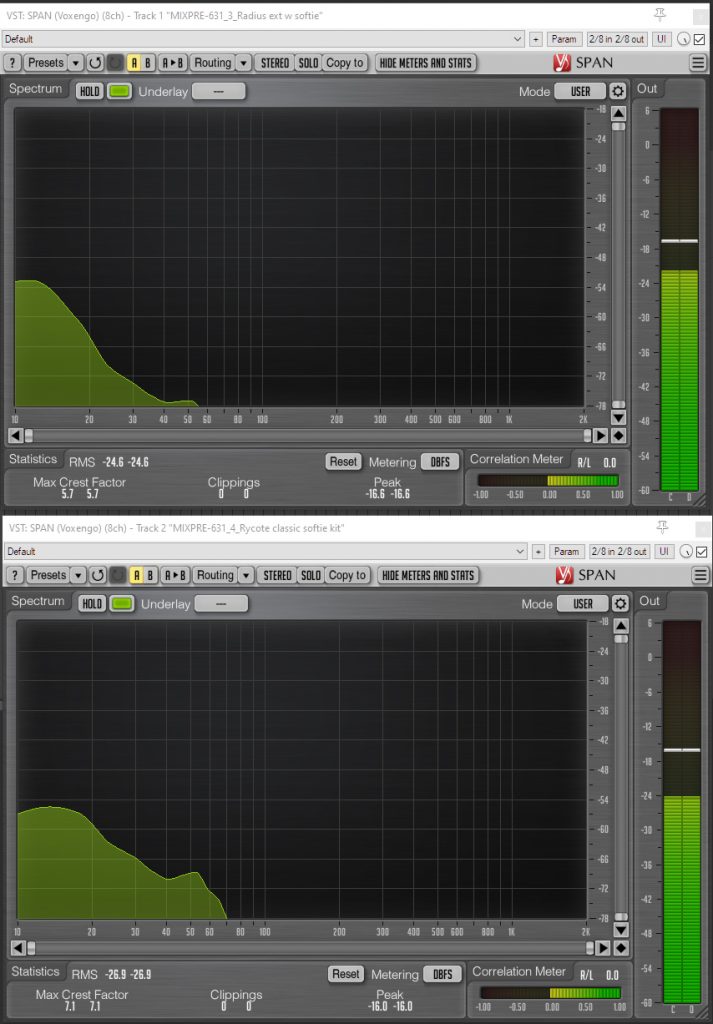
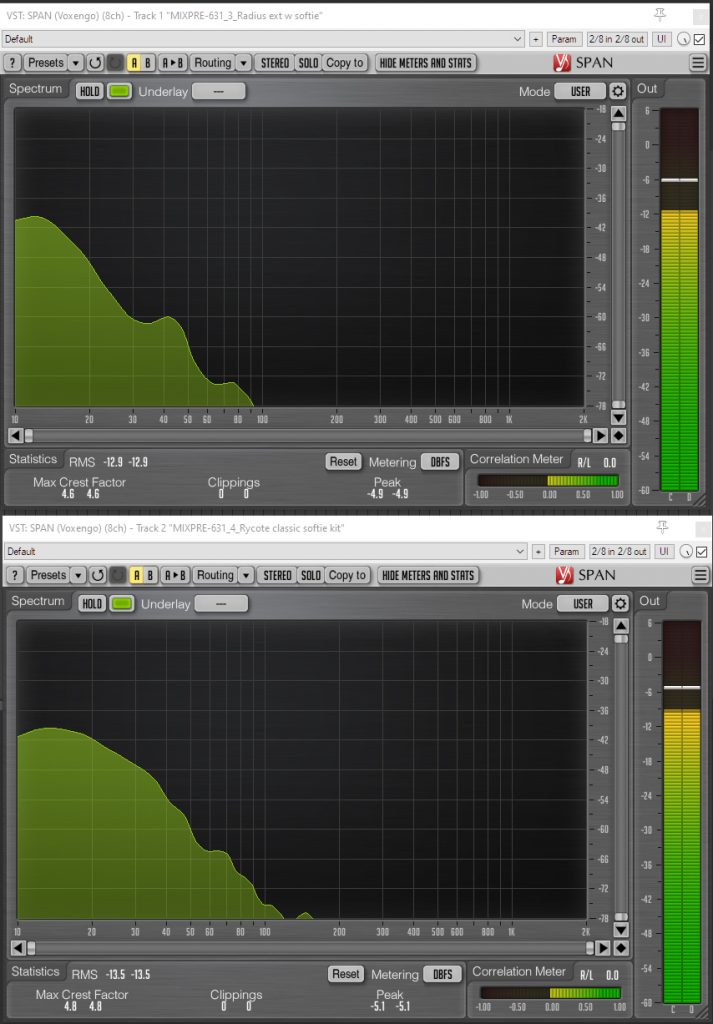
First then to the shock mount designed for exterior use: the RAD-2. Evidently designed for a softie type slip-on windshield (Radius are producing the Nimbus softie imminently), I set this up with a Rycote Classic Softie (18cm) alongside the Rycote Classic Softie kit (18cm) on a short stereo bar on the end of a boom pole, with a pair of Rycote’s excellent HC-22 shotgun mics. Recording into a Sound Devices MixPre-3, I held the boom in a conventional manner with the mics angled down as if booming normally, and then moved the mics up and down and then side to side: these were rapid movements, clumsier than normal. And finally, I held the boom pole vertically, bumping it (lightly!) repeatedly onto a carpeted floor to send shocks up the pole. Obviously, all this was something of a stress test for the shock mounts and essential since in smooth and gentle operation, both performed well and were impossible to differentiate. Normally, I include wav files with my tests and reviews, but I think with these tests numerous sound samples of me wobbling a boom pole would make for pretty tedious listening, and the following spectrograms – which very much reflect what I could hear in the field and when listening back – make the findings more easily digestible.
Radius RAD-2 + 72D shore hoops (top) and Rycote Classic Softie kit (bottom) with HC-22 shotgun mics: boom pole held and mics angled conventionally, and mics moved up and down.Radius RAD-2 + 72D shore hoops (top) and Rycote Classic Softie kit (bottom) with HC-22 shotgun mics: boom pole held and mics angled conventionally, and mics moved side to side.Radius RAD-2 + 72D shore hoops (top) and Rycote Classic Softie kit (bottom) with HC-22 shotgun mics: boom pole held vertically and bottom bumped on to carpeted floor.
The tests with the classic softies then show fairly consistent results, with noise from motion and transmitted via the boom pole all, as would be expected, at low frequency and, if wild movement was to be attempted for real, easily removable with a, say, 80Hz high-pass filter: this would likely be needed for wind noise anyway. One thing is evident in that the RAD-2 has a slightly more base-heavy profile, which opens up scope for a slightly lower high-pass filter. But I’d be happy using either: evidently choice would come down to whether you want a pistol grip too (the Rycote) or prefer the more boom pole-friendly RAD-2.
RAD-1 interior shock mount: standard (black) hoops
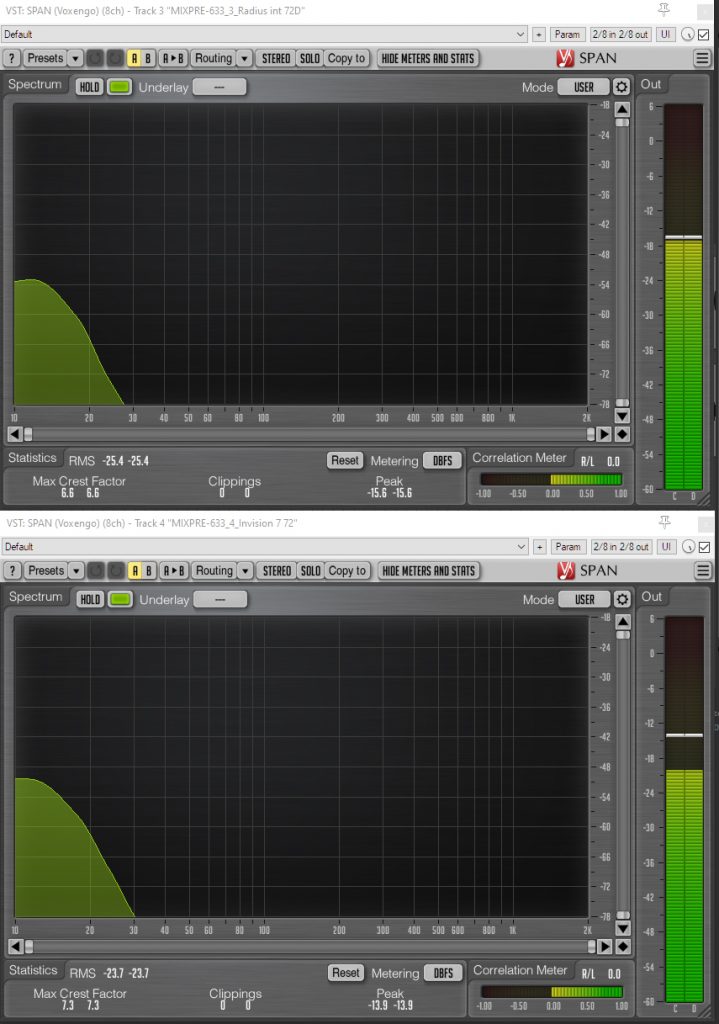
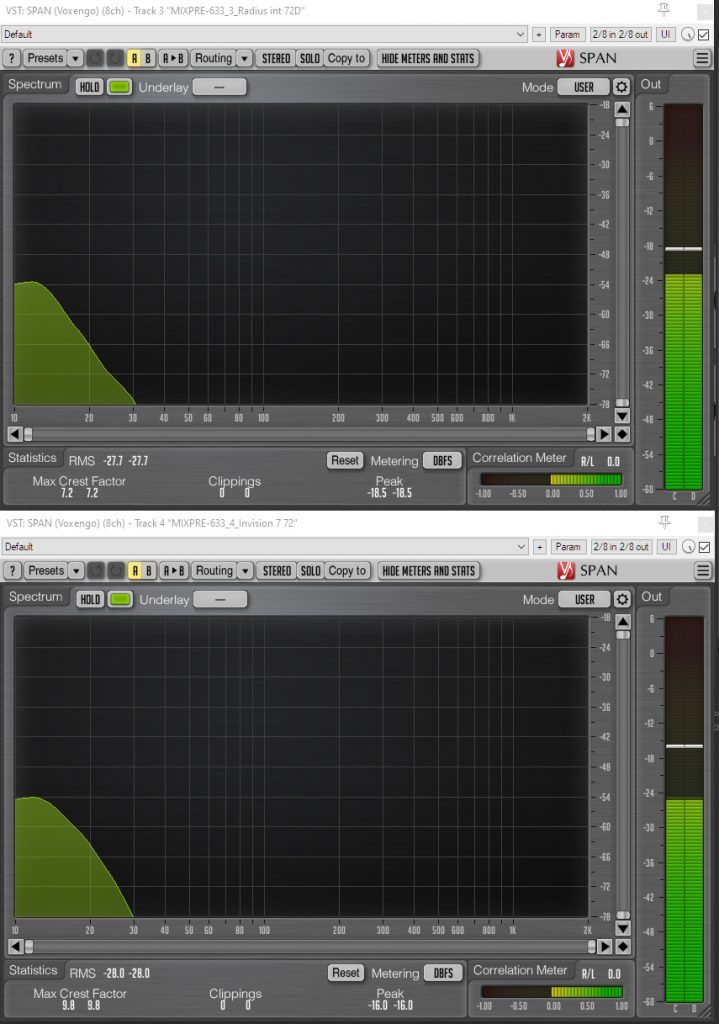
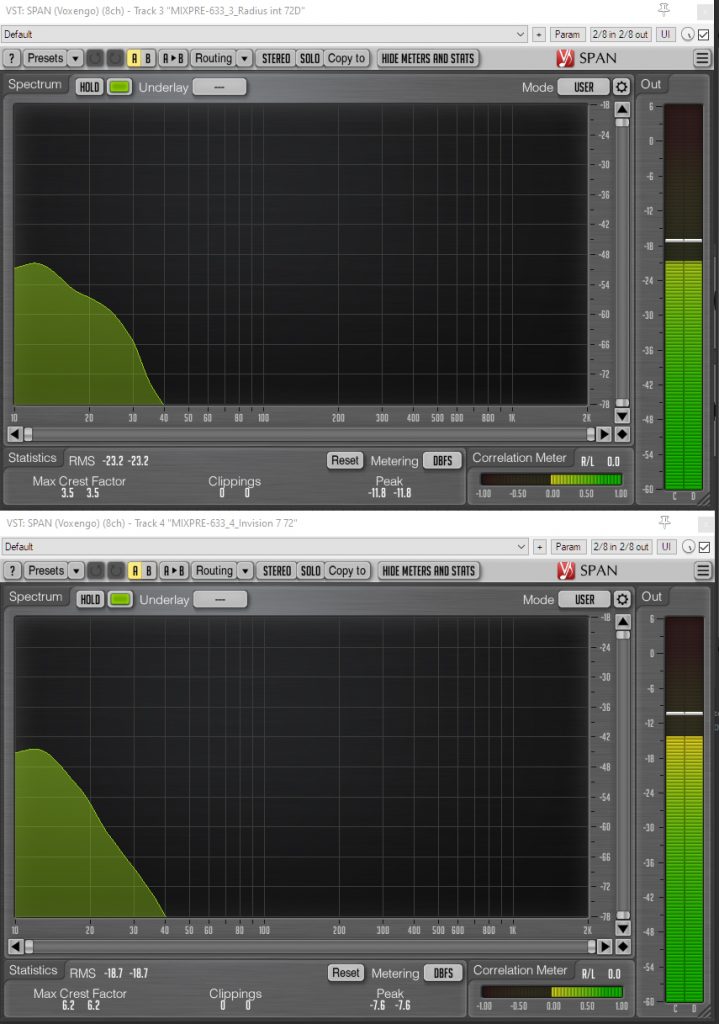
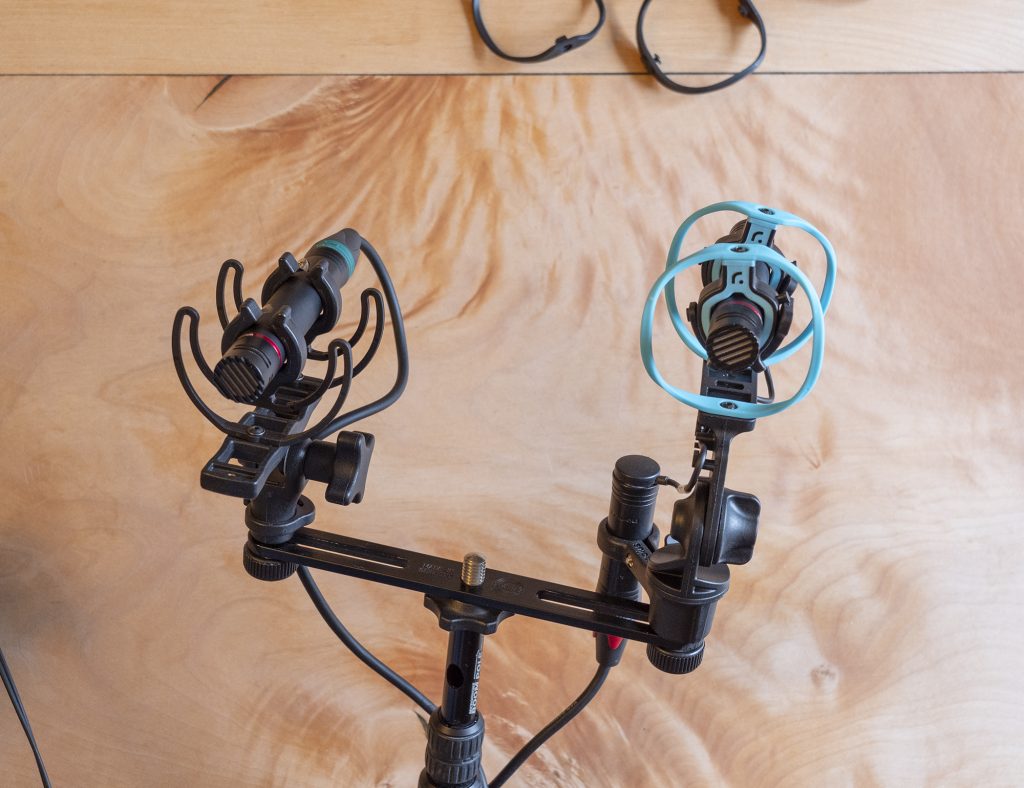
Moving then to the shock mount design for interiors – the RAD-1 – I first compared the mount with its stiffer 72D shore hoops against the Rycote InVision 7 with its, standard, 72 shore lyres. I used the Rycote HC-22 shotgun mics again, with the same stereo-bar on boom pole set up, and repeated the same three sets of movements. The spectrograms below show the results:
Radius RAD-1 + 72D shore hoop (top) and Rycote InVision 7 + 72 shore lyre (bottom) with HC-22 shotgun mics: boom pole held and mics angled conventionally, and mics moved up and down.Radius RAD-1 + 72D shore hoop (top) and Rycote InVision 7 + 72 shore lyre (bottom) with HC-22 shotgun mics: boom pole held and mics angled conventionally, and mics moved side to side.Radius RAD-1 + 72D shore hoop (top) and Rycote InVision 7 + 72 shore lyre (bottom) with HC-22 shotgun mics: boom pole held vertically and bottom bumped on to carpeted floor.
Again the first two tests showed fairly similar results, with the InVision 7 just slightly shading the RAD-1 in terms of peak noise, but with the RAD-2 showing a lower frequency weighting: this was subtle, however, and not evident in the boom bumping test. With both mounts, the noise was very low: even a 40Hz high-pass filter removed it.
RAD-1 interior shock mount: ‘lite’ (blue) hoops
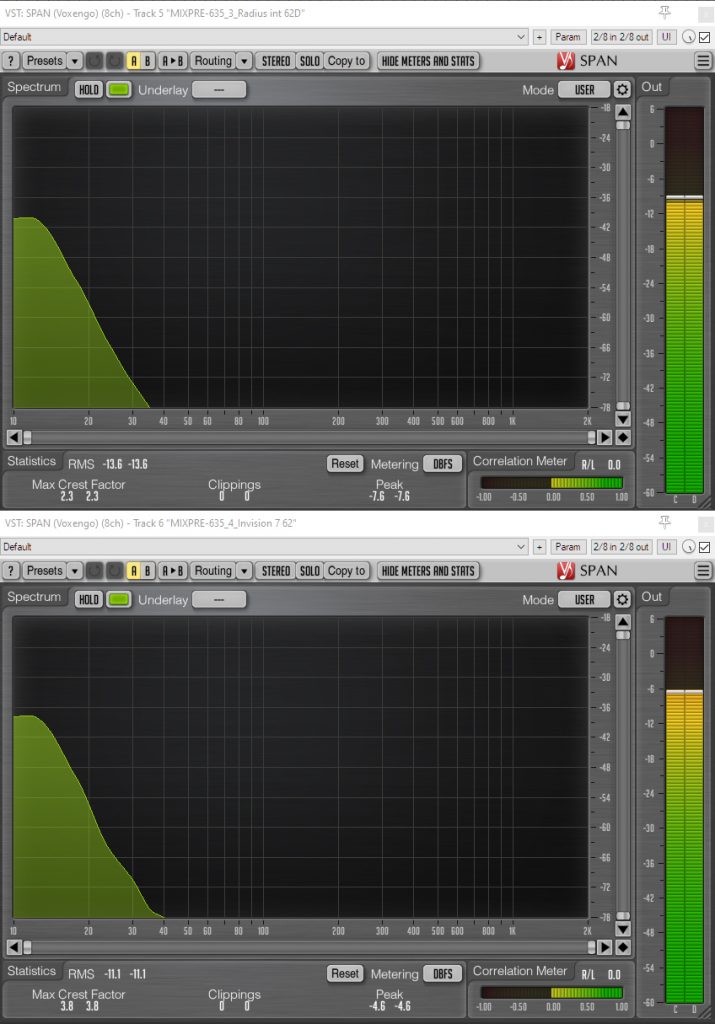
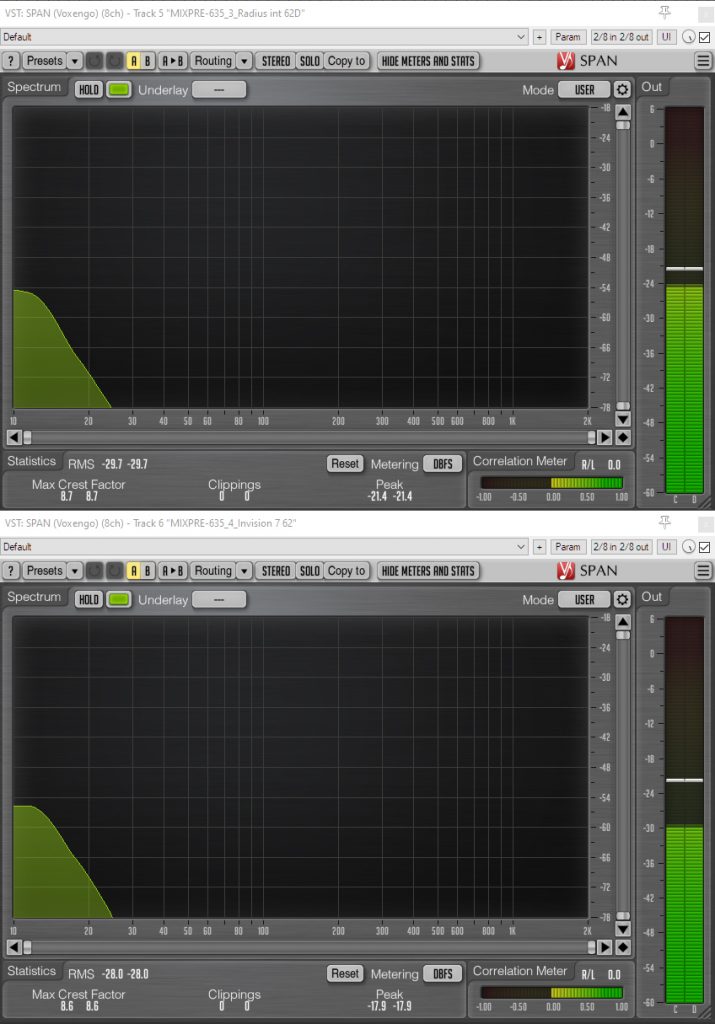
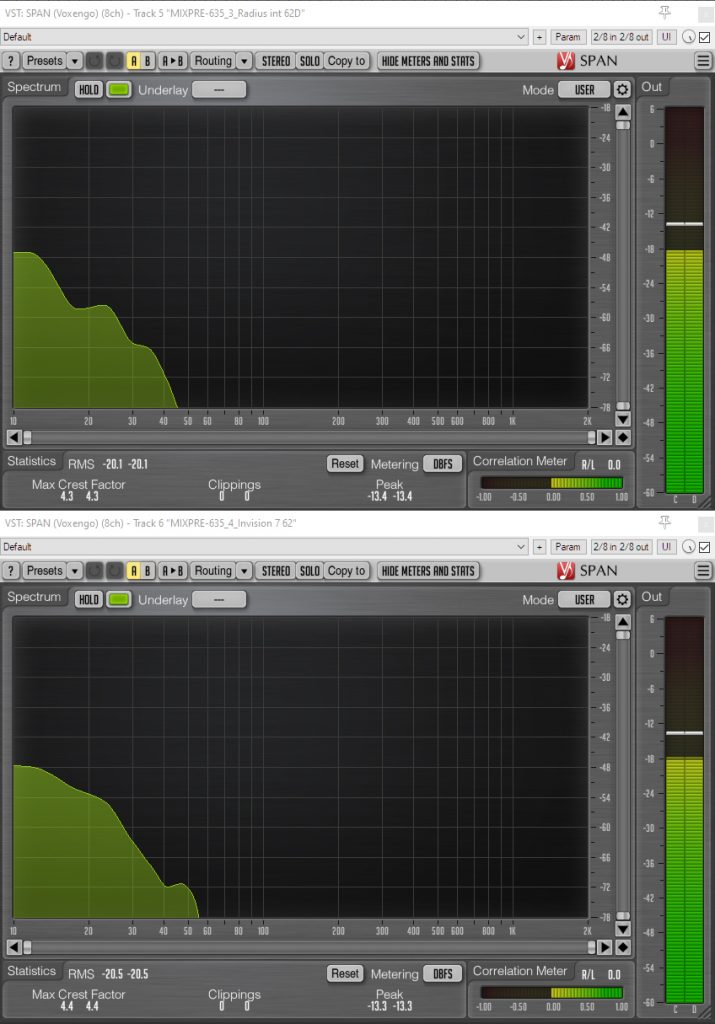
So much for the 100g HC-22 shotgun mics: I was interested to see how the RAD-2 worked with lighter mics, so mounted a pair of my CA-08 cardioids (69g): the CA-08 weighs the same as my SC-08 supercardioid and, evidently, use of a light supercardioid or hypercardioid (perhaps with no more than a foam cover) is a likely use for interior booming. With the lighter mics, I switched the RAD-1 to its light blue 62D shore hoops, and the InVision 7 to the softest (i.e. 62 shore) lyres. The tests were as before and, again, the results can be seen in the spectrograms below:
Radius RAD-1 + 62D shore hoop (top) and Rycote InVision 7 + 62 shore lyre (bottom) with CA-08 cardioid mics: boom pole held and mics angled conventionally, and mics moved up and down.Radius RAD-1 + 62D shore hoop (top) and Rycote InVision 7 + 62 shore lyre (bottom) with CA-08 cardioid mics: boom pole held and mics angled conventionally, and mics moved side to side.Radius RAD-1 + 62D shore hoop (top) and Rycote InVision 7 + 62 shore lyre (bottom) with CA-08 cardioid mics: boom pole held vertically and bottom bumped on to carpeted floor.
In the two mic movement tests, the RAD-1 has the slight edge in terms of overall peak noise levels, although this is matched in the boom pole bumping test: and there is again a slightly bass heavier element to the noise from the Radius shock mount. But both perform well, and the noise, even from such extreme mishandling, is very low in frequency and easy to remove with a high-pass filter (which, again, would be necessary on wind grounds for any rapid boom movements indoors).
RAD-1 interior shock mount: ‘lite’ (blue) hoops vs Nano Shield shock mount
I have been impressed by the new lyres designed for Rycote’s Nano Shields. In use I have found they perform better than the older lyre designs used in Rycote’s Cyclones, modular windshields and InVision mounts, as indeed intended. In particular, I have found the most compliant 55 shore Nano Shield lyres to be the best performers for Rycote’s own lightweight (i.e. 69g) SDC mics, outperforming the 62-shore soft lyres (my previous best fit for such light mics). At present the new lyres only fit the mount within the Nano Shield full basket windshields, so the comparison – unless you also own a Nano Shield – with the RAD-1 is a bit spurious, but, in for a penny in for a pound!
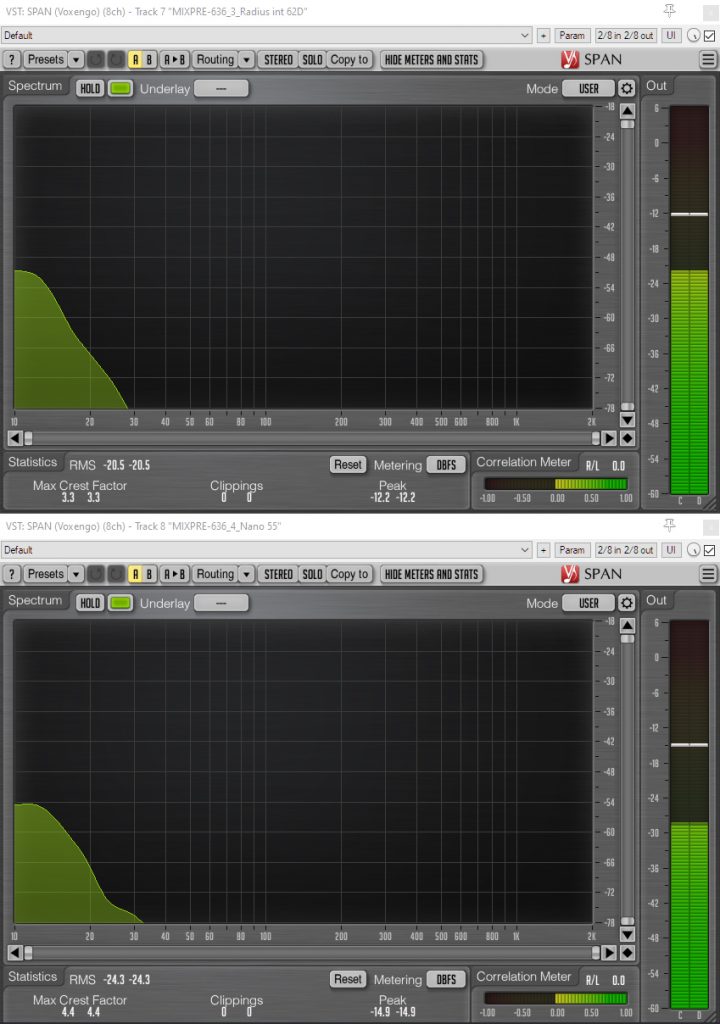
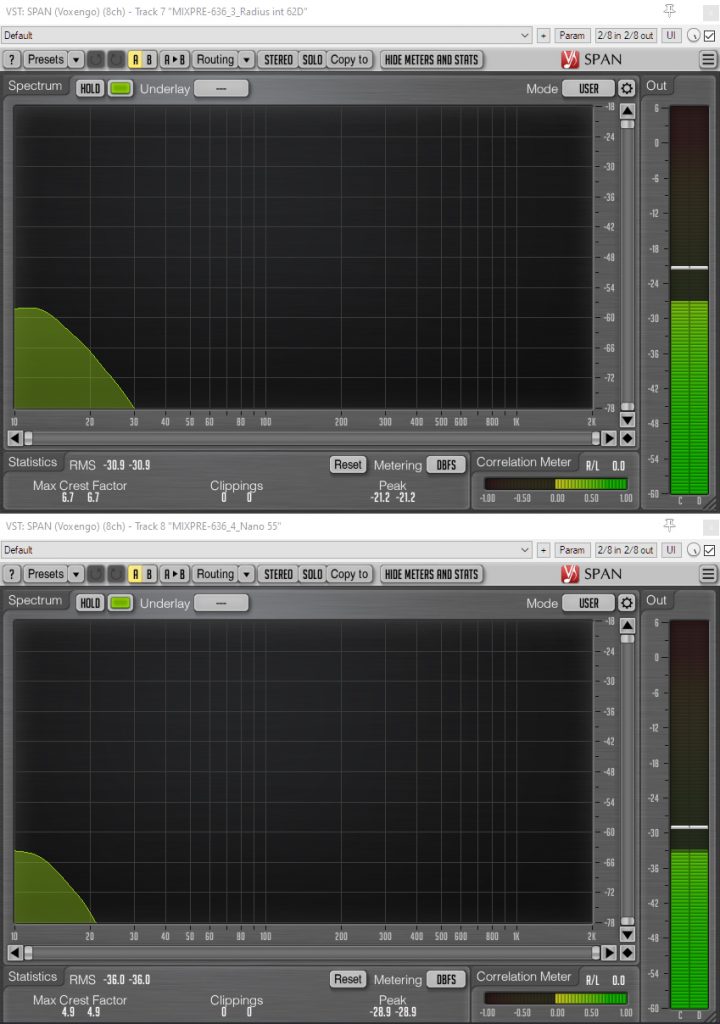
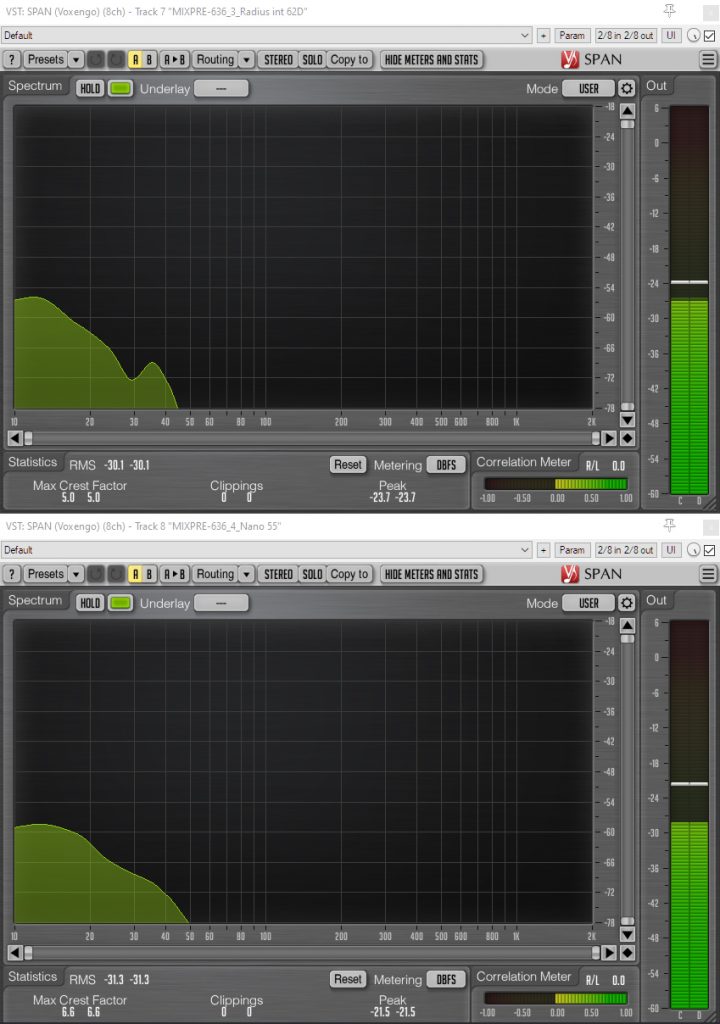
Radius RAD-1 + 62D shore hoop (top) and Rycote Nano Shield (NS2-CA) + 55 shore lyre (bottom) with CA-08 cardioid mics: boom pole held and mics angled conventionally, and mics moved up and down.Radius RAD-1 + 62D shore hoop (top) and Rycote Nano Shield (NS2-CA) + 55 shore lyre (bottom) with CA-08 cardioid mics: boom pole held and mics angled conventionally, and mics moved side to side.Radius RAD-1 + 62D shore hoop (top) and Rycote Nano Shield (NS2-CA) + 55 shore lyre (bottom) with CA-08 cardioid mics: boom pole held vertically and bottom bumped on to carpeted floor.
My expectations for the RAD-1, even with its most compliant 62D-shore hoops, against the 55-shore Nano Shield shock mount were low. Indeed, the Nano Shield suspension outperformed the RAD-1 on the side to side test, where the lateral resistance of the new lyres proved most evident; but the difference was more subtle with the up and down motion (and the RAD-1 again had more of its energy at lower frequencies); and, surprisingly, the RAD-1 was slightly better in the boom pole bump test. So a much closer match between the two shock mounts than I had assumed would be the case.
Conclusions
The results of small differences in such specific tests and with such specific mics, cables and boom pole should not be overstated. From these tests (and broader testing that I have undertaken with the shock mounts), however, it is clear that the RAD-1 and RAD-2 perform well and, also, close to the Rycote equivalents, insofar as there are exact equivalents. Indeed, it is the physical differences between, and different features of, the shock mounts that are likely to determine which model anyone could or should choose: the XLR plug holder and better pivot knob of the Radius shock mounts vs the more minimalist InVision series shock mounts (which make the latter more suited to acoustic music recording, for example); or the more boom pole geared design of the Radius shock mounts vs the Rycote InVision softie lyre mount with pistol grip? Of course, as Radius introduce new models, those differences will change. Pricing will come into play too, although the different suspension hoops included will make up for the slightly higher pricing of the Radius shock mounts for many. Anyway, it is good to see such a high-quality start to Radius Windshield’s production, to have another UK manufacturer, and to have more choice in terms of shock mounts and suspensions. I’m also glad that all the experience embodied in the team hasn’t been lost to some unrelated business or the golf course! It will be interesting to see what comes from Radius over the next few years; what their first full basket windshield is like; and, with my personal interests, what they produce in due course in the way of suspensions for more esoteric uses such as mid-side mic pairs.
NB Although I matched the mics and gain in each set of two-mic test, the signals were normalized in Reaper so that I could get a decent level of shock mount noise for each comparison: therefore, please don’t compare noise levels across the different sets of tests or, indeed, start thinking that the shock mounts are all noisy! All the shock mounts I used here are ones I would (indeed, do) happily use and are excellent: this was very much about accentuating any differences between mounts in each set of tests.