Introduction
Following on from my Avignon jaunt in October, this is another tale of a short city break in Europe with a hidden agenda of sound recording. The planning of a four-day visit to Vienna with some of my wife’s side of the family got me thinking: it seemed like a golden opportunity to sneak off from the group to see the engineers at Nevaton, 40 miles down the road at Siegendorf. During my testing of their mics over the last year, they have been asking many a time when I might visit them, and, as it is a bit of a hike from Norfolk, this seemed to be the perfect chance. And then, more latterly, I have been in contact with William Eduoard Franck, based at the Filmakademie Wien: William is a force of good-humoured energy and expertise, Head of Direct Sound at the academy, a great proponent of the importance of sound in film, and organizer of the new Soundscopia Vienna events and forum. He invited me to meet up with him at the academy. So it was looking as if I might skip some chunks of the family trip, but I felt I could live without the dancing horses, and missing a few coffees with Sachertorte on the side might be no bad thing for the waistline! So, on the basis that the (not so) hidden agenda parts of my trip might be of interest to one or two readers, here goes…
Nevaton factory visit
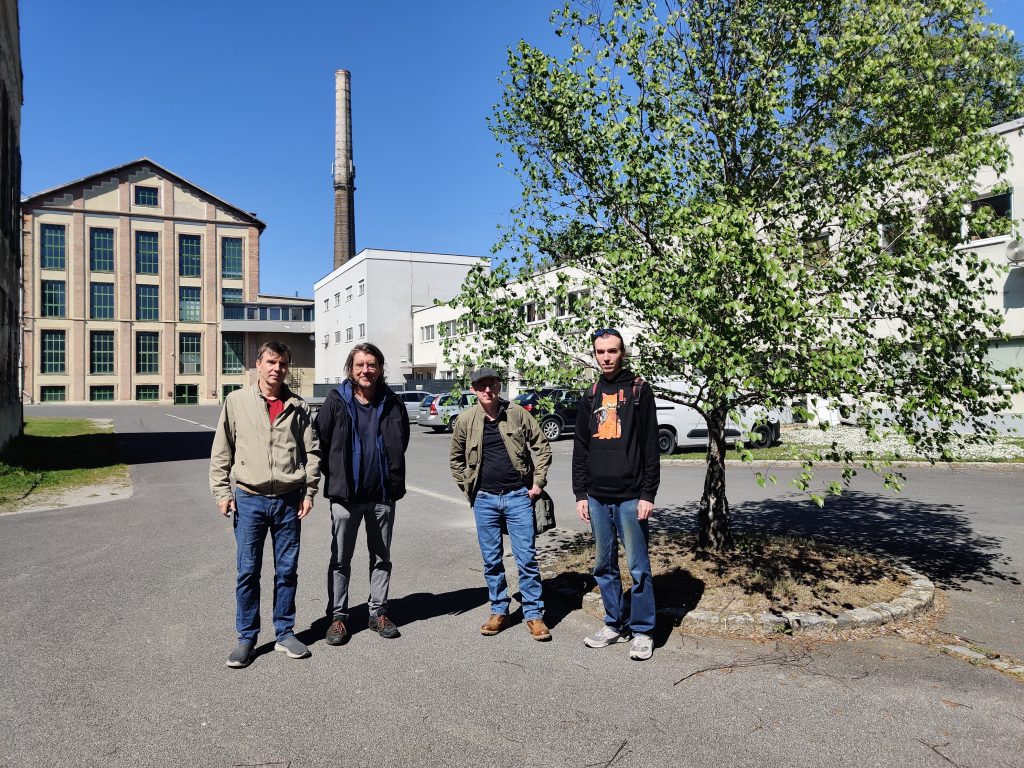
I’d seen a few photos of the workshop/factory/laboratory (it seems to be somewhere between the three) that Nevaton moved to in Siegendorf, from St Petersburg, a couple of years ago, but visiting it in person and – above all – meeting the good folk there (Egor, Pavel and Dmitry) in the flesh promised to be a great opportunity. William Eduoard Franck also joined me on my trip out to Siegendorf. Well, he more than joined me, kindly driving us there: I loved the way that William was entirely confident that he would have no problem identifying me when picking me up at Radetzkyplatz in Vienna (I quote: ‘you will be the only English Man (stylish as you are)… around’)!
When opening up mics from time to time, you can look at a circuit board (which, in my case, doesn’t tell me much, given my lack of electronics training!) and see the outside of the capsule. With most mics, I haven’t dared or had need to get that far, and have limited myself to peering through the grille, trying to see what is inside: you may recall my close-up photos of, say, the Sennheiser MKH 8030 which typify the limit of what I – and many others – see of the insides of a mic. So this is my long-winded way of saying that, in addition to meeting the designers and builders of the mics, I was especially keen to see how their capsules are made and, more specifically, the dual-capsule designs (i.e. with a passive rear diaphragm) that are a feature of most of the Nevaton MC59 mics.
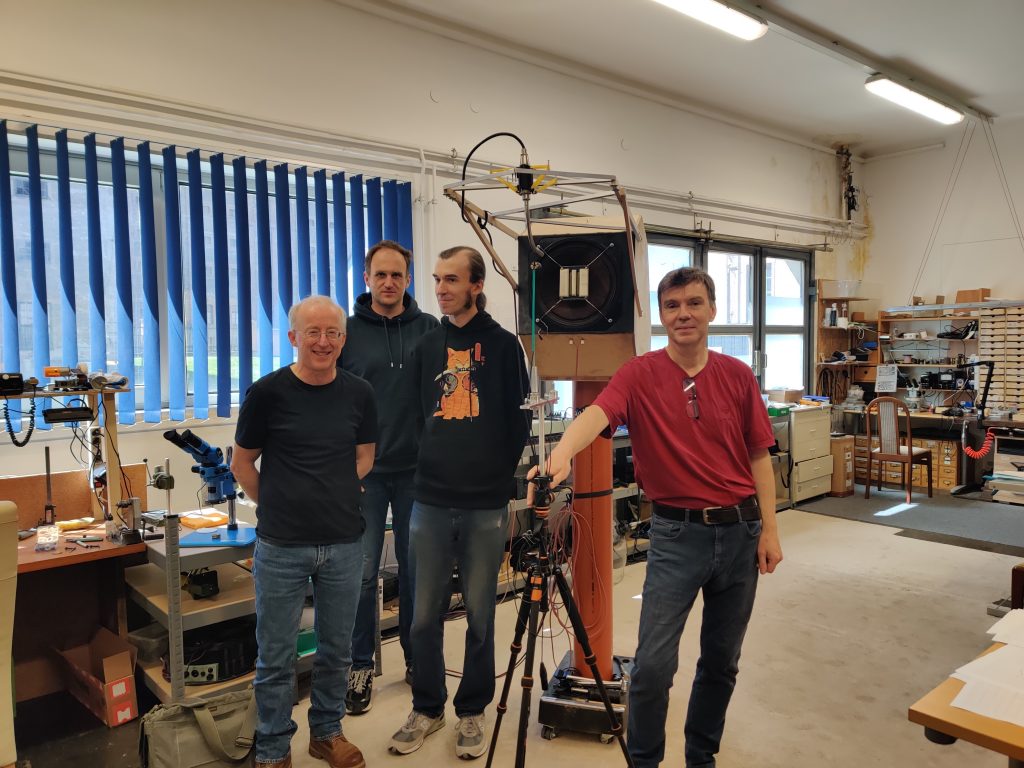
With Egor translating and adding much additional detail, Dmitry (the chief designer and engineer) obliged by showing the process from cutting the mica sheet (off a roll 37 years old: you can’t get the same quality these days!), to careful tensioning (and checking resonant frequencies using a Brüel & Kjær 2010 Heterodyne Analyzer: this allows measurement to see if tension is within tolerance, and to allow capsule tuning – especially relevant with front membranes with slightly different tensions to those of passive rear membranes), through to assembly – even down to the little paint kiln. Without their former massive anechoic chamber of St Petersburg days, testing mics is done in the large but untreated room, using a Brüel & Kjær 4133 measurement mic and Brüel & Kjær measurement gear (1027 sine-wave generator; 2610 and 2636 measuring amplifiers; and 2308 XY recorder) corrections are made in real time for frequency plots on paper. Old school, doubtless, but very effective nonetheless. And for testing self-noise, the mics are placed in a sound-proofed double-box made of granite: I feel inspired by this item and could see myself making one (everything else there was out of my league and for serious engineers!). Plenty of fine engineering equipment – including some enviably solid small CNC machines – makes for a very competent set up. Inevitably, some processes are farmed out: as far as I can see this includes little more than gold sputtering of the mica, replication of the PCBs (and, once prototype and pre-production test versions are hand soldered by Dmitry, population of production versions with surface-mount components), and making of the brass mic bodies. So very much an in-house operation, as, indeed, I expected.
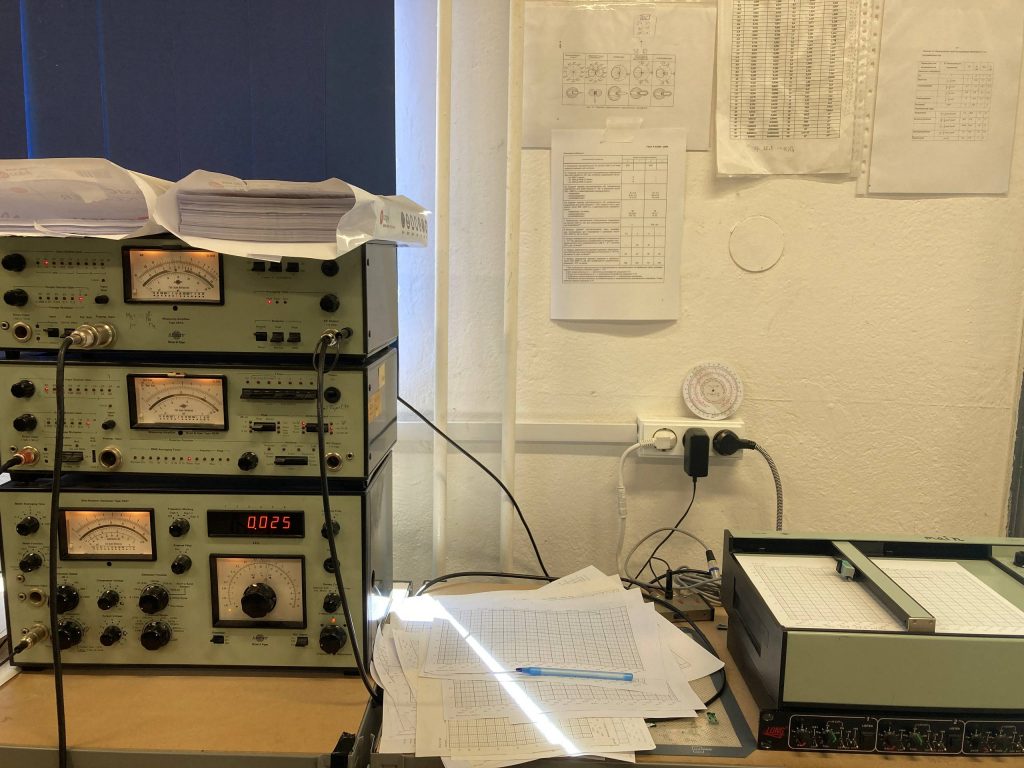
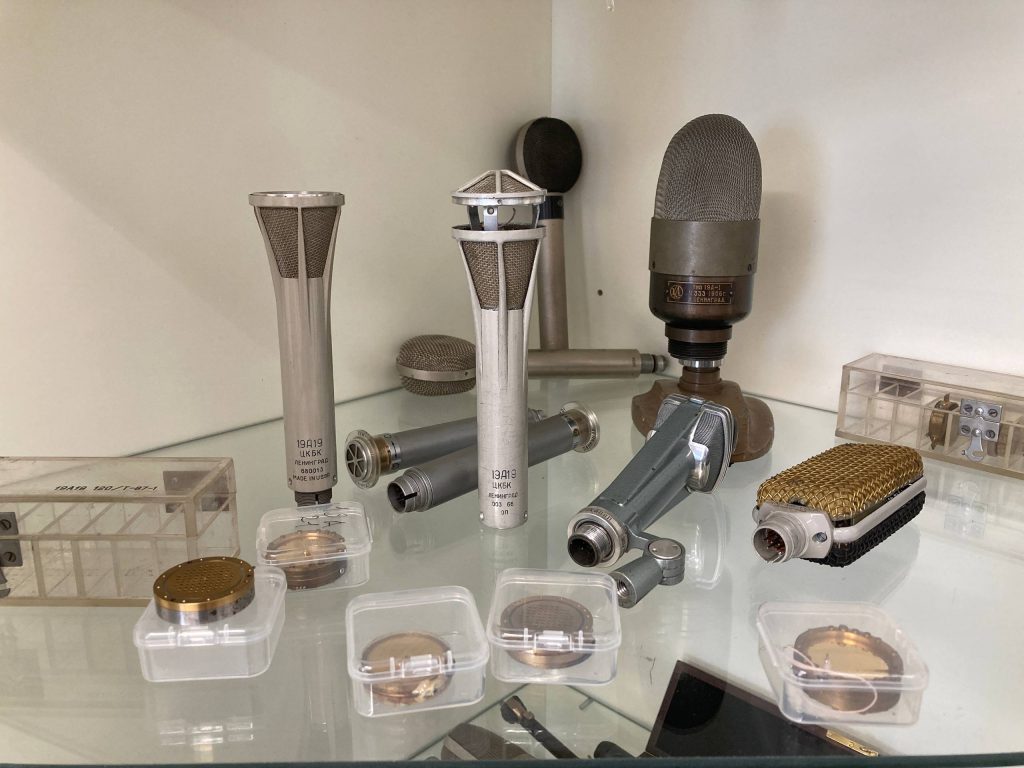
I can’t do justice to the whole process and, of course, that isn’t really my story to tell: hopefully, in time Nevaton will build on their new website and, perhaps, also use social media to give more detail. But, from an inexpert but keenly interested perspective, it was fascinating to see something of the processes involved; the remarkable care taken with the complex nature of the Nevaton mics; the meticulous checking, measurement, and fine tuning involved; and the sheer passion Dmitry, Egor and Pavel have for their mics, reflected in the continuous developments they are making. And it was great to understand more why, in this highly automated world, there is so much hand crafting involved in high-end microphone manufacture. Finally, of course, it wouldn’t have been a visit without seeing the little Nevaton mic museum, reflecting their long history, and to meet Dmitry’s beautiful cat Nyusya during lunch, which was so kindly laid on.
Zither at the Filmakademie Wien
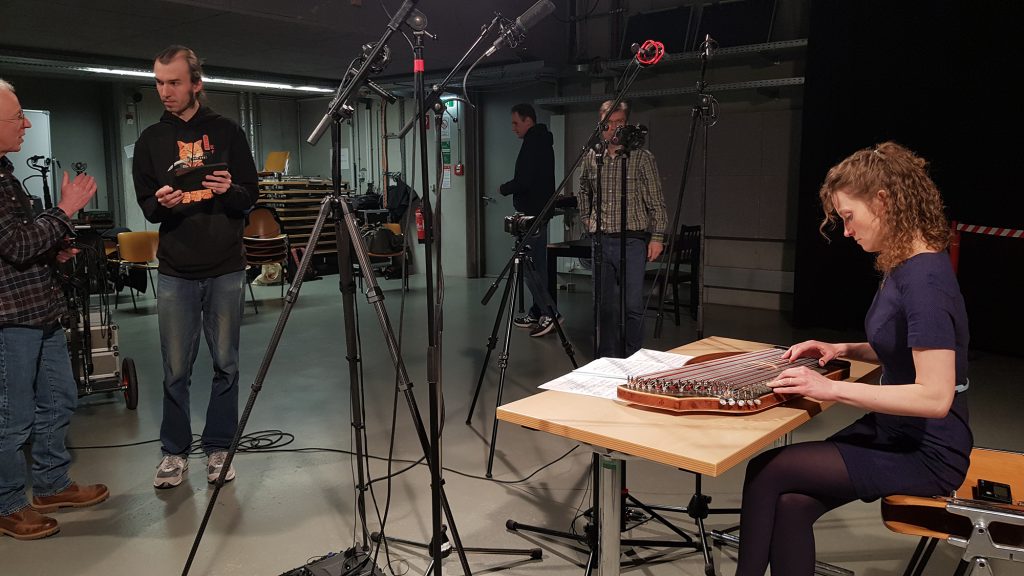
The number of famous composers associated with Vienna is overwhelming and their imprint today remains significant, be that musically or, with examples such as the Mozarthaus, physically. But for some the music of Vienna is most associated with the zither player, Anton Karas. Plucked from obscurity in 1948, playing in a Viennese heuriger (wine tavern), by the film director Carol Reed to compose and perform the soundtrack to ‘The Third Man’, Karas’s playing certainly shouts out ‘Vienna!’ to me. So, to add another layer of complexity to the trip, I thought it would be fun to incorporate a zither recording. A bit of detective work (OK, Googling) later, I came across Zithersound, the website of a group of three zither players, all former pupils of Professor Cornelia Mayer, the great exponent of the Karas style (and transcriber of his music) who died in 2021. I was lucky that one of the group, Anna Karnthaler, was game for a bit of zither recording. My initial thought was to find a quiet place (perhaps a church) to record in a minimalist manner, but, as things do, the plan snowballed rather and became combined with my planned meeting with William Eduoard Franck at the Filmakademie Wien: we ended up with a session in one of the film studios there, during a class workshop that William was hosting. He provided his sound cart (even fishing out his Sound Devices 788T – untouched since Covid – to make me feel at home) and camera, the wonderful technicians obliged with some lighting, the multi-talented Gerald Roßbacher lent a hand, and, last but not least, the team from Nevaton – Dmitry, Egor and Pavel – drove into Vienna with a clutch of their mics and their MixPre-10.
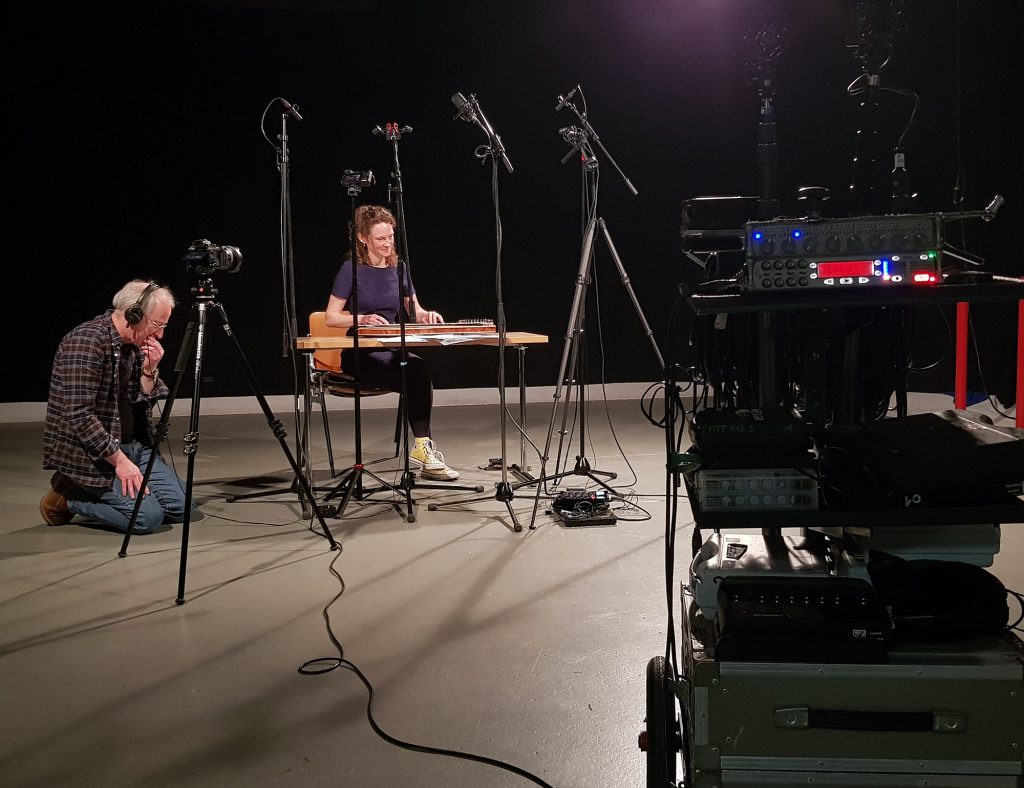
So, my quiet solo location recording turned into something much more sociable and interesting. And it proved to be a chance to hear and test the Nevaton MC50, which, if you haven’t come across it, is a quad large diaphragm condenser. In this case we used it in double mid-side (DMS) mode, which, in post, I decoded to stereo using the Harpex-X plug-in. Other mics used were a pair of the tiny Nevaton MC59uS + 59/C2 cardioids in ORTF, which I had brought with me on my travels; another pair of the same, also in ORTF, which Nevaton brought along, which was set up a different position along with an MC59/H Pro shotgun mic (the same prototype, or pre-production, model I used for my tests here); and a pair of MC59/O omnis.
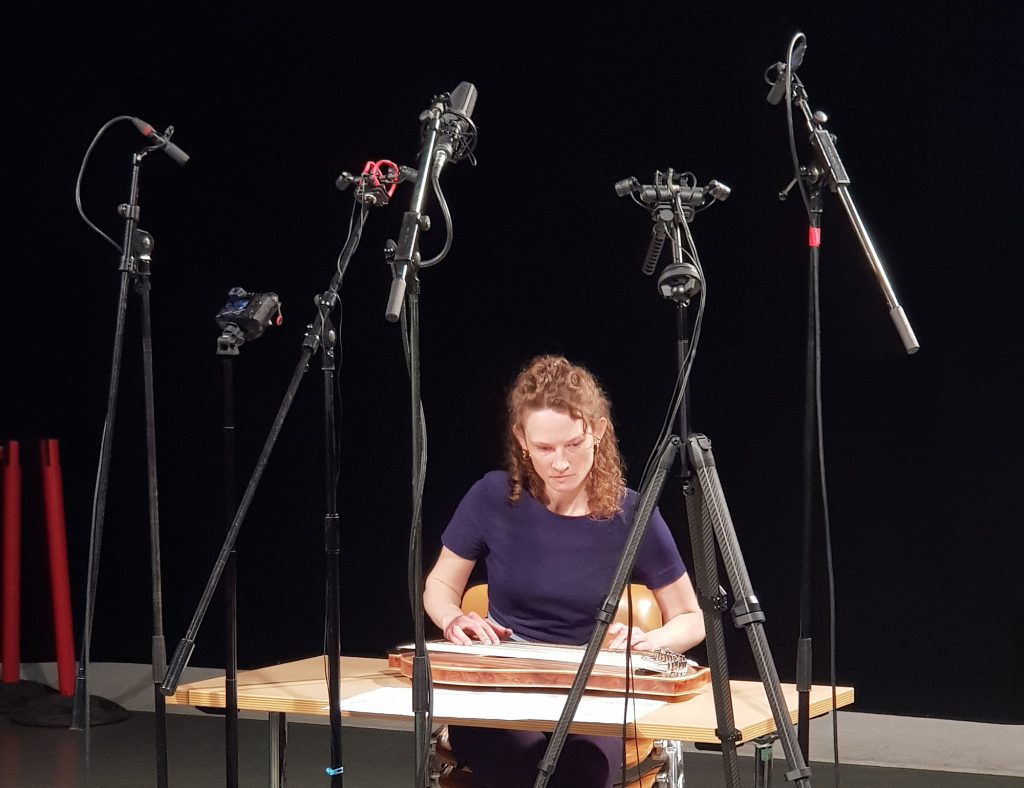
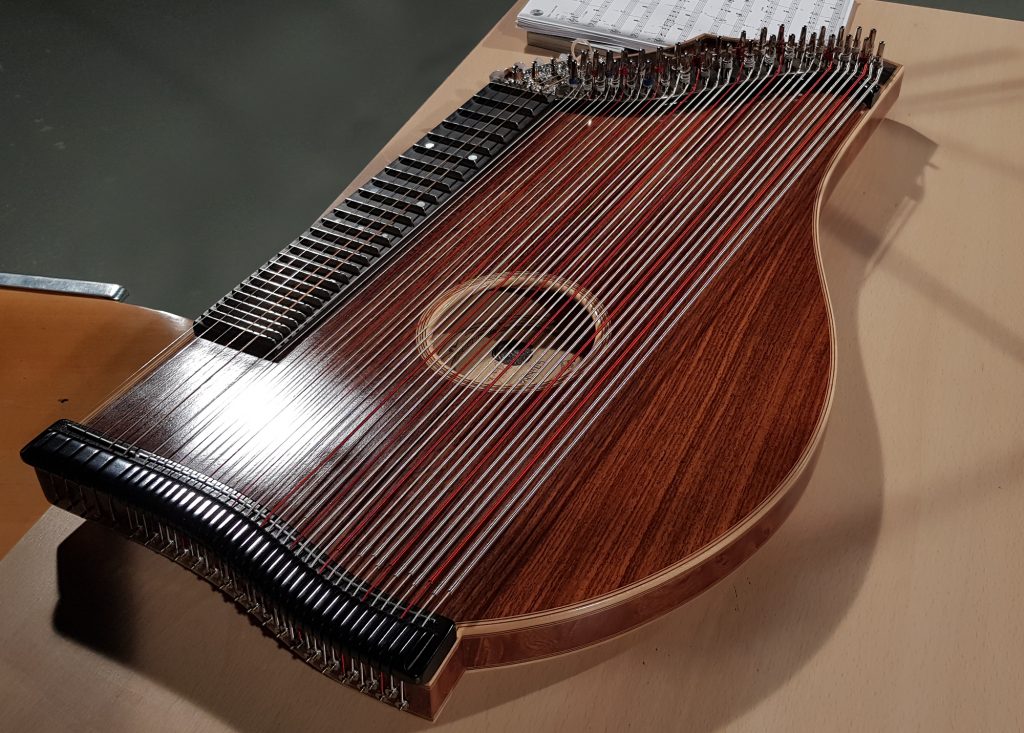
Preparation for a recording like this, especially when travelling light (miserly yet practical!) away from home and with a tight timescale, was inevitably imperfect: ideally, I would have assembled a rig to allow all the mics to be near coincident (apart from the duplicate ORTF pair), and had the omnis at a fairly close spacing. But, hey ho, things don’t always work out ideally and, without such a rigging option, I was just grateful for some mic stands to hold the various mics, even if these resulted in some rather non-coincident positionings and with some rather widely spaced omnis (at 1.17m). So what followed wasn’t by any means a scientific comparison of the mics, but certainly still of interest and value – well at least to me! And, it was a fun way to spend a morning, see the Filmakademie, and spend time with all involved. And, goodness, I did enjoy hearing the zither in the flesh for the first time. I’m so grateful to all for indulging me, not least Anna, who must have wondered what she was doing! She played various pieces, including The Third Man (aka Harry Lime) theme, and here is a video of three short pieces, which Anna performed as a seamless sequence: the pieces are ‘Frohsinn auf der Alpe’ (‘Joy in the Alps’), ‘Das Glöcklein im Thale’ ‘The Little Bell in the Valley’) and ‘B’hüth’ dich Gott!’ (‘May God Protect You’) by Carl J. F. Umlauf (1824-1902). As usual with such videos of mine, the mics switch and what is in use at any moment is shown on the screen. Where combinations of mics are used, the subsidiary ones are 6dB or more down in the mix, not least to reduce phasing issues.
And here is a version of the same video, just with the centrally located ORTF pair on its own, and a dash of reverb added.
For completeness, here are the various WAV files (with no processing) so, if anyone is keen, they can play around and mix files to their heart’s content!
Coda
Yes, the musical world of Vienna is getting to me, but there isn’t really much to say in this ‘coda’. I hope the very basic introduction to the Nevaton set up in Siegendorf is of interest and fleshes out a little the nature of the company behind the clutch of mics I have been testing lately: a small team, dedicated to producing mics to the highest standard they can, constantly looking to innovate and improve. Obviously rather thin on corporate and sales staff, so be patient if inspired to get in touch: hopefully, distribution will improve as they get more settled in their new location. And the upside of the smallness of the company is that you can talk directly to the engineers. It was a complete pleasure to spend a day with Dmitry, Egor and Pavel, and also, of course, with William Eduoard Franck. And it was fantastic to be shown, by William, the facilities at the Filmakademie Wien (lucky students!) and to be able to use them: to have the opportunity to record Anna playing the zither in Vienna was the icing on the cake and a fun exercise too. I have a long history of fusing holidays with activities on the side, and highly recommend it: of course, it takes a bit of effort to set up some things such as on this trip, but, goodness, it was worth it. And as for Vienna otherwise? I’d highly recommend it, from the galleries and museums (I particularly enjoyed the Courbet exhibition at the Leopold; and, better still, the quirky and excellent Third Man Museum), to the ferris wheel in the Prater, to walking the old streets in the Innerstadt, and the amazing public transport. A friendly, welcoming and civilized place too.
But don’t worry, the Random Jottings of Dr Badphil isn’t turning into a travel blog: I’ll be back with another set of detailed tests soon. Tschüss!


8 Comments
Very interesting visit to Nevaton Rol. As for Anna on the Zither, no pressure then..! All those mics staring down at her! Bring the Nevatons down when you visit. I would like to see / hear them too. Jake P Base2 Music
Anna seemed pretty relaxed about the mics, and all the chaps with the mics! Yep, can bring a clutch of Nevatons with me when I visit you: perhaps a bit of a test on organ?
Cheers,
Roland
Thanks for your blog post!
You are very welcome, Frans: always good to know that someone out there is reading my blog posts!
Cheers,
Roland
Terribly interesting article (like the others!) ! I admit that Nevaton microphones are intriguing me and make me want to try them (knowing that I don’t want to bother the people at Nevaton if there is no prospect of acquisition in the more or less short term, in my case…), but I don’t know if they would be suitable for intensive ‘field’ use rather than in a studio or a protected environment… What is your opinion, Dr. B.?
Thanks Regis. Well, that’s extremely hard to answer as you can imagine! Intensive field use could cover a range of things. I can’t pretend that I have as yet dragged them to the extremes of the Arctic or tropical parts, as the UK is more benign: I certainly have no fear using them in the field, but don’t take that as a carte blanche! That said, as I type, Dmitry – the chief engineer – at Nevaton is in Indonesia with a clutch of his mics in the field: I look forward to seeing how he got on.
Cheers,
Roland
Thanks for the quick answer, Roland ! By intense use in the field, I also mean faith, the faith you can have with excellent “workhorses” like an MKH 416, 50, or KMR 81, for example, with their long proven reliability. Living and working in France, I don’t extreme conditions, but I experimented that Schoeps microphones are sensitive with humidity ; I am just curious about that with Nevaton and maybe a victim of the “studio” image of their products I built myself, finding only “quiet recording situations”.
Cheers,
Regis
Hi Regis,
I’d be surprised if the Nevatons weren’t better in high humidity than most other true condensers (inc. the Schoeps and, indeed, the KMR 81) due to the heating from the class-A amplifiers in them. I first physically came across the mics when loaned some by a well-known sound-effects company so I could make an ORTF-3D Mega-Blimp windshield for them: rugged field use was their priority, and I have not heard of them running into problems in the 18 months since. It might be worth you getting in touch with Magnús Bergsson via his Hljóðmynd – Soundimage website (or at least searching ‘Nevaton’ on his website): he has been using the mics in the field (in Iceland) for years.
Cheers,
Roland