Introduction
As I have noted previously, Nevaton’s MC59 mics – that is, its SDC range – are skewed towards the wider polar patterns, with no hypercardioid or supercardioid models available at present (though I hear one is coming!), yet a variety of omni, wide omni and cardioid options. The MC59/H is an exception to that, being a shotgun model: the MC59/H Pro is a new variation of that mic and is what I am testing here. The mic should be available soon, but the copy lent to me by the engineers is the only one in existence – hence the loan and the fact that, as I type, it is winging its way back to Austria!
Physical form
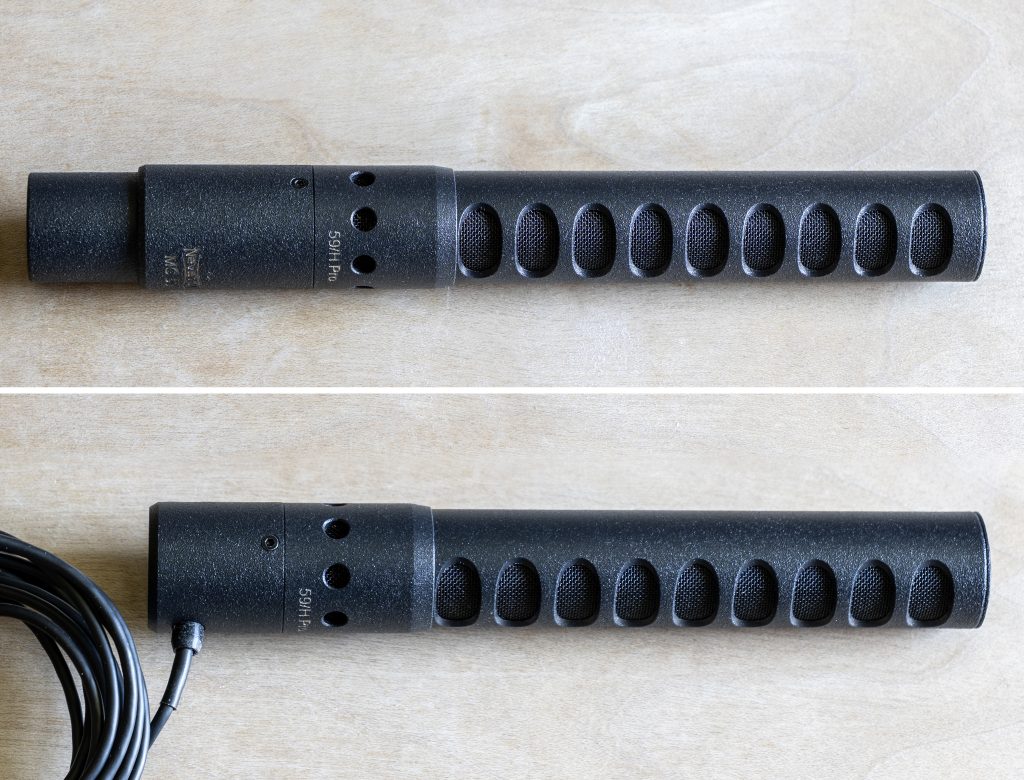
The capsule part of the mic is 120mm long with the 95mm-long interference tube having a diameter of 20mm, which broadens out to the 22mm diameter that is common to the MC59 mics for the part of the mic that contains the capsule itself. The overall length (and, of course, weight) of the mic depends on which preamplifier is used: ranging from the 49mm XLR-equipped MC59 down to the 5.5mm-long MC59uS. I suspect for practical usage – i.e. allowing for a more balanced mic and providing space for shockmount clips – that most will choose the standard MC59 or the 25mm-long hard-wired MC59S. Certainly with the various preamp options to hand here, I have been using the standard MC59 for the shotgun capsule.
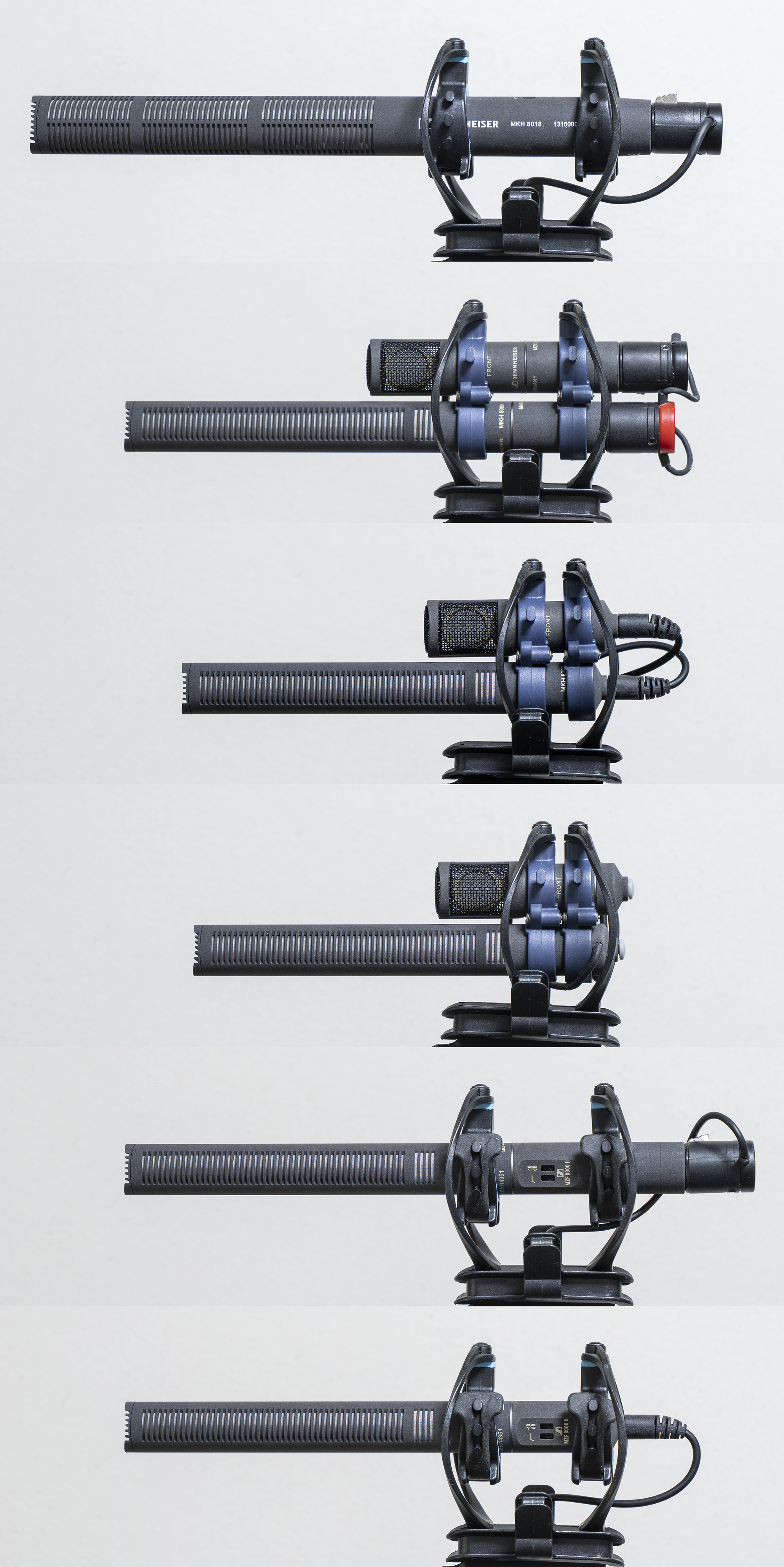
In its physical appearance the mic looks identical to the existing MC59/H, so all the changes in the new ‘pro’ model are under the hood. I understand from the engineers that the main difference is that it has a double-membrane acoustic transducer like most of other capsules in the series (i.e. excepting the MC59/OW, open-wide cardioid, and the omnidirectional mics in the series – i.e. MC59/O, MC59/O+ and MC59/O2, which are pure pressure transducers with single membranes). The second membrane, or diaphragm, has no gold plating and is passive – as, indeed, seen in the Shure KSM42 cardioid LDC mic. The interference tube itself looks unusual in that it has oval openings rather than the more familiar close-spaced slots of most designs, although, of course, many a slotted interference tube covers internal circular openings as, indeed, they do with the Sennheiser MKH 8060 and MKH 8018 mics used in the comparisons for this post.
Self-noise
One of the stand out features of Nevaton mics is their low self-noise, and the MC59/H Pro is similar to the standard MC59/H and the other MC59-series mics in this regard. Nevaton themselves suggest -5 to -6 dBA, but, as ever, it is good to test rather than just repeat the specs, not least since self-noise of two mics with the same value can sound quite different due to different frequencies in the composition of the hiss. In this case, I compared the self-noise of the MC59/H Pro to two mics I have been using a fair amount and which I have tested previously: the Sennheiser MKH 8060, which has a very respectable published self-noise of 11dBA, and the Rycote HC-22, which has a still lower published self-noise of 8.5dBA. Both these published specs seem about right from my previous tests.
As usual with such tests, to start with I measured sensitivity rather than just going with the manufacturers’ figures. For this I set up each mic in turn in my studio using a jig so that the centre of the front of the actual diaphragm was in exactly the same place, then played a 1kHz tone through a Vivid S12 speaker, and compared levels using a narrow band-pass filter centred on 1kHz. Obviously there were no absolute figures from this, but relative sensitivity was measurable. I then recorded the three mics using a Sound Devices MixPre-3 recorder at 96kHz in the quietest space I could find in the house (under the usual great pile of duvets etc.) at full gain (76dB), brought the files into Reaper and applied the small gain adjustments to match levels based on my sensitivity measurements. I applied a 24dB/octave high-pass filter at 200Hz to remove any residual distant rumbles of traffic, tractors etc. Here are the recordings:
And here are the spectrum analyzer visualizations:
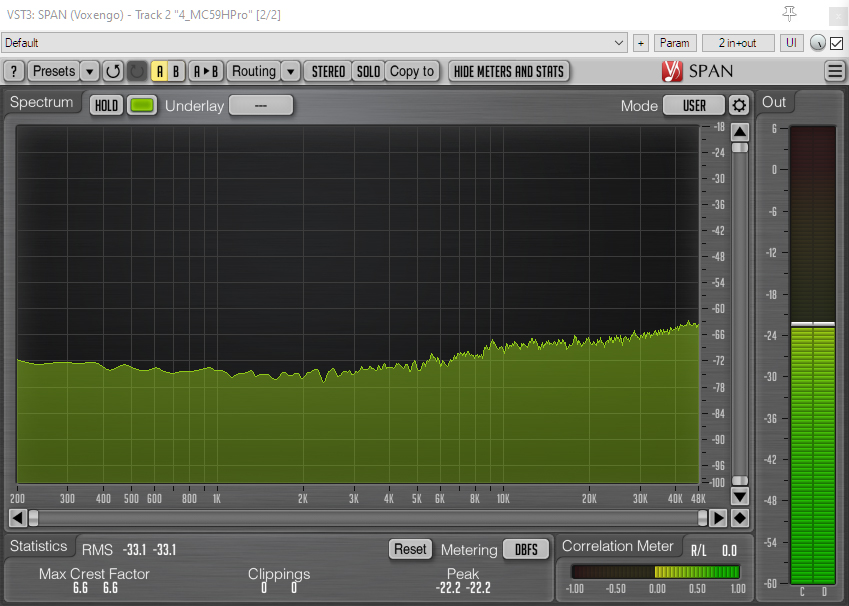
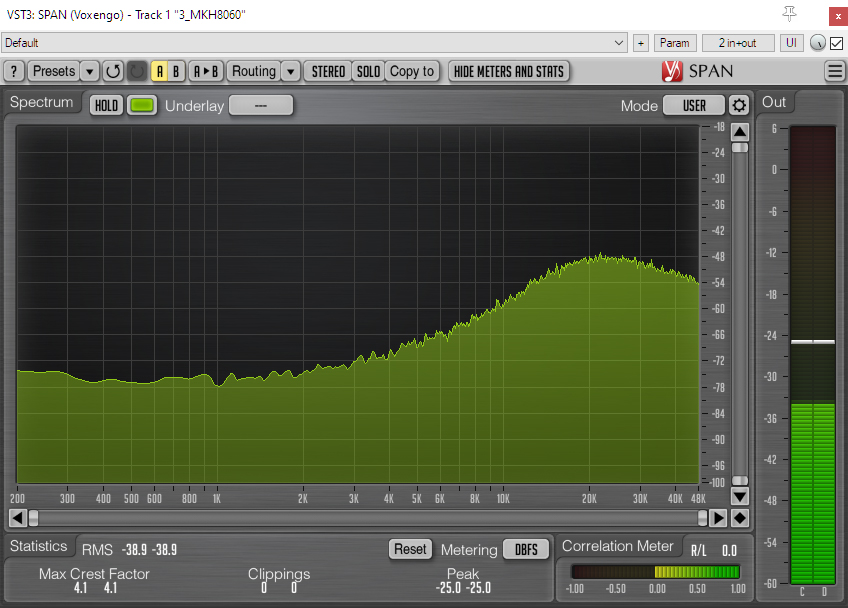
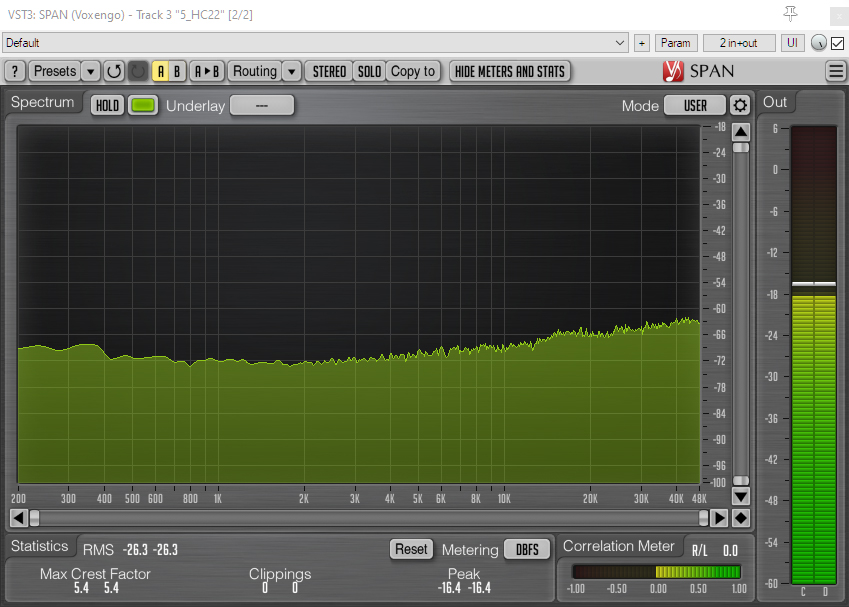
The sound files and the spectrum analyzer visualizations show that the MC59/H Pro is indeed the quietest of the three mics, which takes some doing given the low self-noise of the MKH 8060 and, especially, the HC-22. The two Rycote and Nevaton mics have a broadly similar hiss, albeit at different levels, while the Sennheiser has a more noticeable high-frequency hiss: as with the more recent MKH 8018, the MKH 8060 is not tuned like its first-order siblings, where steeply rising self-noise towards 20kHz continues to rise to 48kHz, but, rather, sees the rise in self-noise start lower and is less steep, and then flattens off after 20kHz, resulting in the self-noise being characterized by more of a high-frequency hiss (say in the 6-12kHz region). In practical terms, these massively cranked-up self-noise tests will be largely immaterial for most recordings, as all the mics are quiet in normal use: but for some, say recording extremely quiet sounds in quiet locations (think effects recordings), there is no denying that the Nevaton has a significant edge in this regard.
Frequency response
Prospective purchasers of Nevaton mics are not aided by the lack of published polar and frequency plots, although, as with the MC59 Twin, the engineers at Nevaton have provided me with specific frequency response measurements of the actual mic I am testing (with none of the smoothing of published graphs):
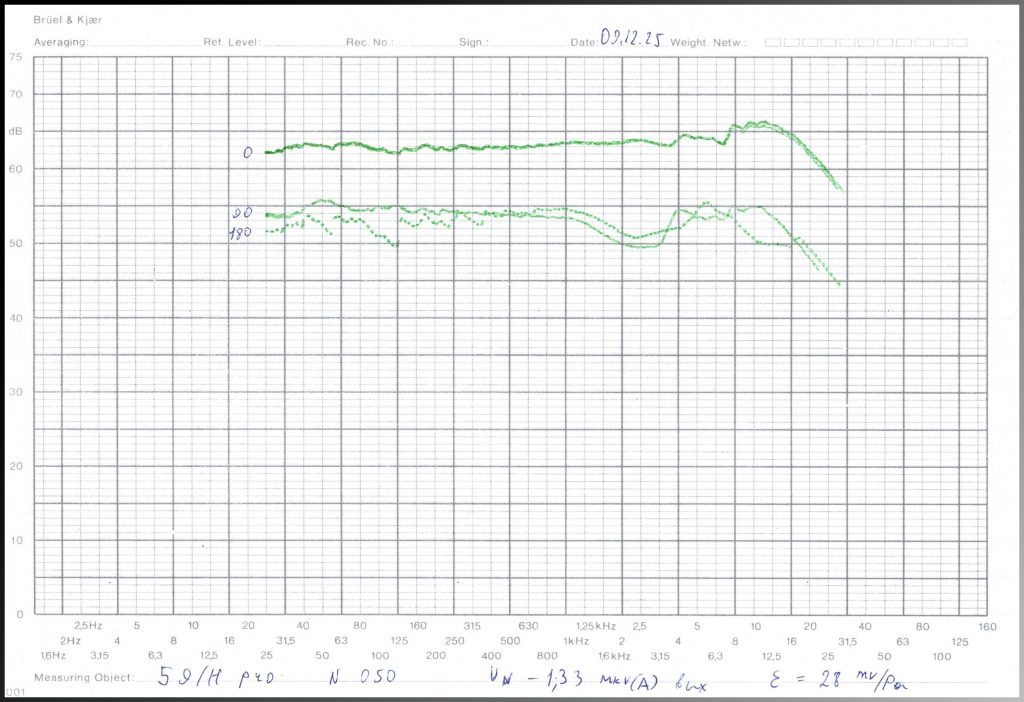
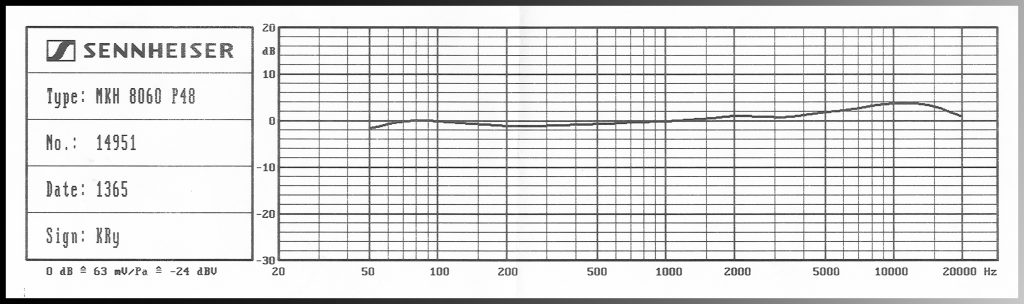
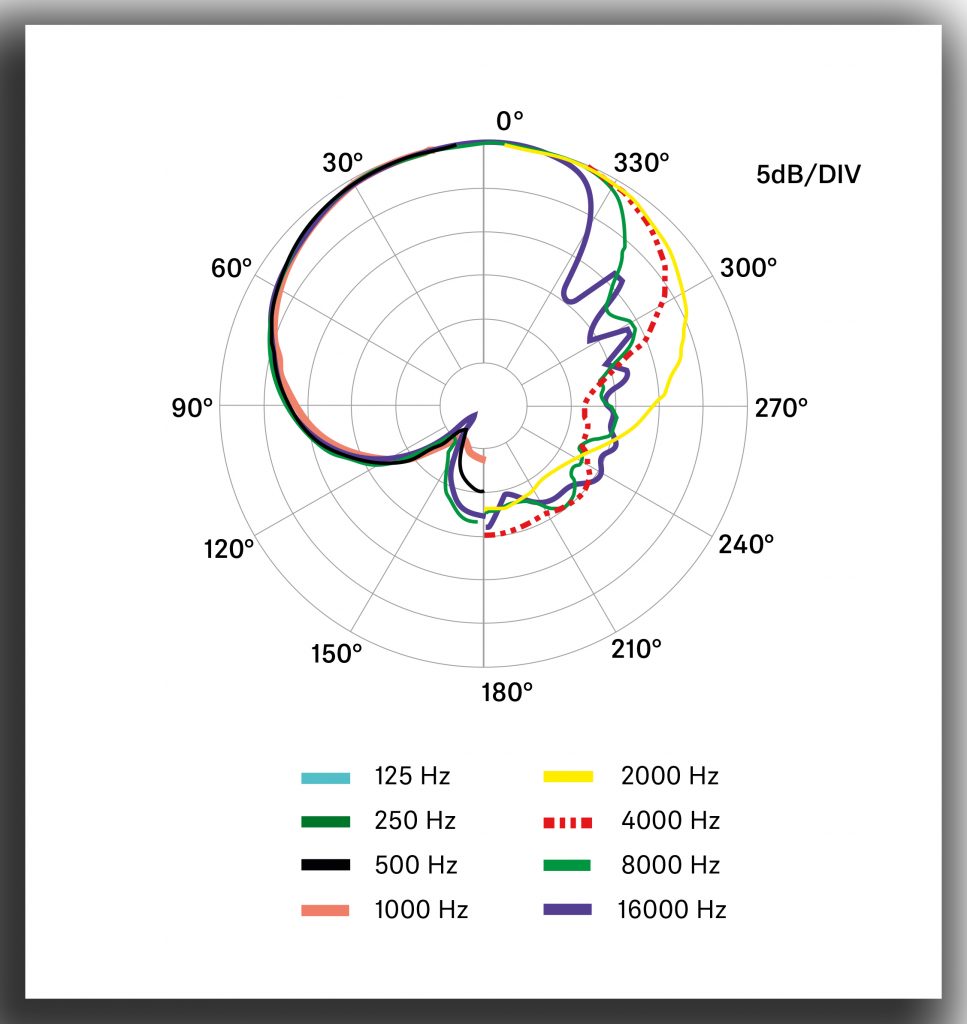
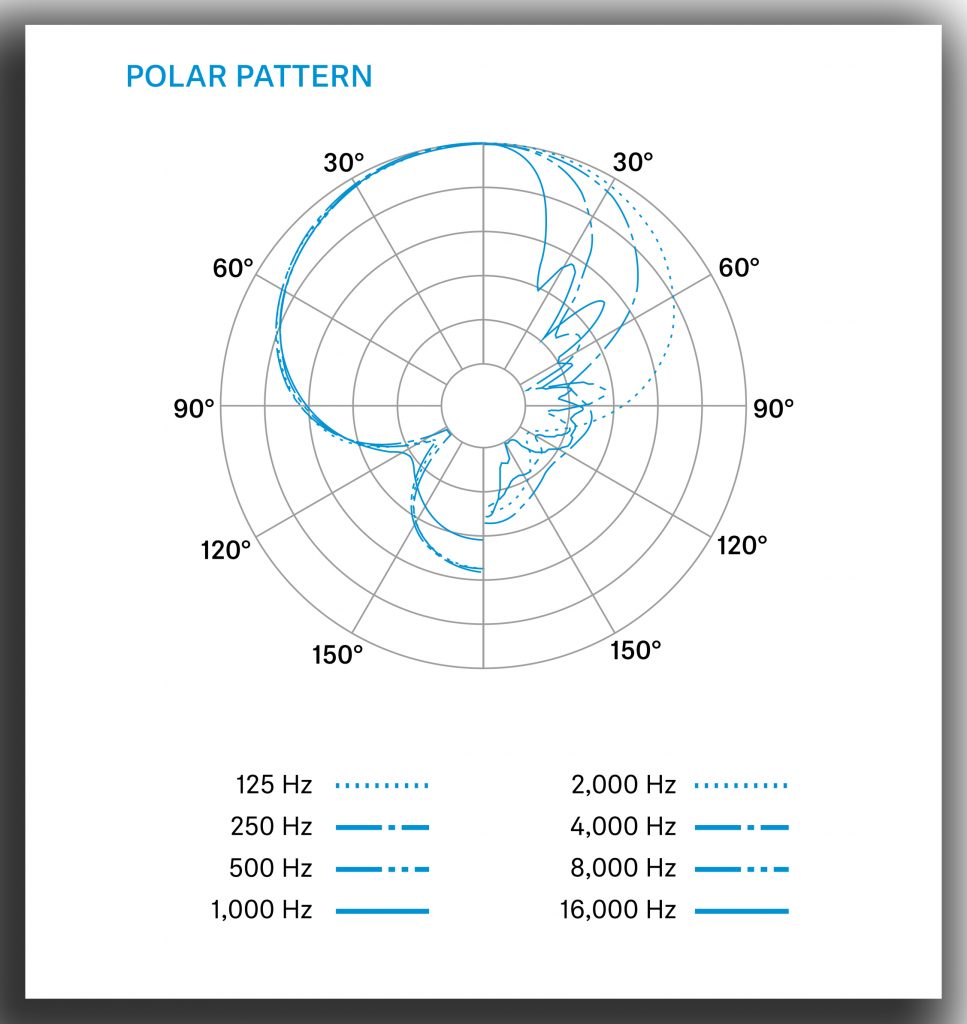
The two frequency plots show broadly similar responses for the MC59/H Pro (at 0 degrees) and for the MKH 8060, with a significant bump in the high frequency response. That latter is typical of many shotgun mics and I assume is there in both cases to counter typical use with windshields with attendant loss of high frequencies, and for clarity with dialogue. Anyway, let’s leave the graphs and do some real world tests!
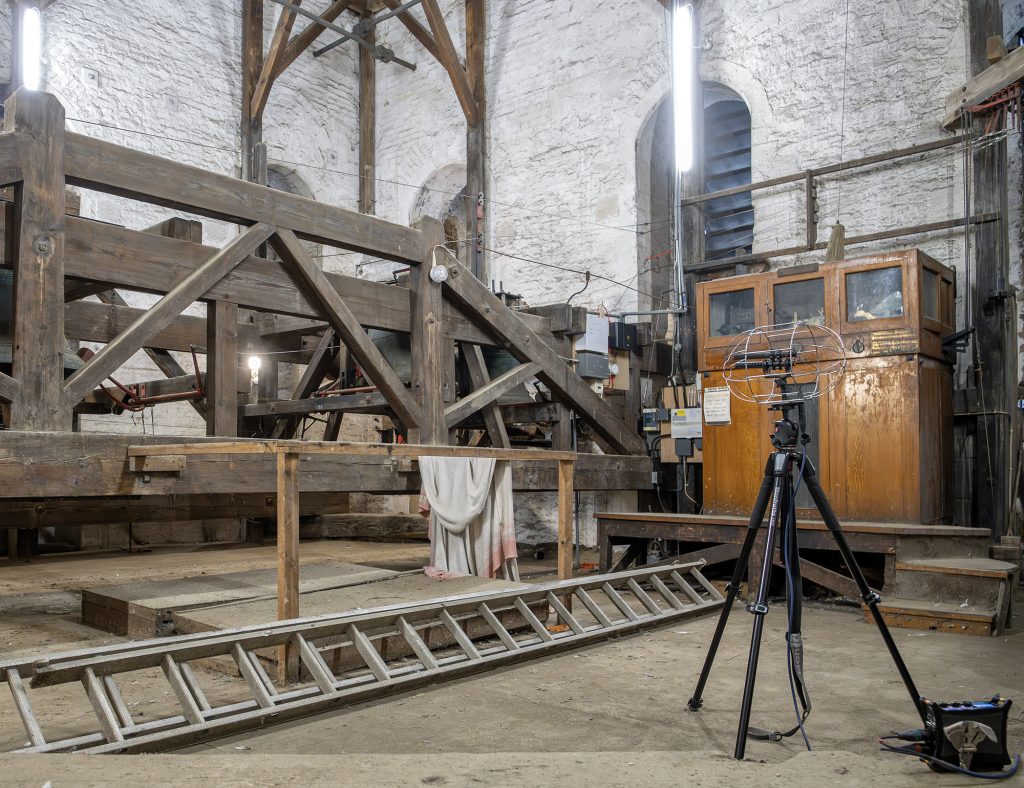
Kicking off with high frequencies, I returned to one of my old haunts in the belfry of Norwich Cathedral where the overtones of the bells provide an interesting sound source. Sticking with the MKH 8060 comparison (as I do for most of this blog post), I rigged this and the MC59/H Pro in a Mega-Blimp (as usual, there was a bit of a breeze blowing through the belfry), and recorded the mics into a Sound Devices MixPre-3. Here are the resultant recordings:
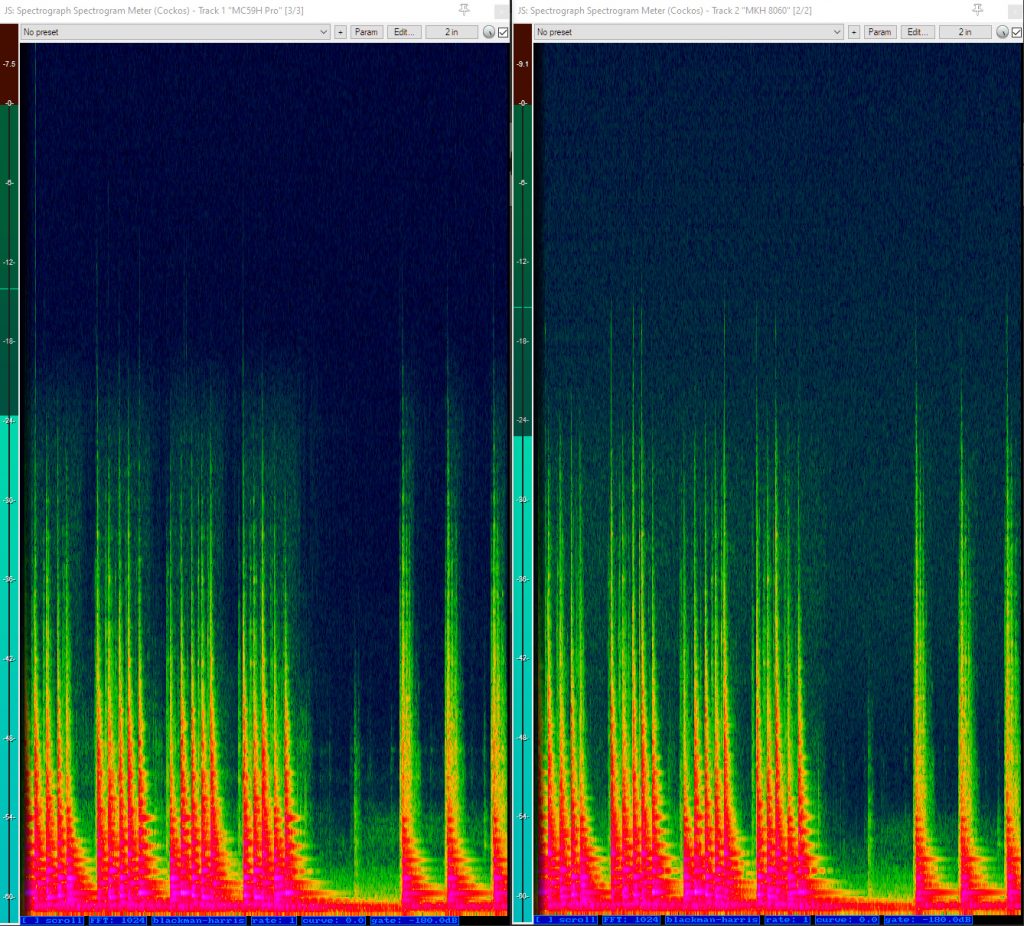
And here is a spectrogram of the recording, showing the chimes. There isn’t a great deal of difference between the two mics in terms of high-frequency response, although the MKH 8060 shows a little more signal above 20kHz, albeit with more self-noise.
I’ve used the cathedral bells for some time for such tests, but recently discovered a more homely and controllable – but, yes, more boring – source of high-frequency sound, useful for exploring mic response in the form of the humble shaker (that simplest of percussion instruments). Here are simultaneous recordings made using the two mics, adding to the exploration by recording on axis, at 90 degrees and 180 degrees, all at the same distance (1.5m). The recordings, which were made outside to reduce reflections, at the three different angles are separated by brief silences.
Listening to these recordings, you can hear the different side and rear rejection of these two mics at the frequencies produced by the shaker (i.e. above 400Hz).
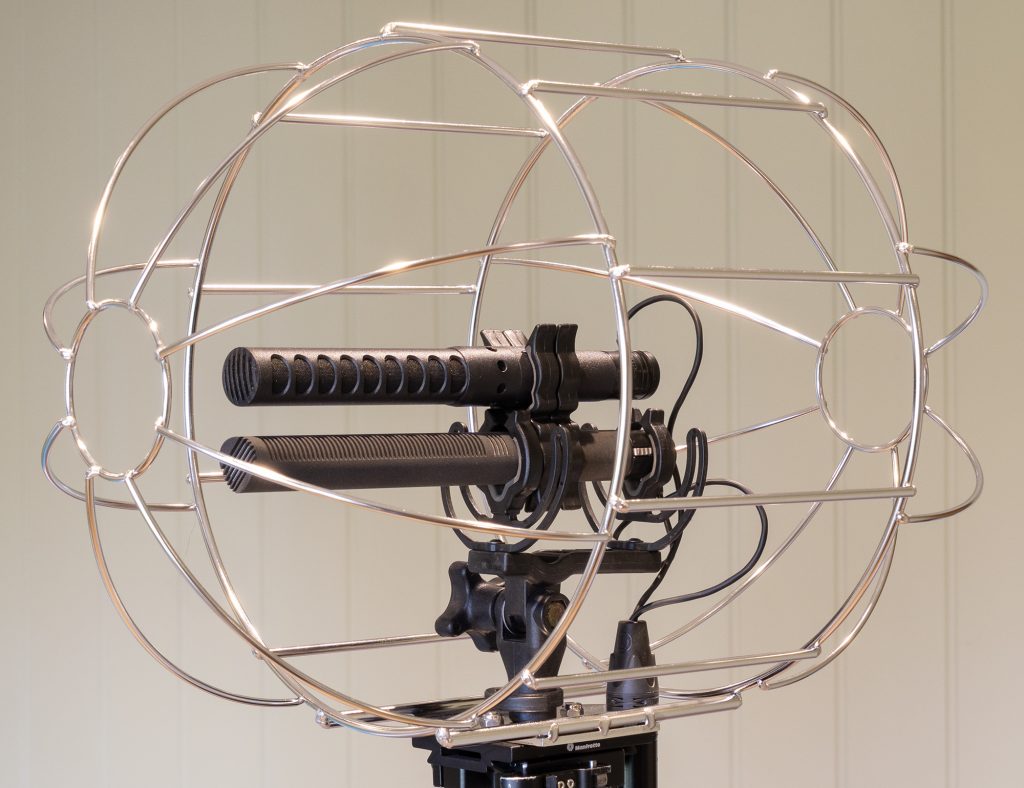
Turning to the other end of the spectrum, I set up a Sennheiser MKH 8060 and the MC59/H Pro pair in a single windshield aimed at the exhaust pipe of the rear of a parked car (with the engine idling, of course). Then the mics were rotated side-on to the exhaust and, finally, angled 180 degrees to the sound source. Here are short clips from the recordings, each having the on-axis recording followed, after a very short silence, by the 90 degree recording and, then, the 180 degree recording:
And here are the spectrum analyzer visualizations:
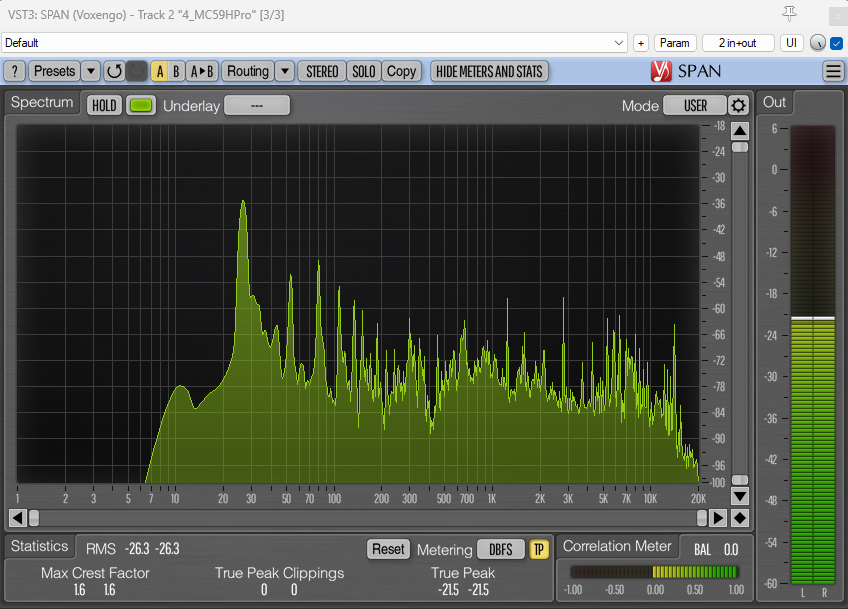
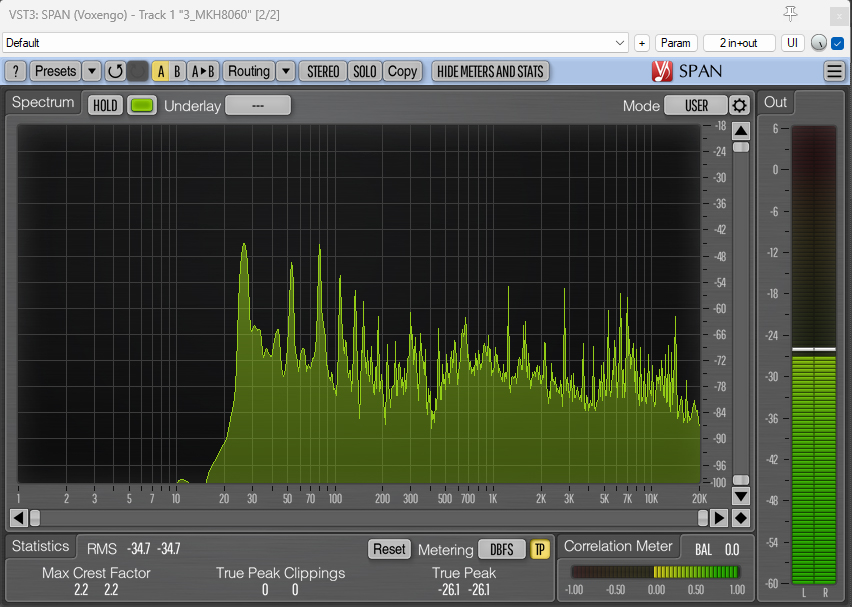
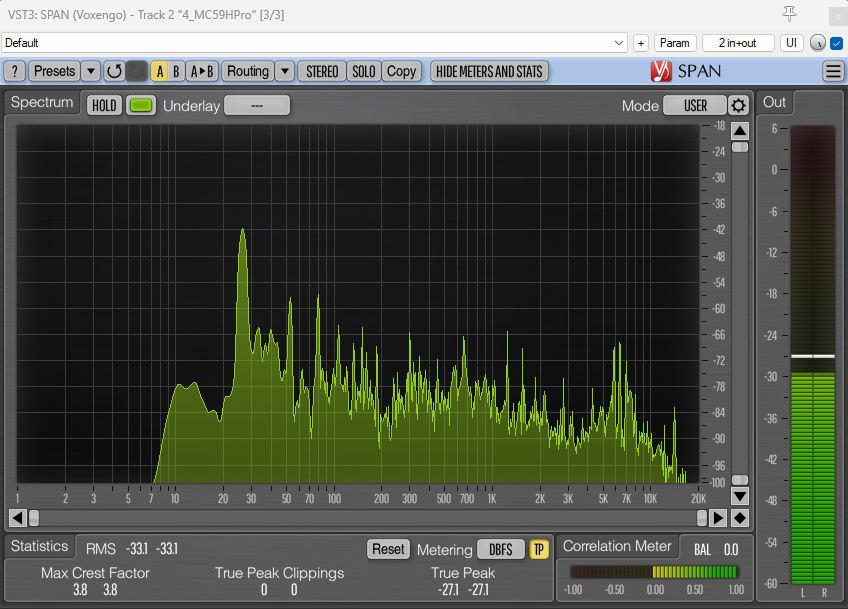
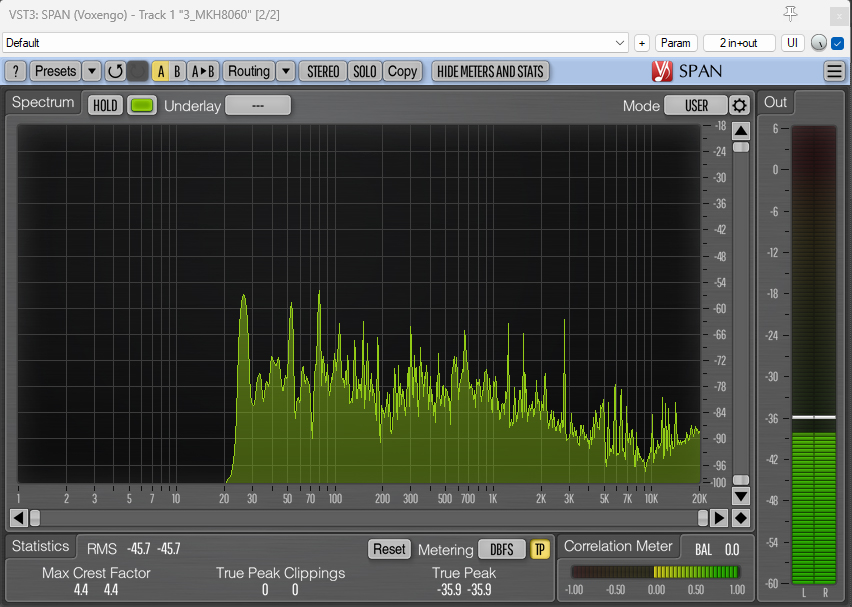
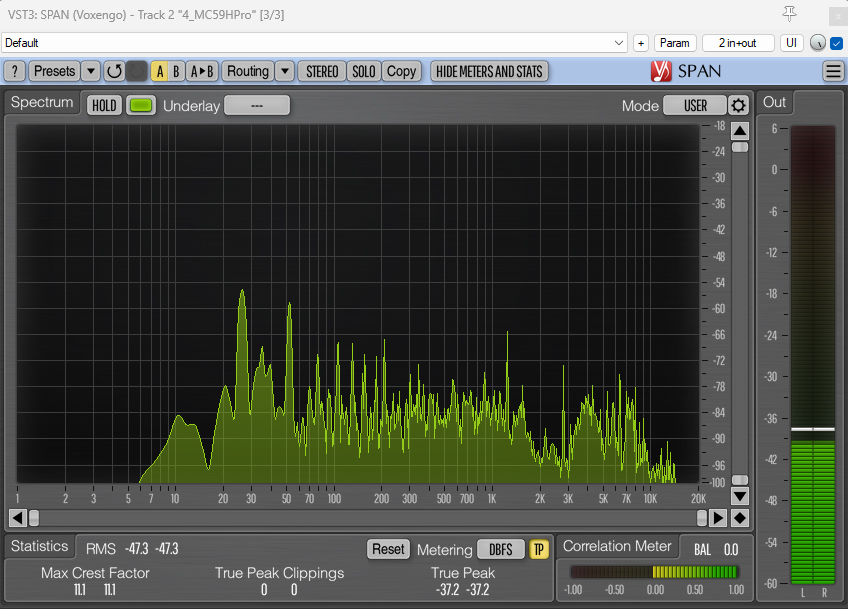
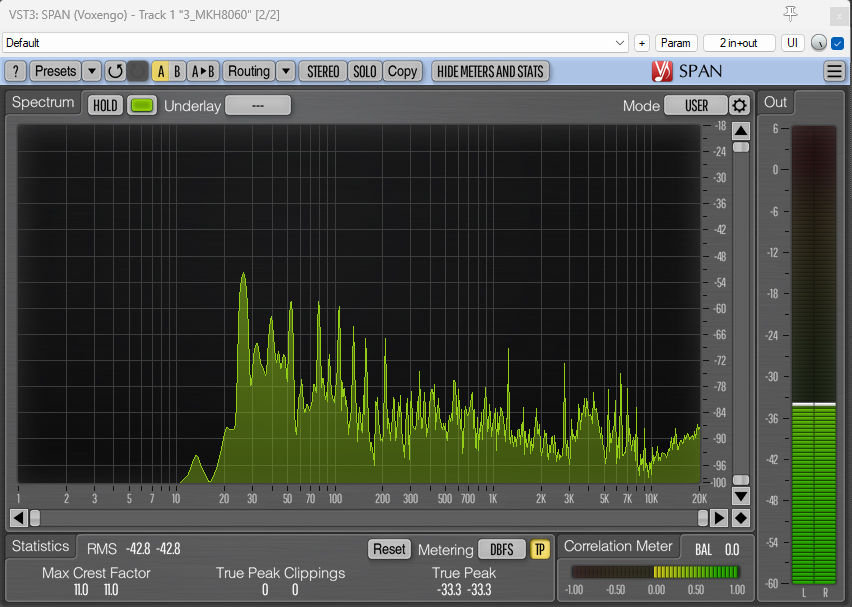
In the two recordings you can hear and (from the spectrum analyzer visualizations) see that the fundamental at 26Hz is much more pronounced with the MC59/H Pro than with MKH 8060, by around 10dB, reflecting the reduced bass roll-off in the Nevaton mic. At ninety degrees, even this low frequency is attenuated in both mics, as you would expect: by around 11dB in the case of the MKH 8060 and by around 7dB with the MC59/H Pro. At 180 degrees, however, the two mics are quite different in the case of low frequencies: with the MKH 8060 the 26Hz fundamental is louder than at ninety degrees, and only 6.5dB down compared to the on-axis sound, while the 26Hz fundamental in the MC59/H Pro recording is down 21.5dB compared to the on-axis recording. There’s nothing very unusual about the MKH 8060 in this regard: it is a shotgun mic with a good low-frequency response on axis and with low frequencies also quite evident in the rear lobe, which is an inevitable feature of most conventional shotgun mic designs. The MC59/H Pro has a stronger bass response on axis, but also, and much more unusually, its double-membrane acoustic transducer means that it doesn’t have a back lobe at low frequencies, and the effect is both noticeable and dramatic. Of course, this may or may not be useful for any given recordist or situation. In many uses of a shotgun mic, especially if mounted on a boom pole, then a high-pass filter is almost certain to be required anyway, obscuring much of the effect of the different design. In that case, if rear rejection is wanted, a mic such as the Sanken CSR-2 might be more useful (its rear rejection isn’t for very low bass, but rather above this in the 80Hz to 1kHz range) or the Schoeps SuperCMIT (though Schoeps caution that much care is needed using the latter’s preset 2, which gives maximum reduction of the rear lobe). However, there are many situations where a shotgun mic might be mounted statically and where on-axis bass response is wanted (e.g. music recording, or a sound effect recording where the low-frequency content is significant), but where the absence of low frequencies (e.g. traffic rumble, the sound of distant aircraft or even, and this is especially relevant to indoor recording, reflections of the source sound) in the rear lobe will be a significant advantage. Obviously, if choosing a shotgun mic with rear lobe reduction – be it one such as the Sanken CSR-2 or Schoeps SuperCMIT models with active second transducers, or the Nevaton MC59/H Pro with its passive second diaphragm – the application and, of course, the sound of the mic need to be considered carefully.
Handling noise
More so than in the case of condenser mics with other polar patterns, a shotgun mic is likely to be handheld, be that in a pistol grip or at the end of a boom pole, so handling noise merits consideration. For this, as with other comparative tests, I mounted the MC59/H Pro alongside an MKH 8060, both on identical shock mounts (Radius Windshields RAD 2s) on a short stereo bar fixed at the end of a boom pole.
Here are the sound files, in which I describe how I am using (or, rather, abusing!) the boompole:
And here are the spectrum analyzer visualizations:
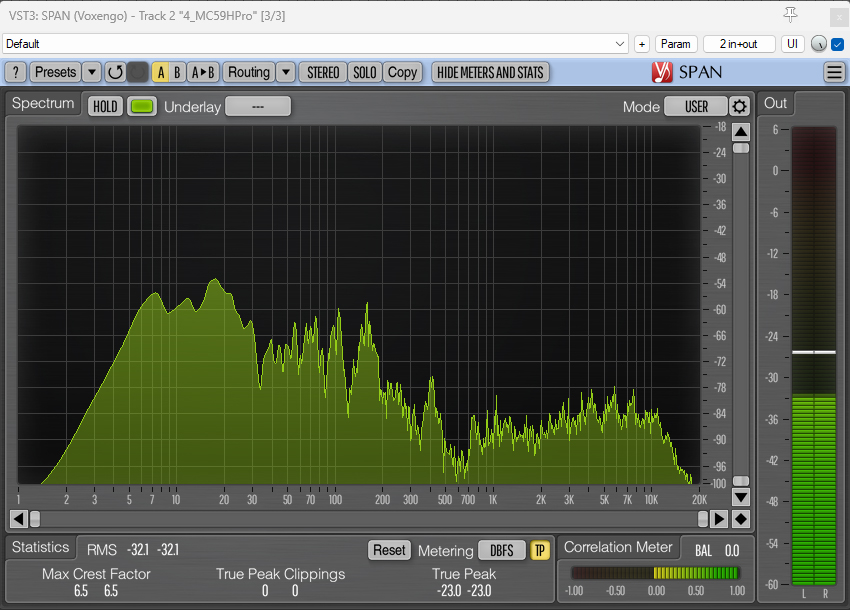
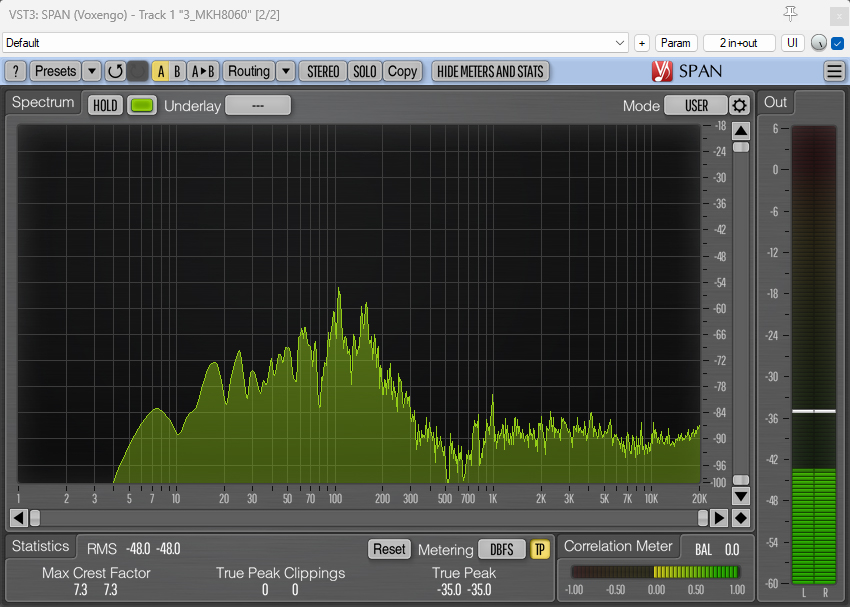
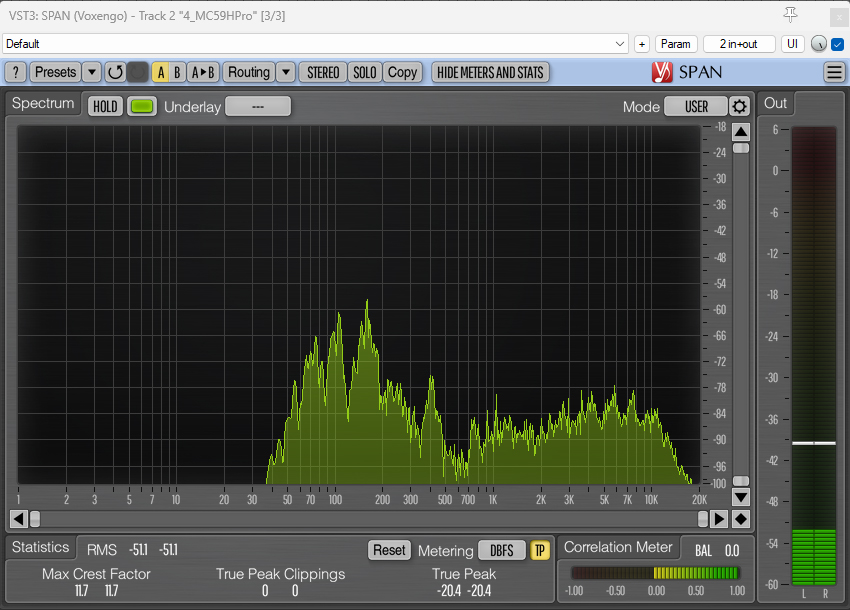
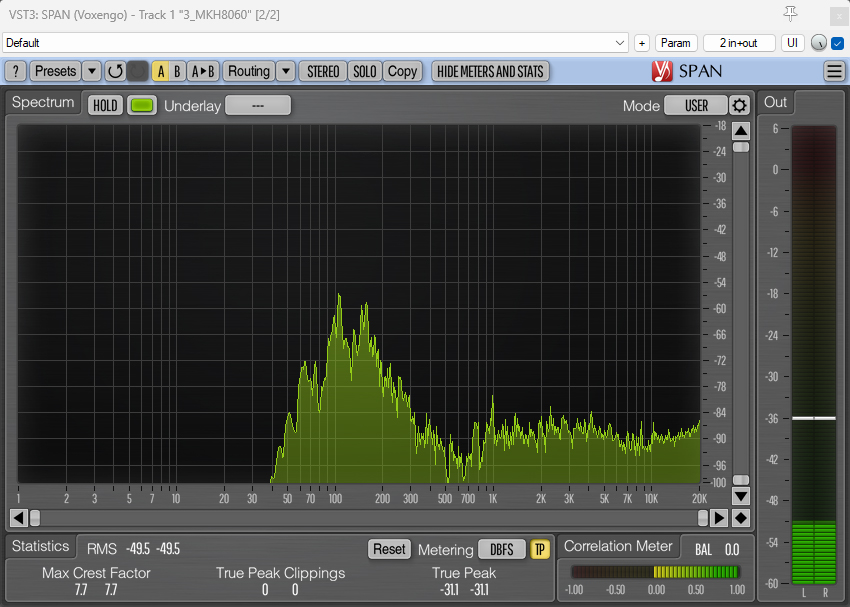
With no high-pass filter applied, the MC59/H Pro has a much greater susceptibility to handling noise, especially below around 60Hz, than the MKH 8060. In part, this doubtless reflects its increased bass response. But, of course, handheld or boom pole mounted shotgun mics invariably require use of a high-pass filter to reduce both handling and wind noise, and applying a typical 80Hz (24dB per octave) high-pass filter to both mics levels things up considerably. In short, I wouldn’t be concerned about booming the MC59/H Pro.
Here are the sound files with the 80Hz HPF applied:
And here are the spectrum analyzer visualizations with the 80Hz HPF applied:
Voice/dialogue
Moving to voice, again I compared the MC59/H Pro to the MKH 8060. First, here is a test with the two mics mounted with back-to-back clips in a single Mega-Blimp, which was statically mounted outside:
And here is a test that combines indoor recording, with the mics mounted together (with back-to-back clips) on a boom pole: in this case the speaker/talent is moving forward the whole time and the boom is never stationary. Sorry about the less than ideal boom swinging: I could blame my current tendonitis, but I think that is just me searching for an excuse! Anyway, the indoor space selected was chosen to be a worst case scenario, being a small reverberant room (4.4m x 4.6m) with a low ceiling (2.14m) with a wooden floor and no soft furnishings, to expose any comb filtering arising from the interference tubes of the two mics.
These short snippets are doubtless a poor demonstration of the efficacy of the two mics – and their differences – when used for dialogue (and my booming for the second pair of recordings does leave a lot to be desired), but I am conscious that production sound recordists really do need to spend time themselves with a shotgun mic to see if the nuances of one versus another suits their purposes or taste better. At a crude level, however, my experience from use of the two mics is that I would be very happy with either for dialogue recording, and I must confess I expected much worse of the two mics in that difficult reverberant interior.
Effects/location recording
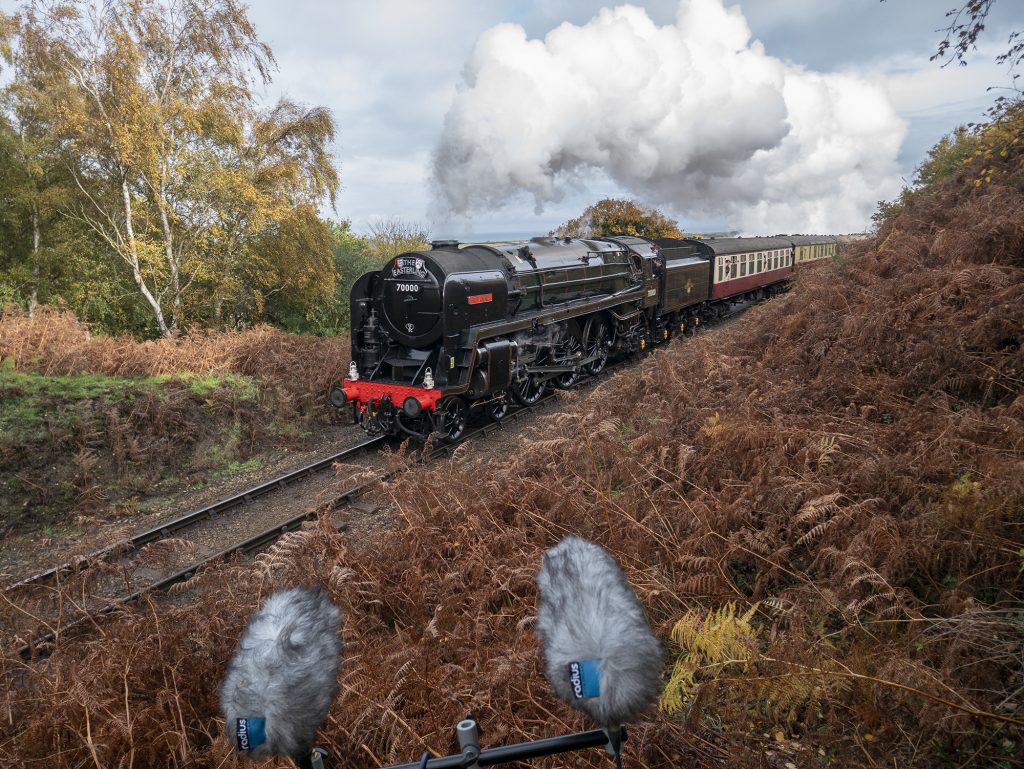
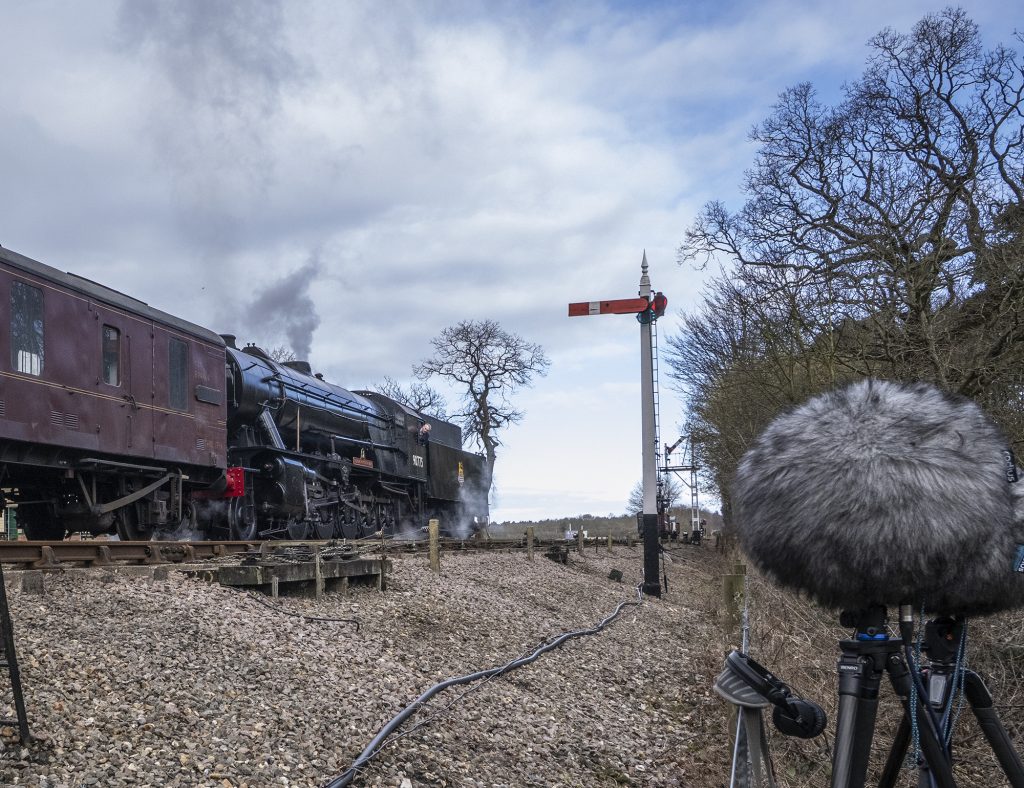
As so often featured in these blog posts (too often now perhaps?!), I went down to the local steam railway again for a recording test. It might be getting a bit repetitious, but, nonetheless, as a sound source it seems to have a good bit of variety in terms of frequency (from steam hissing, to low-frequency rumbling and engine noises, the latter especially evident in this case with the diesel locomotive pushing the train too), as well as movement. And, as ever, the larger furry windshields gave the chaps in the signal box a good laugh: it’s always good to brighten someone’s day! Anyway, here we go with the two recordings:
A bit of music: something bluesy down in the woodshed…
Well, with apologies to Stella Gibbons for the subheading, but not really a woodshed: rather, the nice and spacious workshop of woodcarver Luke Chapman, who will be familiar by now to readers of this blog for his long-suffering of my mic tests, putting down his chisels and chainsaws to pick up a guitar. In this case he provided a bit of impromptu blues slide guitar playing in front of a test rig comprising the MC59/H Pro, the MC58/8 fig 8 (so you can hear the shotgun mic used in an MS pair), the MC59 Twin (so you can hear how the MC59/H Pro MS pair sounds compared to other MS pairs with different mid mic polar patterns – wide cardioid, cardioid and supercardioid), and the Sennheiser MKH 8018, which is, of course, a stereo (MS) shotgun mic. All plugged into a Sound Devices 788T. Here is a video, where the mic set ups keep switching (with the current mic set up clearly shown on the screen):
And here are the individual tracks in full, which you can download and scrutinize should you so wish. First off, here are the MC59/H Pro and MKH 8018 mono shotgun recordings:
And here are the stereo recordings using the the two shotguns – the MC59/H Pro paired with the MC59/8 fig 8, and the MKH 8018 used in its stereo MS mode:
And, finally, here are the comparative MS recordings used in the video above, made using the MC59 Twin to create wide cardioid, cardioid and supercardioid mid mics, combined with the MC59/8 fig 8:
Conclusions
As ever, it is largely for readers to draw their own conclusions from the tests above, insofar as the recordings and comparisons allow. As with any mics, especially when you are talking higher-end mics suited to professional use, choosing a particular mic often comes down to taste and, of course, usage. With regard to the latter, I would undoubtedly be keener to take an RF mic (such as the MKH 8060) if heading off to the extreme humidity of the tropics for some recording than a true condenser mic (even if with some heating of the capsules from the preamps as in the Nevaton mics), and, conversely, would prefer to use an MC59/H Pro either where self-noise was a critical matter (e.g. for very quiet effects recording) or where the low-frequency rejection of the rear lobe was useful. As I said, the latter has applications for music recording and, in this context, it is interesting to learn that Nevaton’s existing standard MC59/H capsule is often used for classical music recordings: I suspect the new capsule will appeal all the more to such users.
As a final note, of course, I must return to the fact that the MC59/H Pro is a pre-production or prototype model. This might suggest that this blog-post has no relevance to other sound recordists, but, evidently (by the fact I have written it!), I don’t think this is the case: on the one hand the MC59/H Pro has much in common with its currently available sibling (the MC59/H), and, on the other, it flags up what Nevaton are developing in terms of their shotguns (and doubtless they might be persuaded to accelerate development of this model if there is interest) and, also, (as with my other pre-production model tests, such as that for the Sennheiser MKH 8030) there is value in having independent tests and reviews available for when a microphone becomes available. When that day comes, I do hope that I can manage to get hold of an MC59/H Pro again, and just not as a loan: it is certainly an impressive mic and I can see applications where it might be uniquely useful. So, crossing fingers here that it won’t be too long!