Browsing Tag

double mid side

Audio Gear

The Sennheiser MKH 800 Twin meets the MKH 8030 in the great outdoors

June 9, 2026
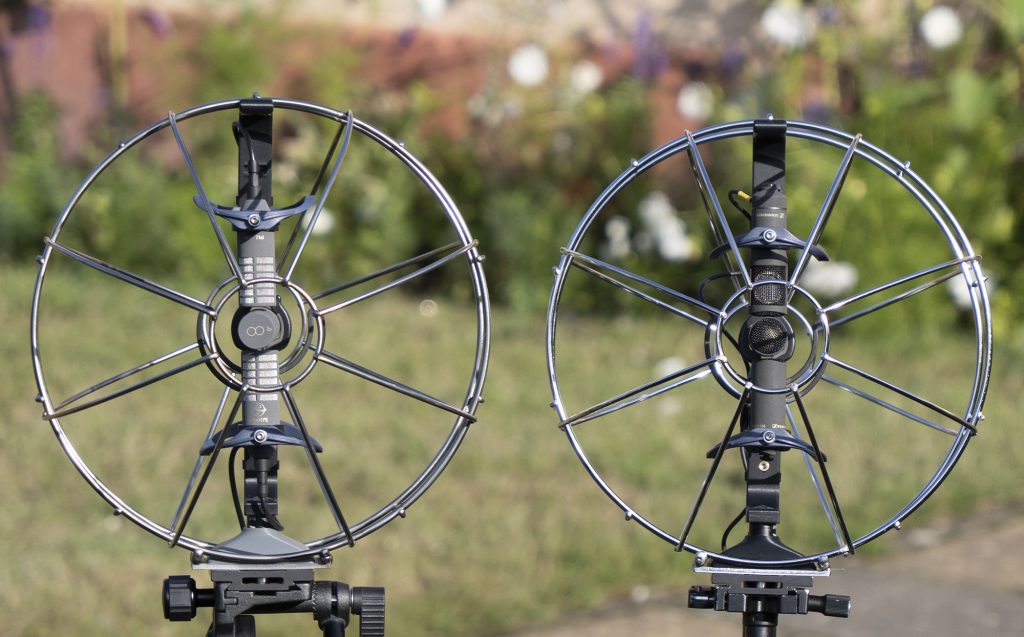
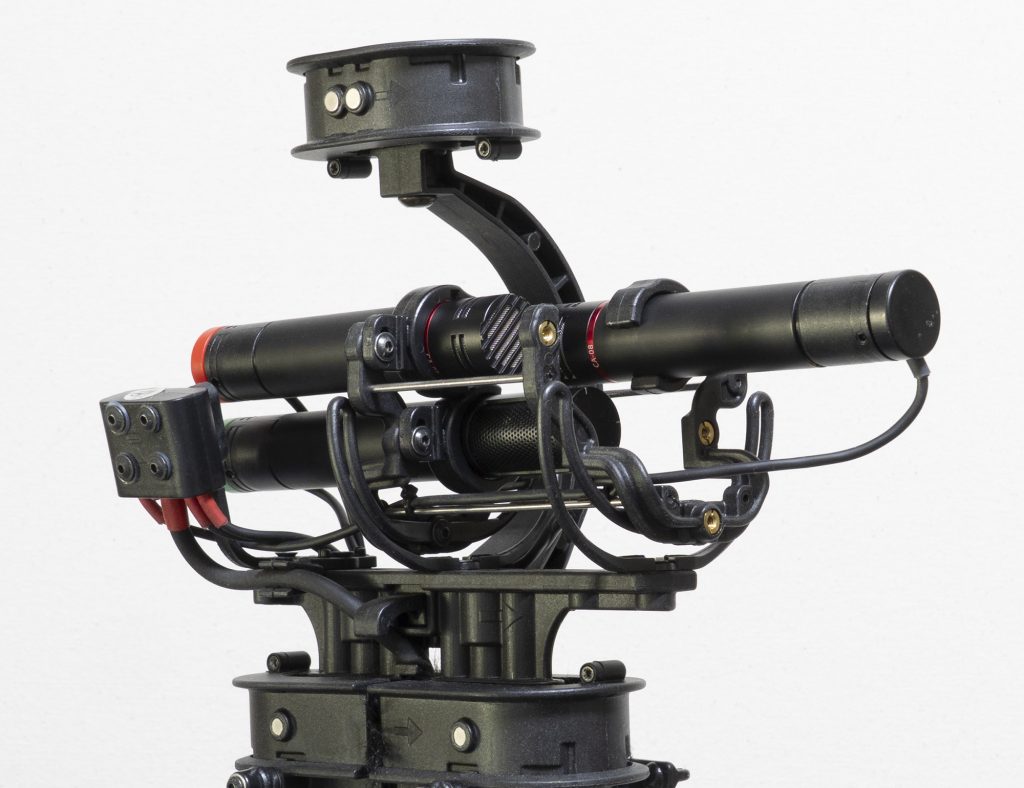
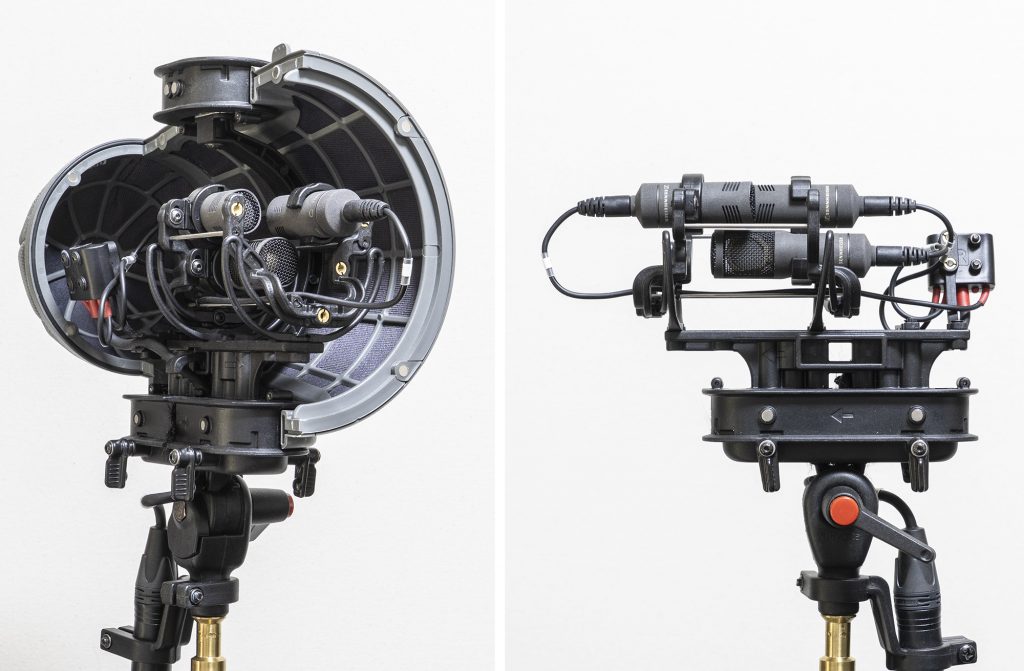
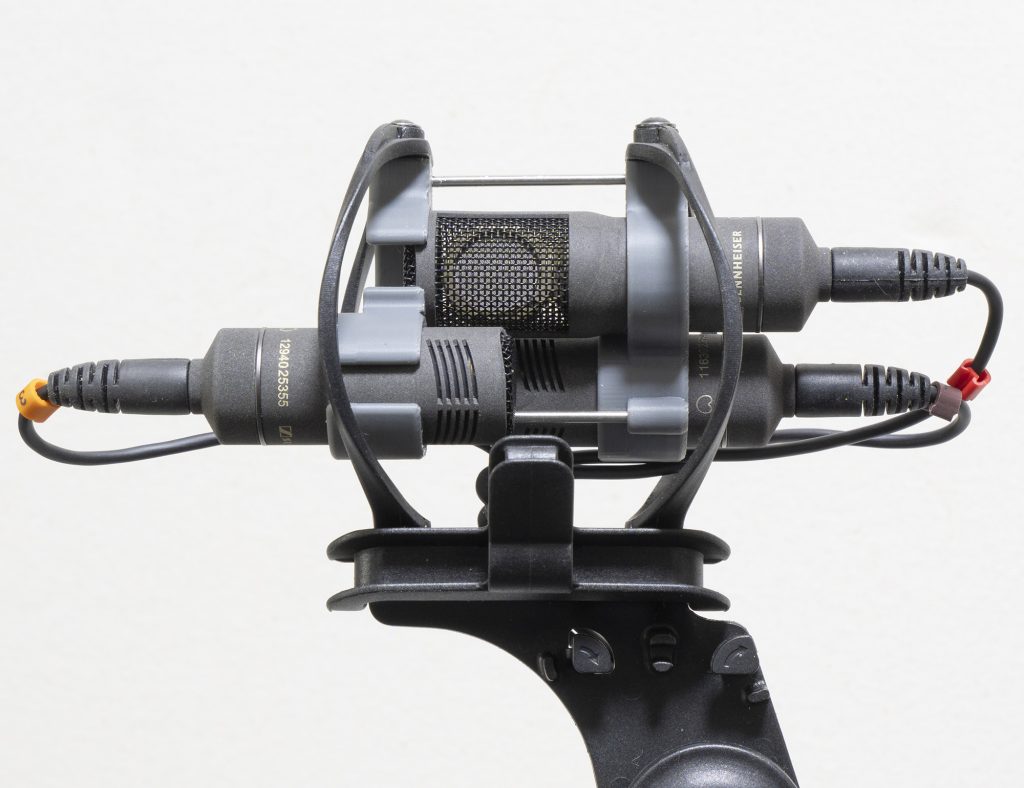
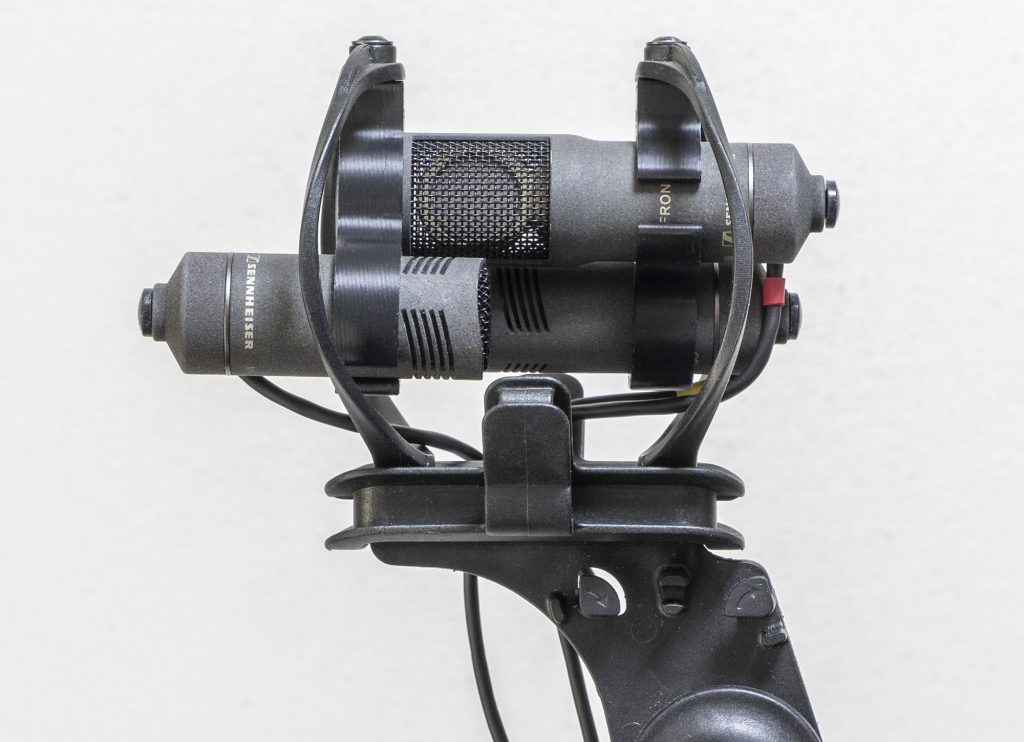
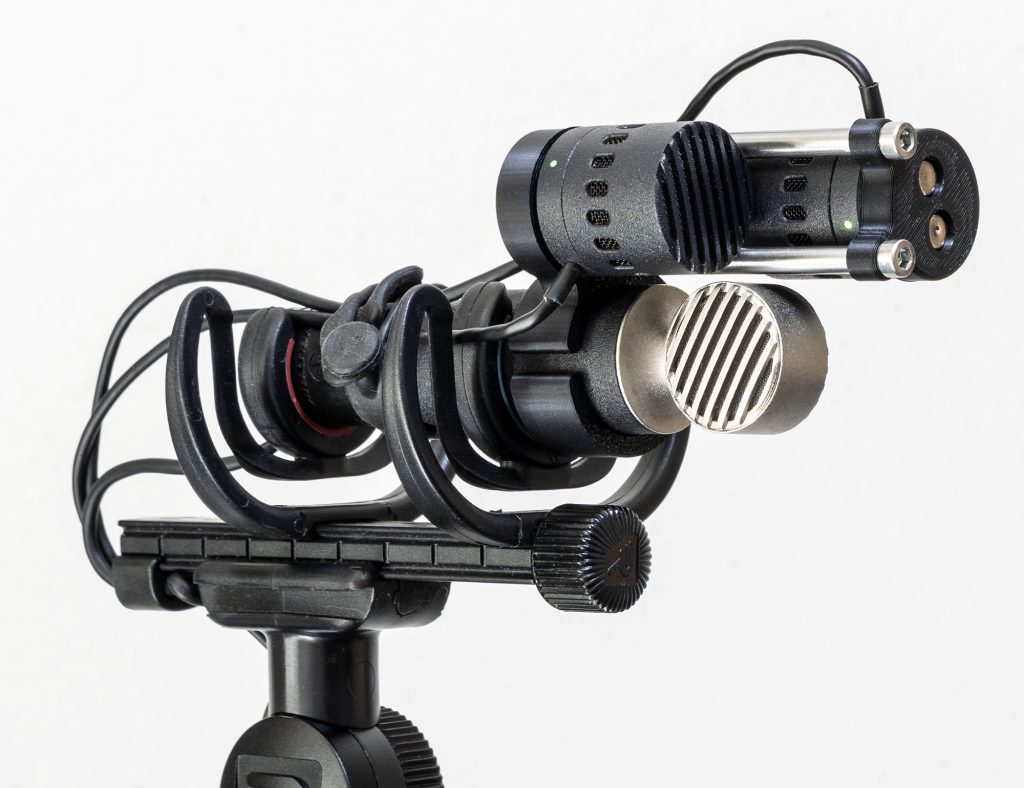
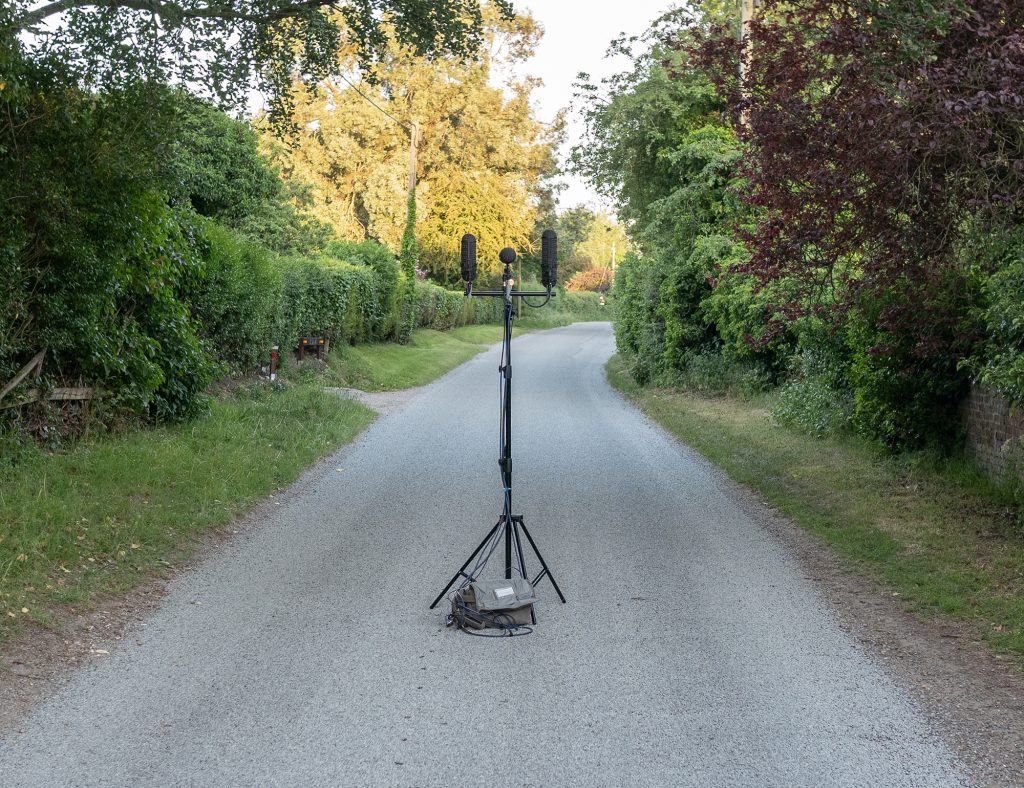
A Sennheiser MKH 800 Twin and MKH 8030 DMS rig (right) in a compact windshield (Mini-ALTO 250), along with a Nevaton DMS rig (left), and a Sennheiser MKH 8090 and MKH 8030 MS pair (centre) in the field…or village street. And, yes, there was no traffic at 5 a.m. on a Saturday morning.

Introduction

The Sennheiser MKH 800 Twin was launched back in 2008, and was based on the MKH 800 of 2000 (itself the successor to the MKH 80 of 1993), so is far from a new microphone. But, during my recent testing of the Nevaton MC59 Twin, I began to wonder more and more why, given the reputation of the Sennheiser MKH mics – with their humidity-resistant RF technology – for outdoor use in all conditions, I had seen no examples of this mic being used for such purposes, whether that be for field recording, sound effects, production sound ambiences or outside broadcast. I’m sure there have been recordists putting the mic to such use, but certainly it is nothing like as popular as the older MKH 30 etc. and the newer MKH 8000 series mics. Above all, I was puzzled why it seems to see such little use for double mid-side (DMS) recording in the field.
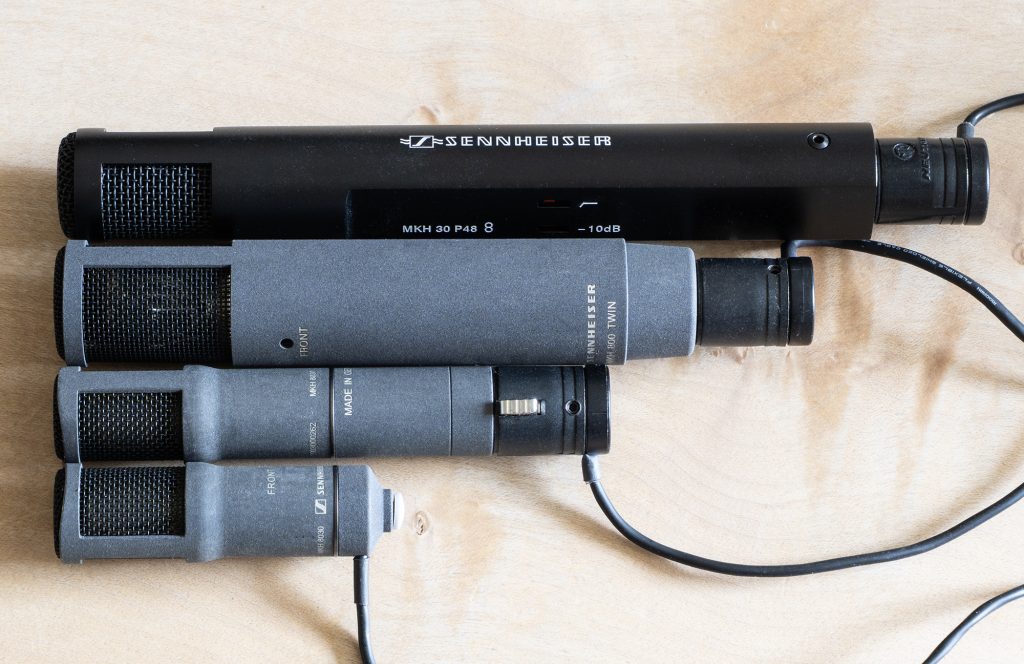
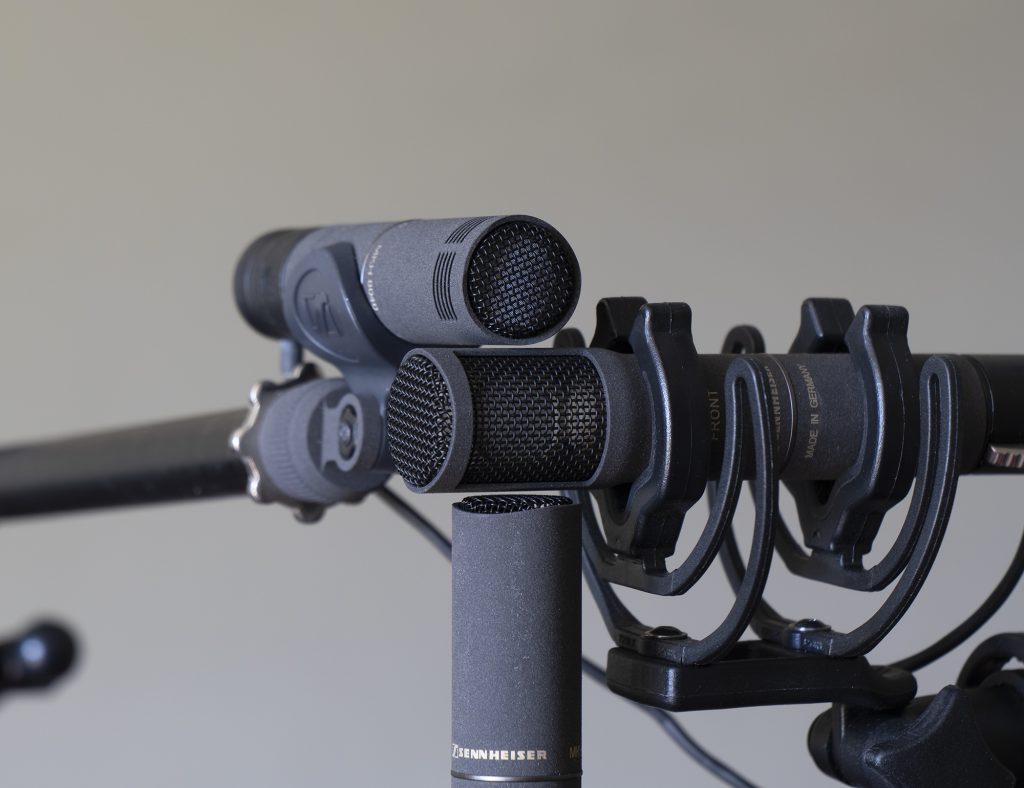
Size comparisons of selected Sennheiser MKH mics with connectors, top to bottom: MKH 30 (fig 8), MKH 800 Twin, MKH 8030 (fig 8) and MKH 8030 with custom side-exit MZL connector.

OK, the MKH 800 Twin is expensive (with a street price in the UK usually above £2,500 inc. VAT), but not (well, at least for some!) frighteningly so: that’s around double the price of a single MKH 30 etc. or an MKH 8000 mic, for what is, arguably, double the mic or more. And it is by no means a small mic: measuring ø27mm x 136mm, and with a weight of 172g, the mic is certainly chunkier and heavier than, say, the MKH 30 fig 8 (ø25 x 174mm, and 110g), but is noticeably shorter. I wonder, therefore, whether it is a combination of weight, size and the rigging options – and with this I am thinking especially of windshields – that has resulted in low use outdoors. For field recording, using a near-coincident or spaced pair of MKH 800 Twins is, perhaps, less desirable than for music recording, although this would be easy to rig with each MKH 800 Twin in a separate windshield, and would be very flexible in post. Rigging a coincident pair of MKH 800 Twins or one MKH 800 Twin and a fig 8 seems more suited to field recording, given its suitability for MS (with the mid mic polar pattern decided in post) or for DMS, yet this might seem challenging to house in a windshield. Even if placing two mics side-by-side (a viable approach: there is often too much concern about the shadowing effects of such a configuration) the overall width and shock-mounting arrangement can be problematic. Certainly there are no off-the-peg options for this. And, equally, going for the preferable end-to-end rigging makes for a long mic pair, again with some trickiness to the mounting inside a windshield. With two MKH 800 Twins or one MKH 800 Twin plus an MKH 30 I can see why such rigs might be daunting, but my recent rigging of the new and diminutive Nevaton MC59 Twin for DMS got me thinking: surely the comparatively small MKH 8030, especially if used with an MZL connector, opens up opportunities for something acceptably compact? The MKH 8030 has been in production since 2024, but, as yet, I haven’t seen it rigged with the MKH 800 Twin in this way, let alone for field use.

So that, in short, is the purpose of this blog-post: to test the MKH 800 Twin + MKH 8030 combination as a practical and supremely flexible field-recording option. Does the new MKH 8030 provide a means to make the MKH 800 Twin a more practical tool for use outdoors? Well, let’s see!

NB I am grateful to the good folks at Sennheiser for sending me an MKH 800 Twin so that I could explore this.

A quick recap: the advantage of a twin

The MKH 800 Twin is closely based on its predecessor, the MKH 800, but while the latter combines its two cardioid capsules internally to allow different polar patterns (just like any multi-pattern LDC mic), the later Twin outputs the two diaphragms separately, allowing any polar pattern to be created in post, from fig 8 to omni, and, of course, two different mics to be created simultaneously: for example, the output can be used to create both a forward-facing cardioid and a rear facing cardioid, or indeed the same with other polar patterns (which need not be the same front and back). Added to this flexibility, a twin mic like the MKH 800 Twin also has a distinctive form, being a side-address mic: this means that if used to generate forward and rear-facing direction mics, as required in DMS, the capsules are both coincident and are not obstructed by the mic bodies (as would be the case when using two end-fire cardioids for the mid mics). As we have seen in my various blog-posts, a twin mic opens up scope for the cleanest (as in least obstructed) DMS, and with near-perfect coincidence of the two mid mics in all planes.

A brief introduction to the MKH 800 Twin

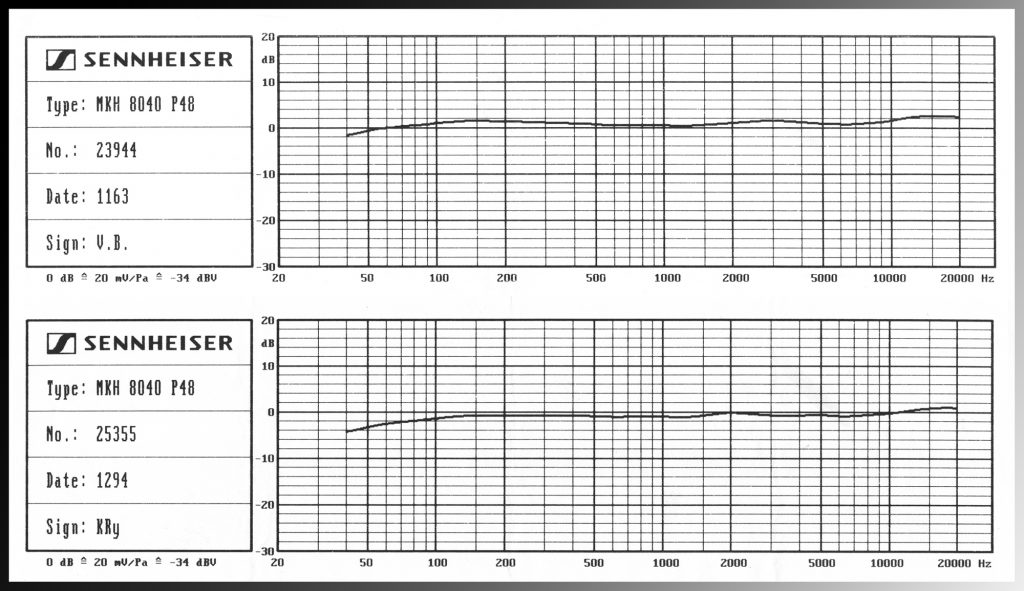
There’s no great value in repeating the specifications of a mic that has been on the market for 18 years, and for which the technical details have long been available on the Sennheiser website. But a few salient points and comparisons are useful. We have covered the physical nature of the mic above, but moving on to the sound of the mics it is perhaps worth considering the frequency response. Below are frequency response graphs for the two cardioid capsules in my MKH 800 Twin, which, as you would expect, are well matched and which, also, are broadly comparable to the cardioid MKH 8040. I include the frequency response graphs for two different MKH 8040s below, which, as unmatched, provide a useful indication of the variation across the model.
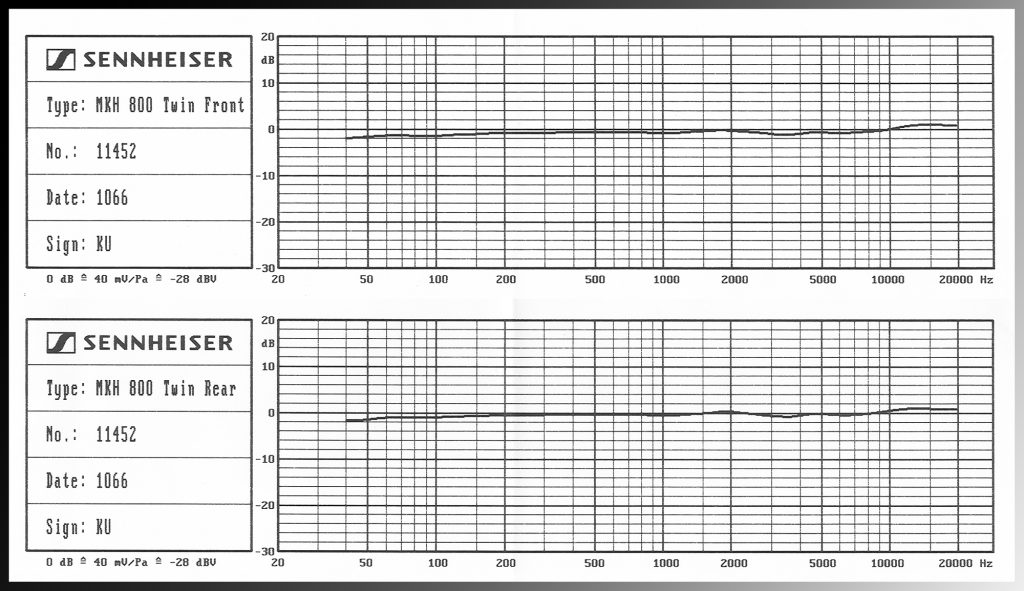
Frequency response graph for the two cardioid capsules in my MKH 800 Twin.
Frequency response graph for my two (unmatched) MKH 8040 cardioids.

Looking at the self-noise profile, the MKH 800 Twin has the same sharply rising self-noise towards 20kHz and continuing to increase above this as found in the MKH 8000 mics. This isn’t at all surprising, since the mic has the same transducer as in the MKH 800, which, when introduced in 2000, was the first Sennheiser MKH mic to have the extended high-frequency range, then seen in the MKH 8000 mics, for which this self-noise at high frequencies is the quid pro quo. Not a problem per se, unless recording very quiet ultrasonic sounds, but a reminder that the mic has more in common with the MKH 8000 range (and, therefore, the MKH 8030) than the older MKH 20, 30, 40 etc. series. And I should hasten to add that the MKH 800 Twin has self-noise in the audible spectrum of 12dBA (as per the specs), which is very respectable and consistent with the other MKH mics.
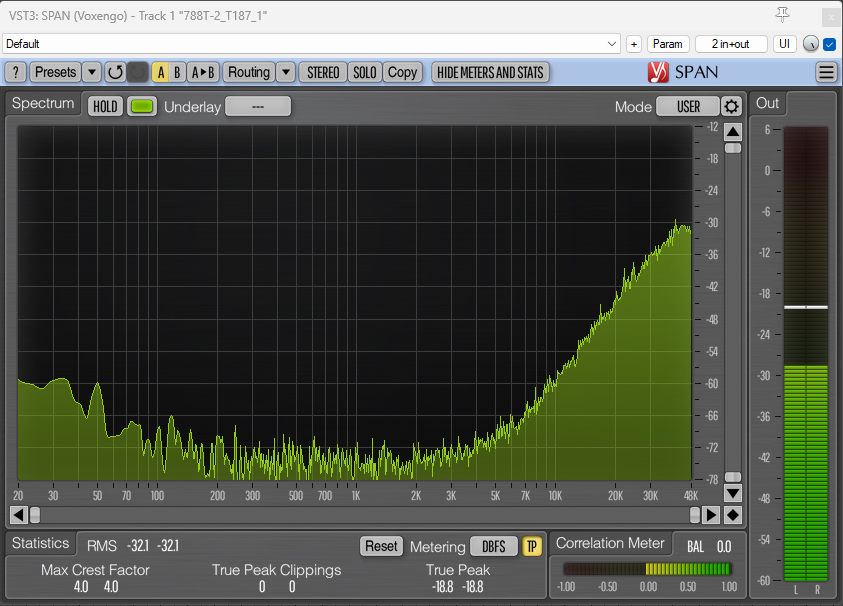
Self-noise of the MKH 800 Twin, showing the high-frequency rise typical of the MKH 8000 series mics, and a consequence of the extended high-frequency range – above 50kHz – of these mics vs the older MKH series.

Comparing polar patterns between the MKH 800 Twin for a single cardioid capsule only vs that of the MKH 8040 shows consistency, as you might expect, although the differences in the approach to the published graphics below make that a little tricky. In short, there are some differences from 4kHz upwards, but they aren’t huge. Sadly, Sennheiser don’t publish the polar patterns for the combined capsules (especially for omni and fig 8), where the differences will inevitably be more marked vs their single diaphragm counterparts in the MKH 8000 or older MKH 20, 30, 40 etc. series.
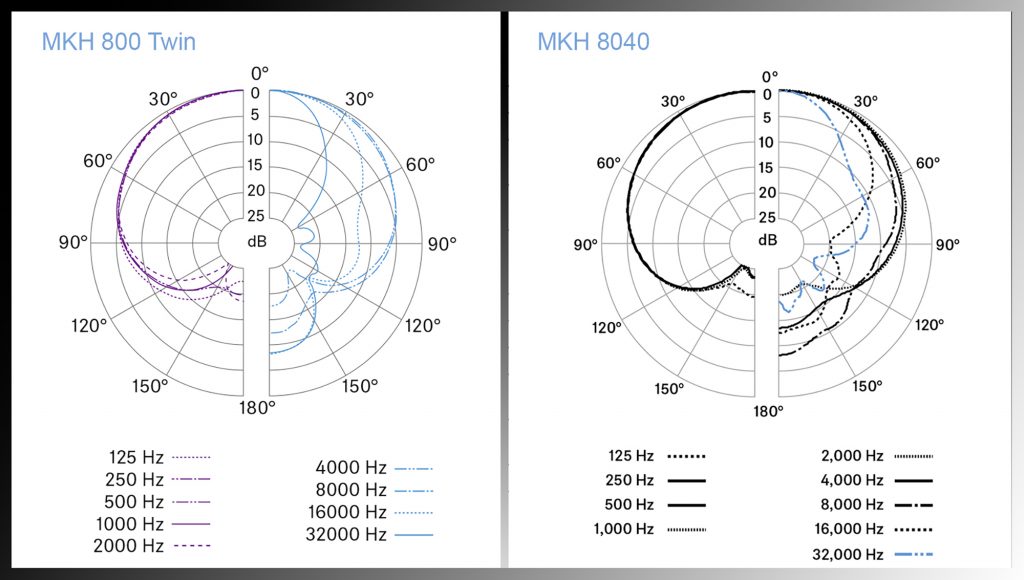
Polar pattern of a single cardioid capsule in the MKH 800 Twin compared to that of the MKH 8040 cardioid mic.

As discussed in previous posts, whereas most SDC omni mics are also imperfect, typically becoming more directional from, say, around 8kHz (I am thinking here of the polar pattern of the MKH 8020 mic), the frequency response on-axis remains consistent, while the omni polar pattern of a dual-diaphragm mic is best at the front and rear (i.e. on-axis to the individual diaphragms), but sees significant high-frequency fall off at 90 degrees. We saw this with the Nevaton MC59 Twin, and I repeated the measurements with the MKH 800 Twin to see how it compared. For this, I placed the MKH 800 Twin on-axis to pinknoise played back via a single nearfield monitor in my studio, then carefully and precisely rotated it so that it was then at 90 degrees, adding the two capsule outputs together in post to compare the on-axis and off-axis omni responses. As expected there is a significant fall off in the high-frequency response of the off-axis omni, in this case from around 14kHz, and corresponding with the progressively greater fall off of such higher frequencies at 90 degrees with any cardioid mic: it is, therefore, an inherent feature of the omni mode in similar dual-diaphragm mics. Aimed on-axis the mic in omni mode will sound fine, but aimed off-access (in effect used as an end-fire mic) it is less likely to be so successful. Again, as discussed in the MC59 Twin blog-post, this last use might seem an unlikely one, but in the past I have come across those advocating the use of the Sennheiser MKH 800 Twin as a single mic solution to omni MS (i.e. using the same capsule for the fig 8 and the mid mic): more experienced voices counter this, of course, noting that the omni mid mic (made of sideways-facing cardioids) will have significant loss of high frequency facing forward. I mention it here as a cautionary note: there is much to love about the flexibility of a twin mic, but best not get carried away (and, if your ears are old, forget that frequencies beyond your hearing might be rather curtailed)!
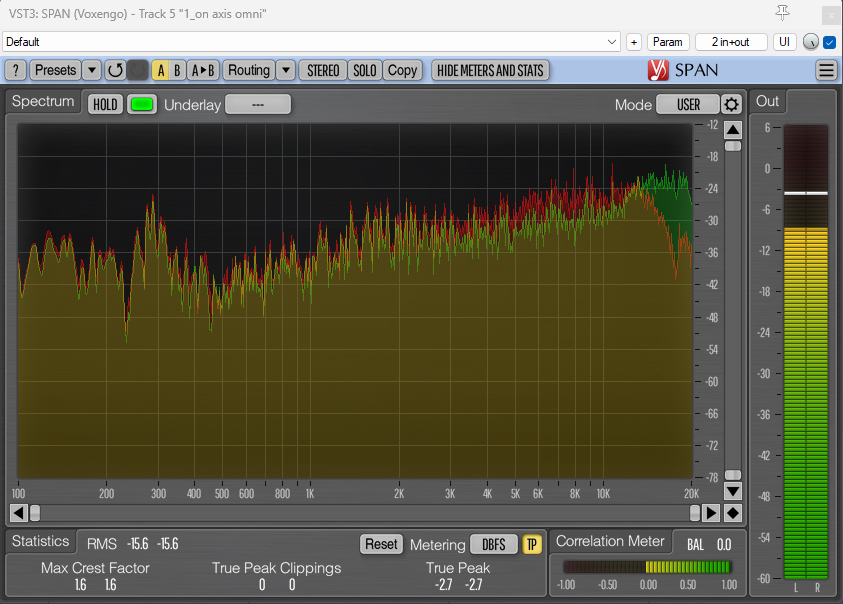
MKH 800 Twin in omni mode off axis (red) overlaid on the mic in omni mode on axis (green).

Rigging the MKH 800 Twin and the MKH 8030 for the field

Mounting an MKH 800 Twin as part of an MS or DMS pair in one of my Mega-Blimps, as shown for the Nevaton DMS rig, gives the most transparent set up in part due to the sparse structure of the TIG-welded basket, but also due to the fact that the upper mic – in this case the fig 8 – can be suspended from the top of the basket, obviating the need for any linking support. These large windshields also, and rather obviously, can easily cope with larger mics: indeed, as readers will know, the origins of the Mega-Blimps lie in the first TIG-welded windshield I designed back in 2017 for a pair of LDC mics. But that is rather besides the point of this blog-post: the aim here is to explore the use of the MKH 800 Twin in a DMS set up that is a viable everyday alternative to other rigs and, for that, this means compact and using more commercially available windshields.
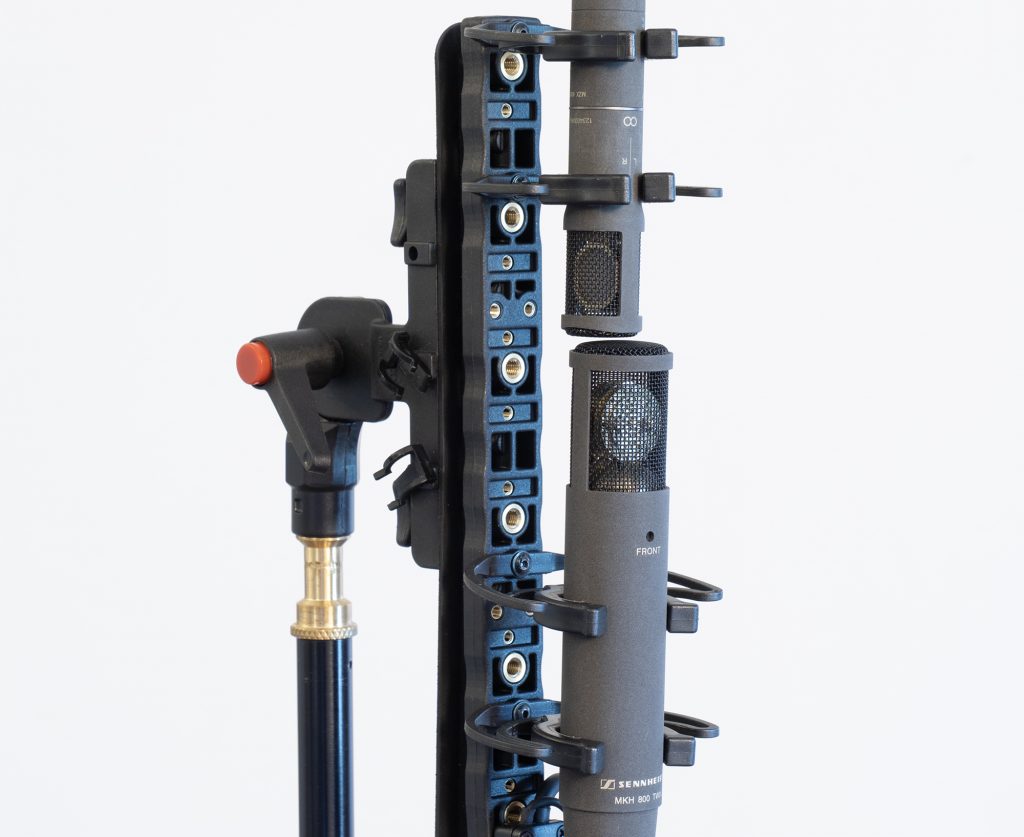
The DMS pair in the mount of a Rycote WS4 modular windshield: easy to mount the mics (even if rather crudely aligned here!), but that chunky plastic mount or rail normally along the bottom of the windshield – out of harms way – is a real impediment to the rear-facing cardioid when used vertically for DMS.

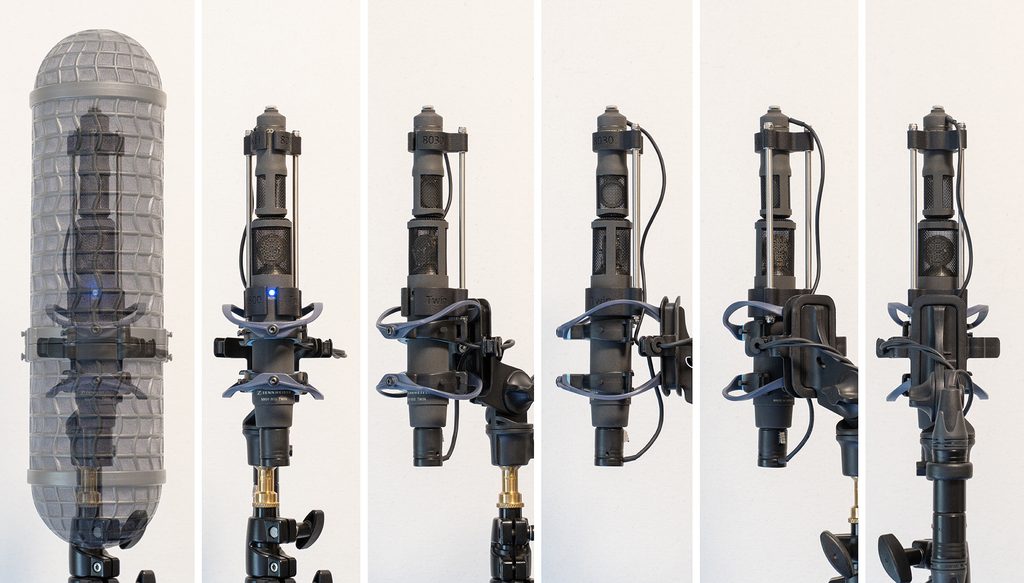
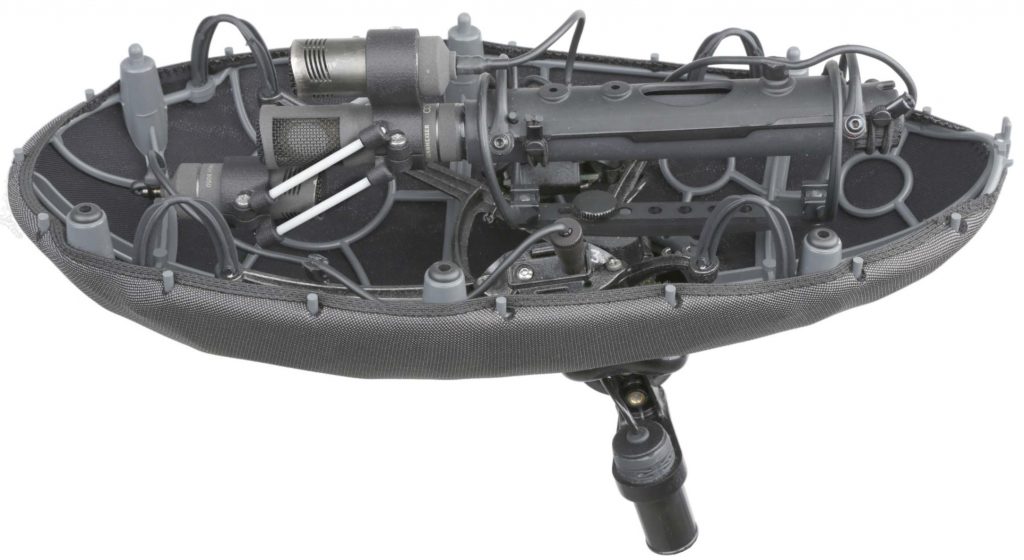
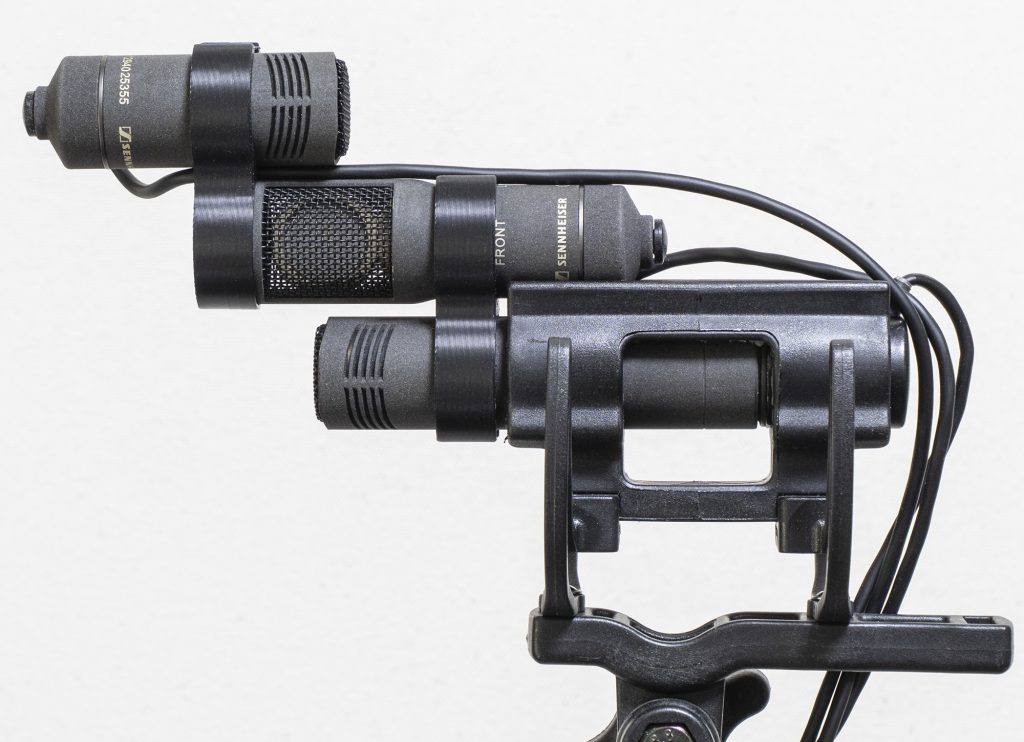
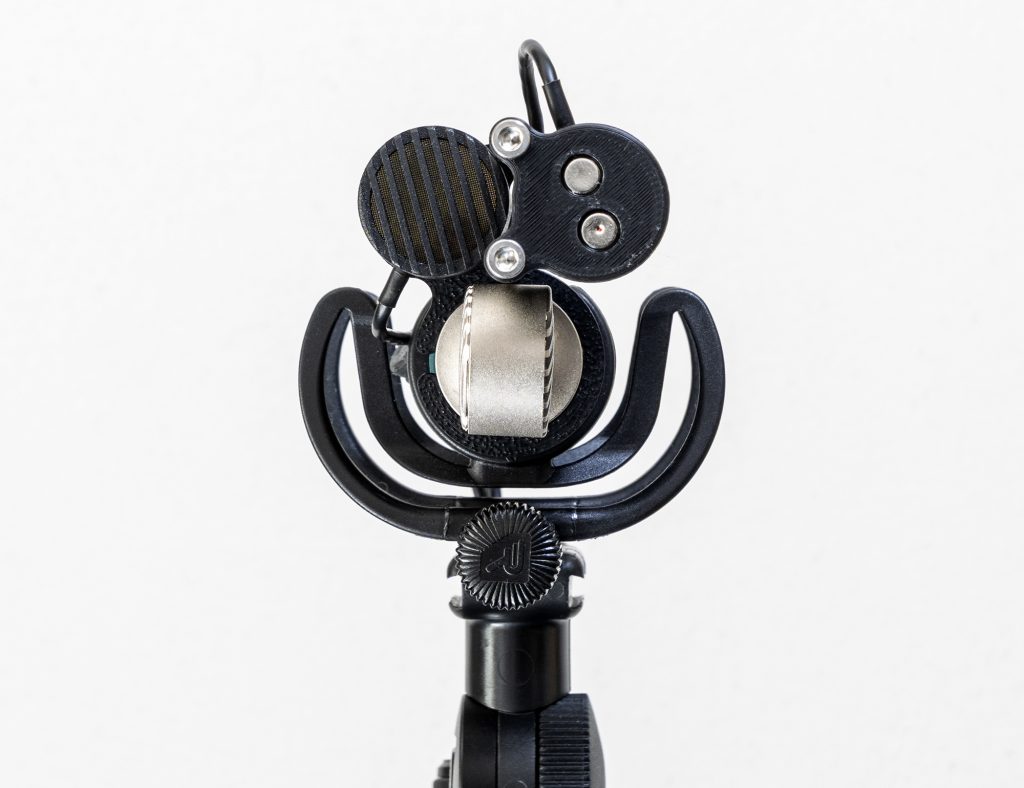
Many a windshield – such as the Rycote modular series, or the Rode Blimp – has a long mount or rail that, when the windshield is rotated vertically (as necessary for end-to-end DMS rigging with a twin mic), offers a significant acoustic obstacle (see photo above). With that in mind, I returned to my compact DMS rig for the Nevaton MC59 Twin + MC59/8 in a Radius Windshields Mini-ALTO, and created a very similar version for the MKH 800 Twin and MKH 8030. To keep things super compact I asked Ed Kelland at ETK Cables to make a custom cable for the rig, with a low-profile XLRF for the twin mic and a custom side-exit MZL for the fig 8, which he has now made available for others. For reference the cable is configured as follows: channels 1 and 3 have a low-profile XLR 5-pin female (with 29cm cable) from the MKH 800 Twin, and channel 2 has a low-profile/custom MZL (with 36cm cable), with both cables ending in a single 7-pin XLR male. It’s handy to have a single cable for the rig with lightweight flexible cable, to reduce cable-borne noise, and it’s great to have the channels in the correct order for DMS. With the customized MZL the MKH 8030 is very dinky and sits neatly above the larger MKH 800 Twin: with a low-profile XLR for the MKH 800 Twin, this gives a 235mm total length for the pair and their connectors. As with the Nevaton version of this vertical rig, two 4mm rods (actually stainless-steel tubes with M3 stainless-steel threaded bar inside) pass by the sides of the fig 8, but offer little acoustic impact. These connect two simple 3d-printed clips for the two very different sized mics.
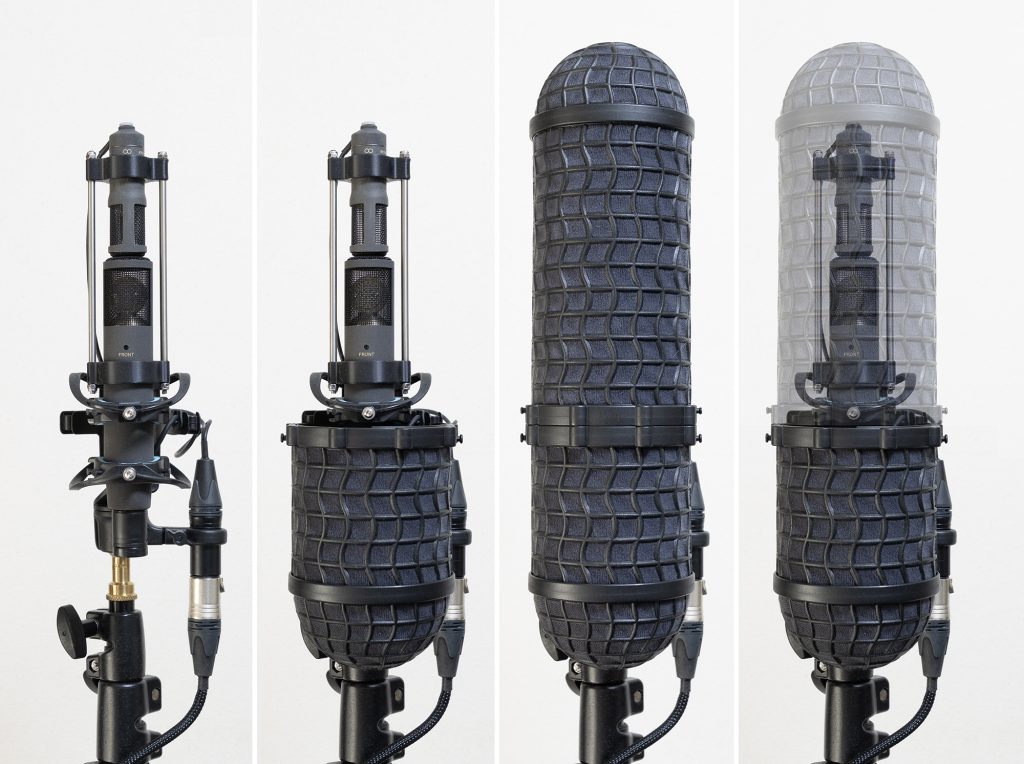
The DMS pair mounted with a DIY clip in a Mini-ALTO 250.

There is one downside to using a Mini-ALTO vertically for such a purpose and this is that the basket has a thicker plastic element running longitudinally, which would normally be along the bottom of the windshield, but which here is placed in front of the rear-facing cardioid. Not as chunky as the long mount in a Rycote modular windshield that we have seen (above), but, it must be admitted, not ideal. Which led me to another similarly compact alternative in the form of the Rycote Nano Shield. I haven’t been using either of my two sizes of this windshield recently since the Mini-ALTO is so much more practical for most usage, but the basket of the Nano Shield has one useful difference for this DMS application: its basket has no rail or seam along what would normally be the bottom and that, when used vertically, becomes the rear.
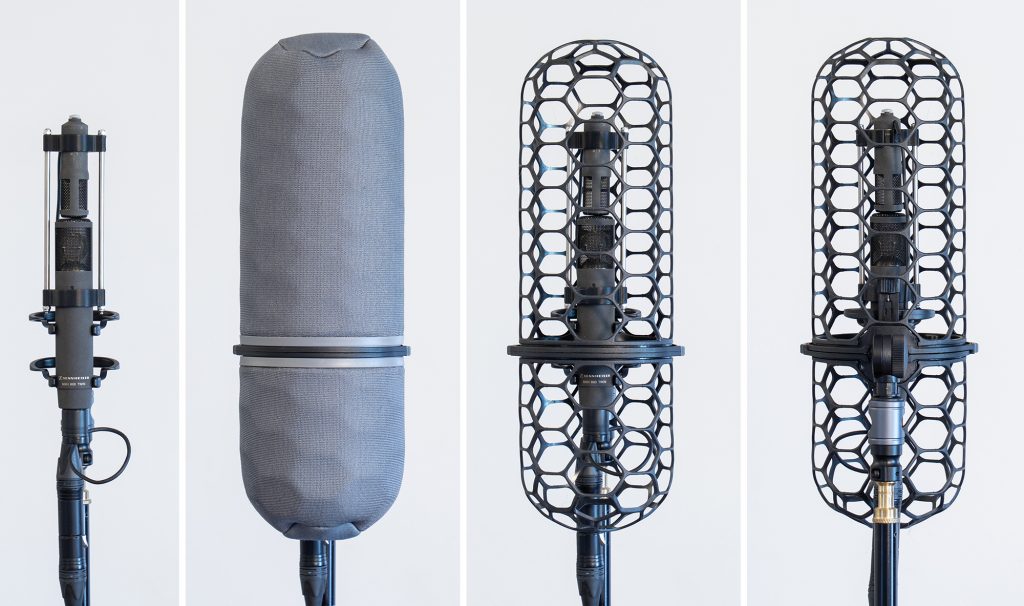
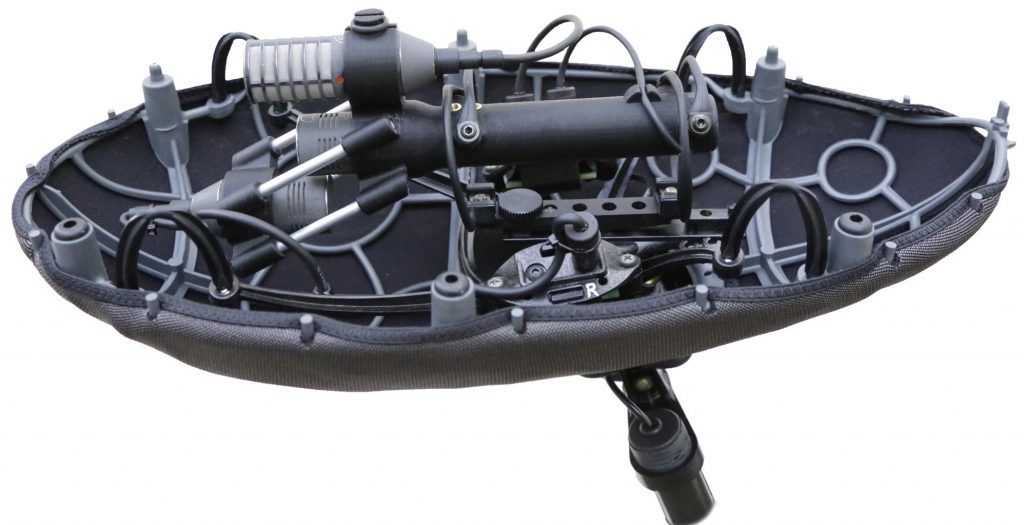
The DMS pair mounted with the same DIY clip as before, but in a Rycote Nano Shield NS4-DB. The two right-hand photos (from front and rear) show the 3D-Tex material removed to expose the seamless basket.

I must admit that the Nano Shield is rather clunkier to use, the lyres are less suited to vertical use than Radius’s hoops (though I have managed to retrofit the latter to a Nano Shield in the past, with a 3d-printed adapter), and routing the two cables is a serious squeeze. Also, I could do with a cable better suited to this mounting option (shorter to the 5-pin XLR and longer to the MZL). But there is no denying it is a more transparent option for this usage than the other compact windshields. Others, I am sure, will – perhaps already have – come up with similar or more effective mounts and windshield options: the Mini-ALTO and Nano Shield examples demonstrate how compact such a rig can be.
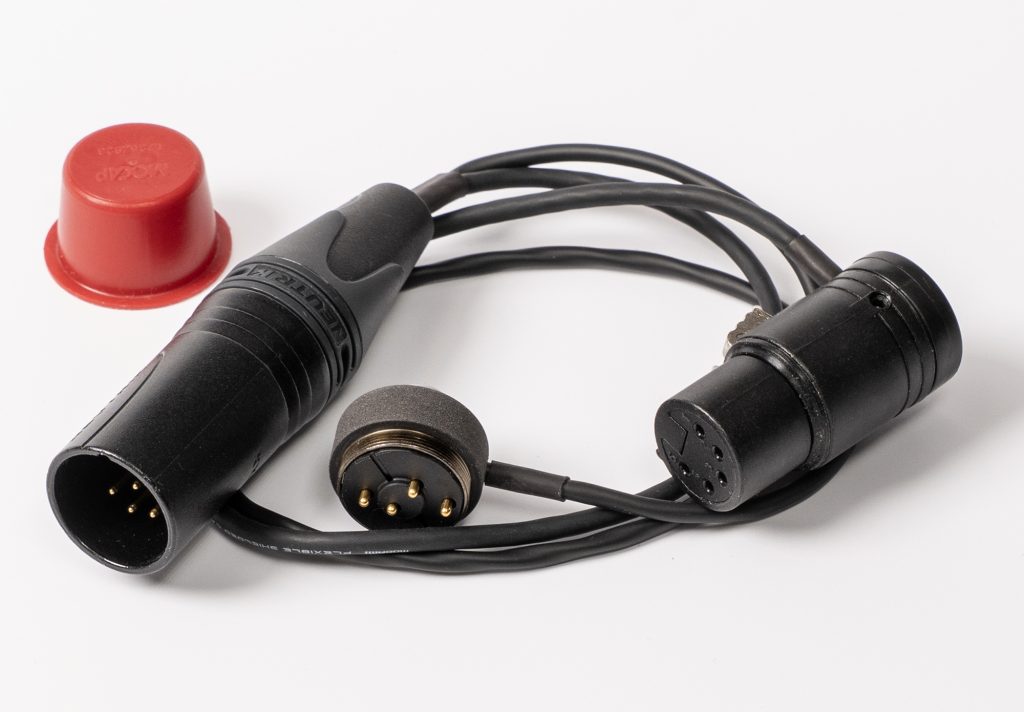
A custom cable (an XLR7M Y-cable to custom MZL and an XLR5F) makes life easier for this rig, courtesy of Ed at ETK Cables: this one was tailored to use of the DMS pair in the Mini-ALTO 250.

Naturally, with a larger twin mic, this DMS rig is not as diminutive as that for the Nevaton equivalent, but requiring a Mini-ALTO 250 only (vs the Mini-ALTO 180) or a Nano Shield NS4-DB, the windshield is still of modest size and quite happily fits in a shoulder bag for a compact rig. For stand or tripod mounted use, in the Mini-ALTO, which is the option I used in the field tests, the black 72D-shore hoops are fine on the shockmount, although for anything handheld you might want to step up to 82D-shore hoops and, in extremis (or, perhaps, in transit), there’s always the foam insert Radius make to stop long shotgun mics hitting the windshield basket. But, to be honest, I fail to see the point of handheld stereo or surround rigs moving around to the detriment of the image and introducing handling noise.
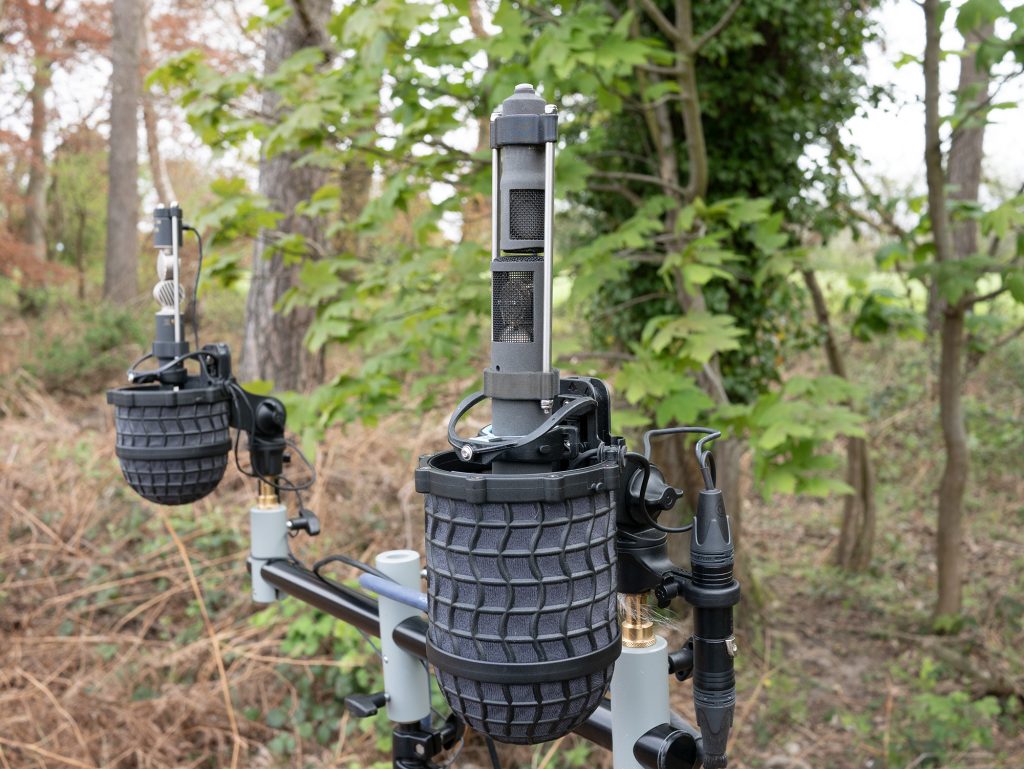
Sennheiser and Nevaton DMS rigs using twin mics, in Mini-ALTOs, with the top pods removed to show the mics.

Field testing

To me, it’s a virtue that the same or similar sound sources feature regularly in my tests, but perhaps that’s just a defense of my laziness! Anyway, here we go again with a passing steam train recording down at the North Norfolk Railway. This time, conscious of the DMS perspective, I set myself a bit further back from the track into a little bit of scraggy lineside woodland: not sure this makes much difference or indeed was necessary, but at least I wasn’t as visible to all and sundry for once! The DMS files have been rendered to XY stereo in Harpex-X,
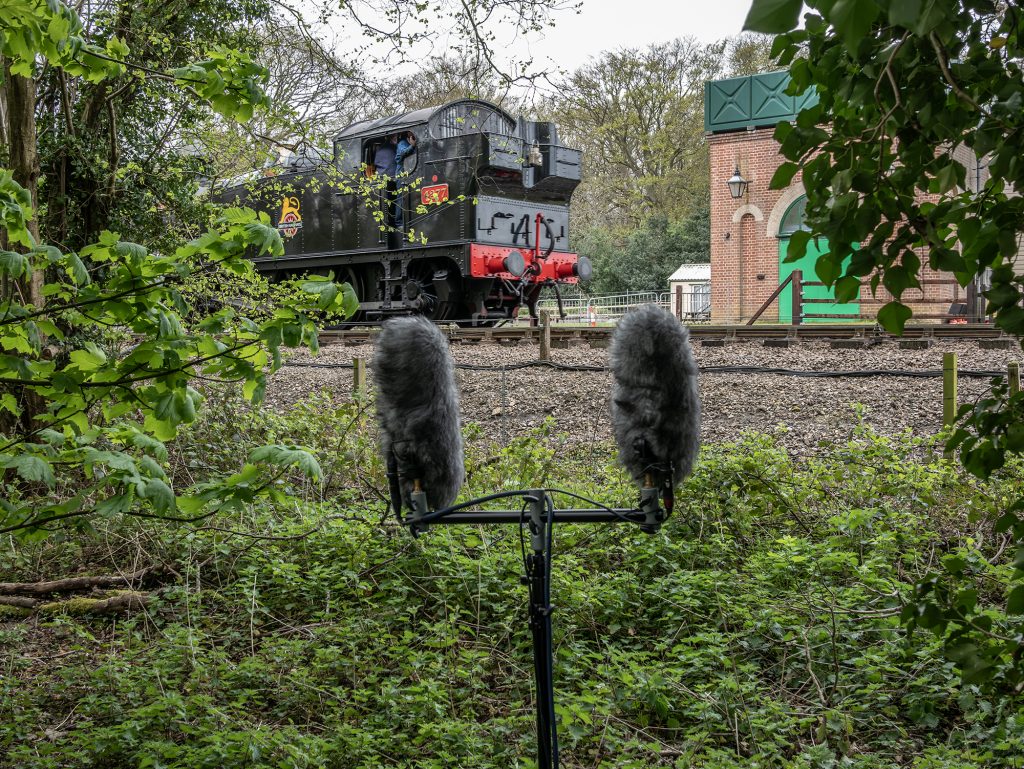
Recording a loco pulling a train backwards out of Holt station on the North Norfolk Railway with the two DMS rigs.

First up here is the Sennheiser MKH 800 Twin + MKH 8030 DMS recording:

Next we have the Nevaton MC59 Twin + MC59/8 DMS recording:
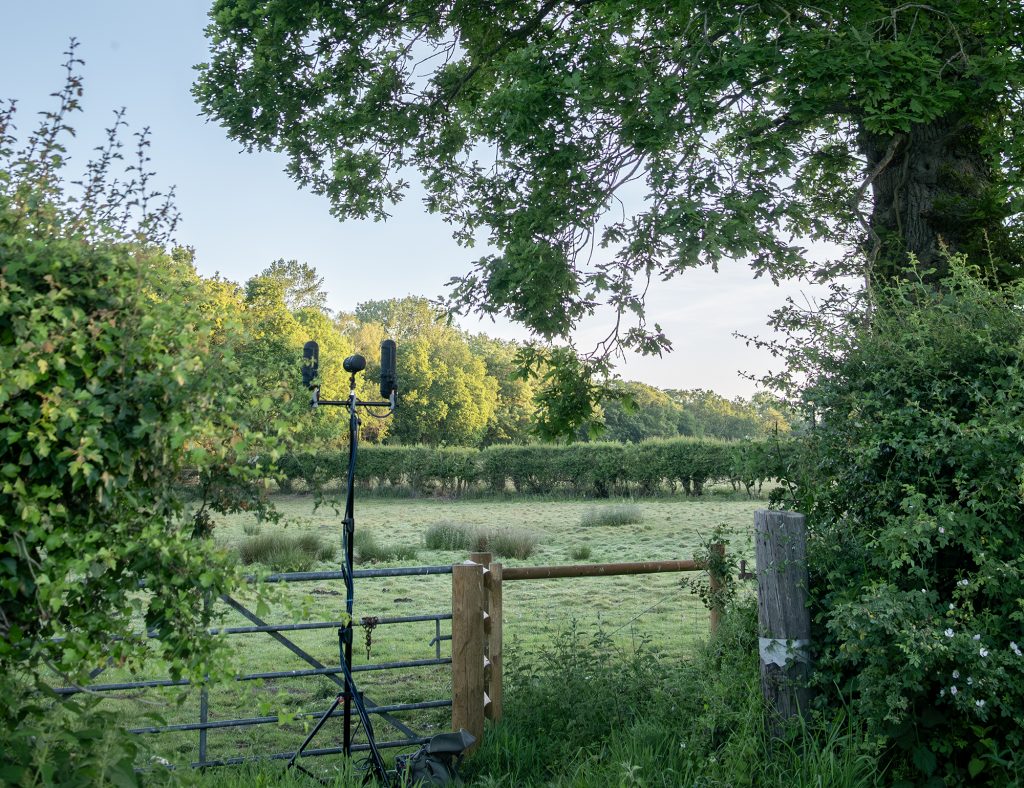
Recording around dawn in rural Norfolk, with the Sennheiser MKH 800 Twin + MKH 8030 (DMS), the Nevaton MC59 Twin + MC59/8 (DMS) and the Sennheiser MKH 8090 + MKH 8030 (MS).

For a more subtle field recording, I got up at 3.45 a.m. (not my forte!) on the 30th of May, which was well before sunrise, did a little recording in the garden in this quiet Norfolk village, then wandered down the road, popping off into fields along my way. For this I took the Sennheiser MKH 800 Twin + MKH 8030 DMS rig, again along with the Nevaton equivalent (MC59 Twin + MC59/8), and, for a bit of fun (and I had two spare channels on the Sound Devices 788T) an MS pair: for this I chose one of my favourites – the Sennheiser MKH 8090 (wide cardioid) + MKH 8030 combination. It was a near windless morning, so I left the furs for the Mini-ALTOs at home and even, at a couple of points, recorded with the naked mics to no ill effect. In post I rolled of the lower frequencies with an 80Hz high-pass filter to remove a little bit of very distant and almost constant aeroplane noise. Here are some short clips of the recordings. For the two DMS ones I rendered to Blumlein stereo in Harpex-X, as this sounded nicest, although, needless to say, the rear lobes become reversed. Of course, the MS render to LR stereo with the wide-cardioid mid mic sounds rather different, but that is rather the point: it is instructive to compare the DMS setups to an alternative approach that one could well take – indeed, I would be very likely to – to a stereo end product. The three files each are a combination of five brief clips, separated by very short silences, and comprise:

i) in the village garden 15 minutes before sunrise (4:21 a.m.);

ii) in a field with the distant sound of a bird scarer firing twice, and a pheasant breaking cover nearby (4:46 a.m.);

iii) by a stream (actually, the exit of the stream from where it goes under a lane in a round pipe) (4:56 a.m.);

iv) the same as above, but with the windshields removed (5:02 a.m.);

v) in the middle of the traffic-free village street, with someone running past (OK, I will confess, it was me, but I was inspired by an early-morning runner who came past moments before, but, needless to say, chatted about what I was up to, so a rather literal re-run seemed better!) (5:28 a.m.).

First up, here is the Sennheiser MKH 800 Twin + MKH 8030 DMS recording:

Next we have the Nevaton MC59 Twin + MC59/8 DMS recording:

And finally, here is the Sennheiser MKH 8090 + MKH 8030 MS recording:
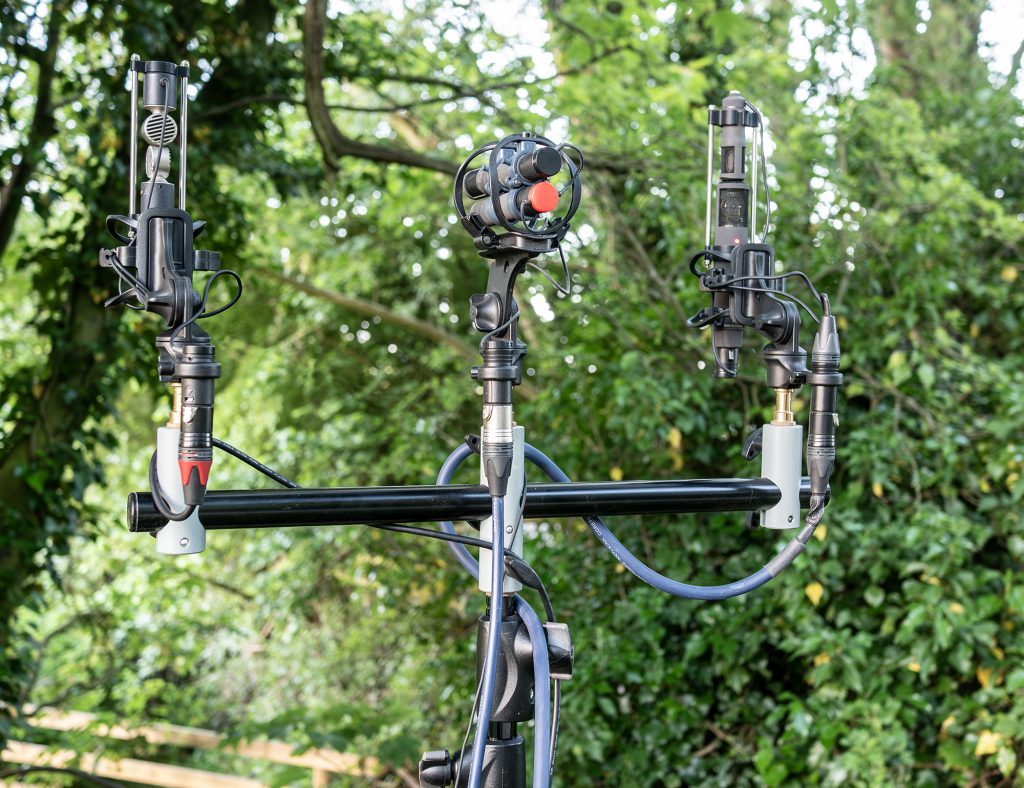
One of those very still mornings where you can chance it removing the windshields….

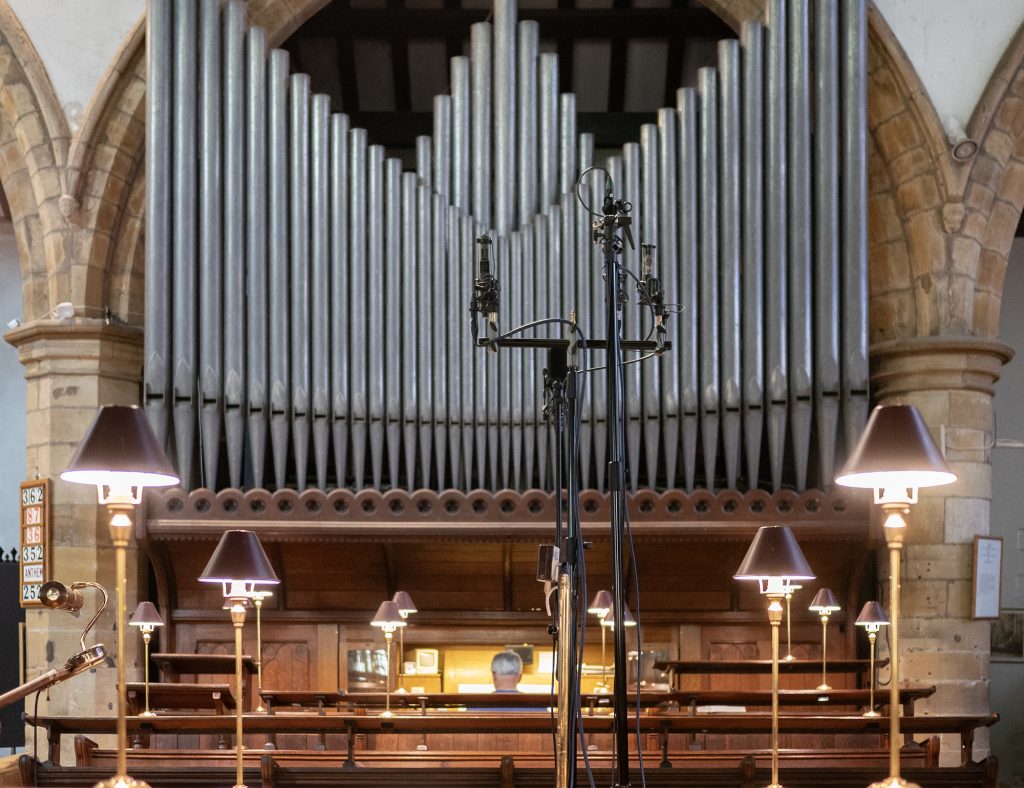
Set up for DMS tests by the Willis organ in St Mary’s Church, Horsham (West Sussex).

A little bit of music

Well, I am conscious that this isn’t a field test sensu stricto with the MKH 800 Twin, but I thought that for some a bit of music would provide an informative test of the MKH 800 Twin and MKH 8030 combination. Added to which, an indoor music test provides some scope for comparing the pair vs others that are not so easy to take outdoors. So, in the midst of the May heatwave here, I popped along to the church of St Mary in Horsham (West Sussex) with my old pal Jake Purches. Instead of recording the organ, as he does for his organ-centric Base2 Music label, he played the organ for me (his love of organ recording has led him to start learning the instrument in his later 50s: a braver person than me, but, aside from the pleasure, without doubt it helps with his recording and editing work) and, also, brought along an additional pair of MKH 800 Twins and a Soundfield ST250 so that we could broaden the comparisons. Rather than bung all the mics up at once – and have a very wide spread of mic positions – I recorded three rigs at a time. The rather nice Willis organ is about to undergo restoration, so, needless to say, the instrument is significantly hissy at present (doubtless the air leaks will disappear during the restoration): so, for those unfamiliar with pipe organs, don’t think it is mic self-noise!
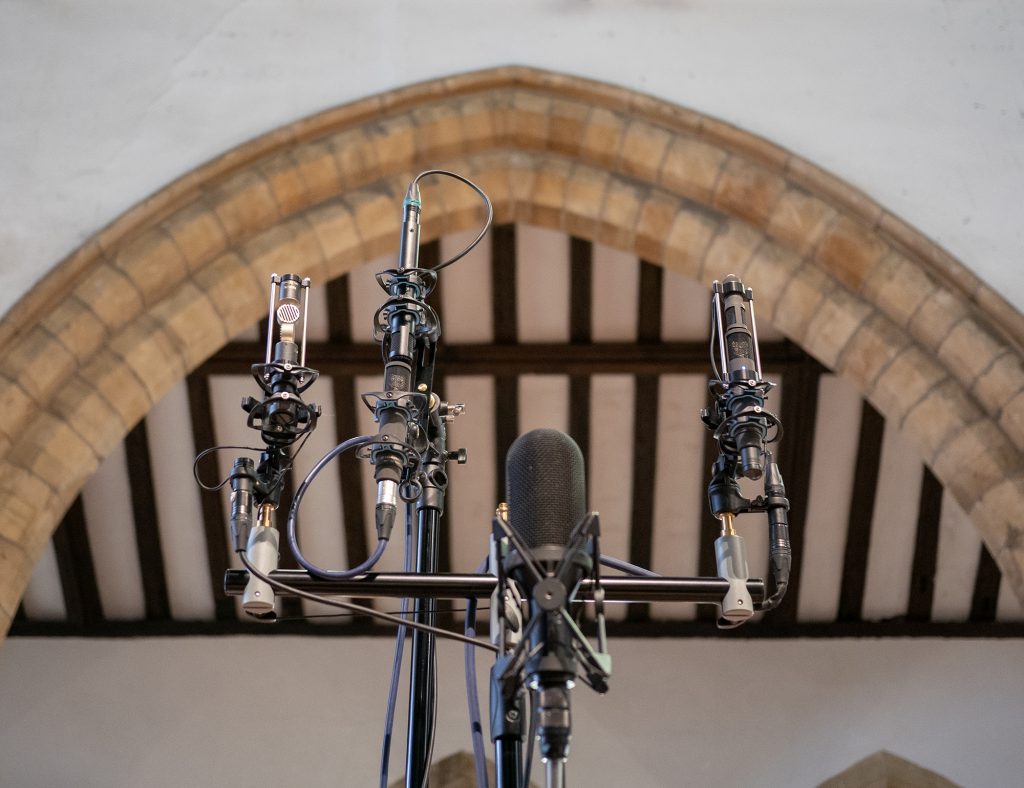
Left to right: Nevaton MC59 Twin + MC59/8; Sennheiser MKH 800 Twin + MKH 30; Soundfield ST250; and Sennheiser MKH 800 Twin + MKH8030.

First up, is a comparison of DMS with an MKH 800 Twin + MKH 8030 vs an MKH 800 Twin + MKH 30. Here, I have rendered them to a stereo Blumlein pair using Harpex X:

As you would expect the difference is subtle, since only the fig 8s differ. But, from the same take, the rendering to a Blumlein pair of the Soundfield ST250 (thanks to Jake: I am not familiar with use or processing of the ST250) is rather different, again as – indeed perhaps more than – you would expect. There’s certainly a lot more high-frequency emphasis than was actually the case with the organ (i.e. the Sennheisers and Nevatons are not oddly muffled!).

Reverting to comparing the Sennheiser and Nevaton twins, next up is a different take, which is a DMS comparison of the MKH 800 Twin + MKH 8030 vs the Nevation MC59 Twin + MC59/8, rendered to a Blumlein stereo pair:
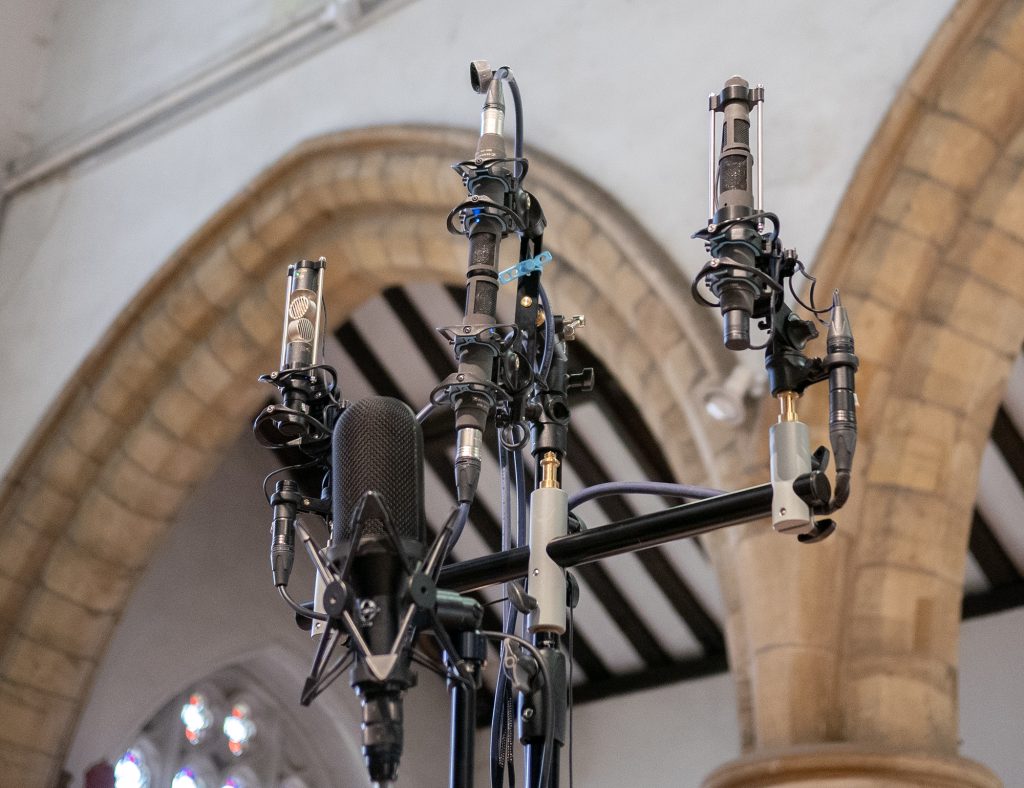
Left to right: Nevaton MC59 Twin + MC59/8; Soundfield ST250; Sennheiser MKH 800 Twin pair; and Sennheiser MKH 800 Twin + MKH8030.

And, finally, and in another take, as we had multiple MKH 800 Twins, here is a DMS comparison of two MKH 800 Twins vs the Nevation MC59 Twin + MC59/8, again rendered to a Blumlein stereo pair:

Obviously it is a bit tricky for anyone not there to compare the mics, especially with regard to the rather different frequency responses, and with different mic comparisons across the three rather different sounding takes: the comparisons are really valid only within the same take (so I have left the take number prefixes – T173, T174 and T175 – in the file names for the avoidance of doubt). But, nonetheless, they may be useful to some: they were to me!

Conclusions

Above all, these tests demonstrate that it is entirely practical to use an MKH 800 Twin in the field and, with some very basic adaptations, it can be utilized as part of a DMS rig within a modest-sized commercially available windshield: in this demonstration, the fairly compact Radius Windshields Mini-ALTO 250 and the Rycote Nano Shield NS4-DB. The key to this is the relatively new MKH 8030 fig 8 mic which, when used with an MZL connector (especially a customized version of this), is so much smaller than the older MKH 30 or, indeed, a second MKH 800 Twin. The pairing not only means the rig is sufficiently compact for most forms of field recording, but also gives a DMS set up where the forward and rearward-facing mid mics are not opposing end-fire SDCs: the cardioids are not heavily shadowed by mic bodies and suspensions. Perhaps because the MKH 8030 is so new compared to most of its MKH 8000 siblings, and perhaps since it takes a (very modest) bit of ingenuity to rig it with the MKH 800 Twin for DMS, the combination seems to have been little utilized: added to that, DMS is, of course, a less-used technique than MS or other – stereo – approaches. Of course, vertical rigging of a twin mic for DMS isn’t suited to all outdoor use: for example, those using DMS for production sound, where it is often used as an adjunct to a forward-facing shotgun mic (for, say, capturing pristine mono dialogue), would find this impractical. But that still leaves considerable scope for field recording, including sound effects recording, where the MKH 800 Twin + MKH 8030 would be very effective.
While for some the MKH 30 fig 8 remains preferable to the MKH 8030, the reality is that they are not hugely different and, consequently, the differences between them when combined with the MKH 800 Twin for DMS are subtle to say the least. Moreover, the design of the MKH 800 Twin – with its extended high-frequency range – is more consistent with the MKH 8030 than the MKH 30. I certainly don’t think I am losing anything by using the MKH 8030 within the DMS rig vs the MKH 30, and, of course, the shorter mic is so much more practical for this usage. Both Sennheiser fig 8s appear preferable (sound-wise) to using a second MKH 800 Twin for DMS: this should not be a surprise, perhaps, given the single diaphragms of the MKH 8030 and MKH 30 vs the double-capsule design of the MKH 800 Twin. Which, of course, brings us to the comparison with the Nevatons, where the MC59 Twin, obviously, has a dual-capsule design, but so also does the MC59/8 fig 8: and yet they hold up so well in the comparisons. Ultimately, however, whatever the pros and cons of these two twin-based DMS rigs – and such things are often a matter of taste and practical requirements – both are excellent options, and, while not achieving something quite as compact, even diehard Sennheiser MKH aficionados should be grateful to the Nevatons for inspiring me to rig and test something very similar for a DMS field-recording rig with the MKH 800 Twin! And talking of inspiration, let’s hope that more manage to get the MKH 800 Twin out into the field.

Audio Gear

Double mid side, part 3: comparing with native B-format

August 12, 2025
Double mid side with Schoeps CCM mics (left) and horizontal B-format with Sennheiser MKH 8000 mics (right).

In Part 1 of this three-part series of musings on double mid side (DMS), I went through the three rigging options; in Part 2 I tested the options; but in this final part, as the title says, I do something rather different, which is compare DMS to horizontal B-format (i.e. native B-format with no vertical component).

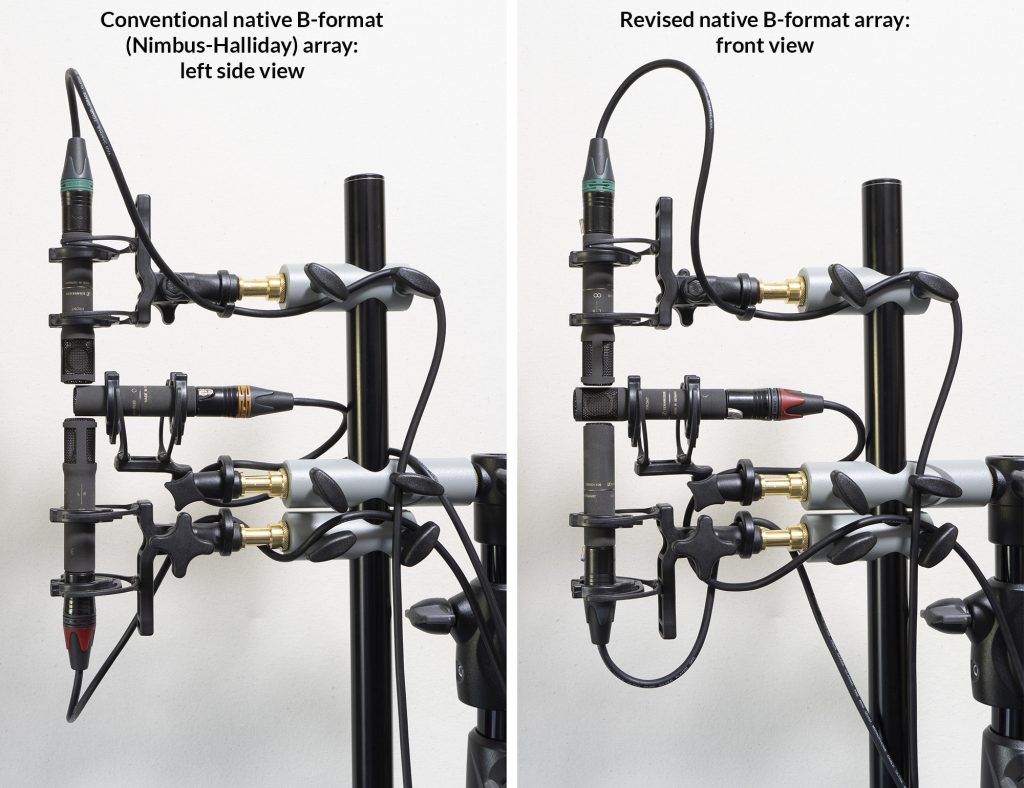
As we have seen in the previous posts, setting up DMS with side-address mid mics produces an array that looks very similar to a horizontal native B-format, or Nimbus-Halliday, array. In that case, a horizontally-oriented omni mic is flanked by vertically oriented fig 8s, one aimed forwards-backwards and one aimed sideways. In a variation of this, which I have used too, the omni can be set vertically as is one fig 8, with the second fig 8 set horizontally between the two: this variation is designed to address the directionality of the omni mic at higher frequencies in the plane of the mic body (a consequence of the mic body itself). I described and illustrated the two different horizontal B-format arrays in my pipe band recording blog posts last year. The similarity between horizontal B-format and DMS is not just that the two rigs look so alike, but also how they perform since, as Wittek et al (Wittek, H., Haut, C., and Keinath, D., Double M/S – a Surround recording technique put to test (Schoeps paper, 10.03.2010) note:

In principle, Double-M/S signals can also be converted to “horizontal B-format” by addition and subtraction:
W = Mfront+ Mrear;
X = Mfront- Mrear;
Y = S;

In this formula, the W (omni mic) is formed by combining the front and rear cardioids, and the X (forward-rearward facing fig 8) by again using the two cardioids, albeit subtracting one from the other. In that limited sense, deriving B-format from DMS is akin to deriving it from ambisonic (A-format) arrays of cardioids.

So the questions remain: if DMS and horizontal B-format are mathematically equivalent, do they sound the same and, either way, are there pros and cons for selecting either array? This, needless to say, is more complex than you might think, as it rather depends on the use of the array. For example, even if not ideal and demanding care when decoding, DMS can be used with a shotgun microphone, typically when such a narrow polar pattern is required principally as a mono mic (say for dialogue in production sound), but giving scope for flexible stereo or surround sound when needed, without changing the rig. The shotgun can be a mono mic with a fig 8 and a rear-facing cardioid clipped to it, or a stereo shotgun (i.e. with a integrated fig 8 capsule, such as the Sennheiser MKH 8018) with a rear-facing cardioid clipped to it. In this regard DMS has no equivalent in horizontal B-format in any practical sense.

Both arrays can and often are used for stereo recording: both allow mid-side recording with a variable polar pattern for the mid mic, and, indeed, steering of the stereo sound after the event. With DMS the mid mic polar pattern is created by mixing the two back-to-back cardioids, in the same way that a variable-pattern mid mic works: only the cardioid pattern is native to the mid mic. With horizontal B-format the mid mic polar pattern is created by mixing the omni mic and forward-rearward facing fig 8: this also gives you, natively (i.e. without mixing), a fig 8 mid mic and an omni mid mic. I use all three native mid mic polar patterns for MS, so wouldn’t choose between the two approaches on these grounds: besides, you may recall my previous test comparing a cardioid to a virtual cardioid created by my mixing a fig 8 and an omni, which showed little to no difference in the sound other than the more extended bass of the virtual cardioid arising from the use of the pure pressure omni. Well, at least the sound was very similar, but I do wonder, in the light of my DMS and horizontal B-format comparisons (below) whether the polar pattern was quite the same.

Comparing a cardioid MKH 8040 (top) with a virtual cardioid made by mixing a fig 8 MKH 8030 (centre) and omni MKH 8020 (bottom).

It is this extended low-frequency response that is perhaps the most distinctive difference between horizontal B-format and DMS when used for stereo. This difference is acknowledged in the Schoeps DMS plugin, however, which, as the user guide makes clear, ‘normalizes the sensitivity of the CCM 8 to match the CCM 2’s and compensates for the low frequency loss of the figure-of-eight microphone’: the CCM 8 being the fig 8, of course, and the CCM 2 being Schoeps’s flat (free-field) omni in the same CCM range.

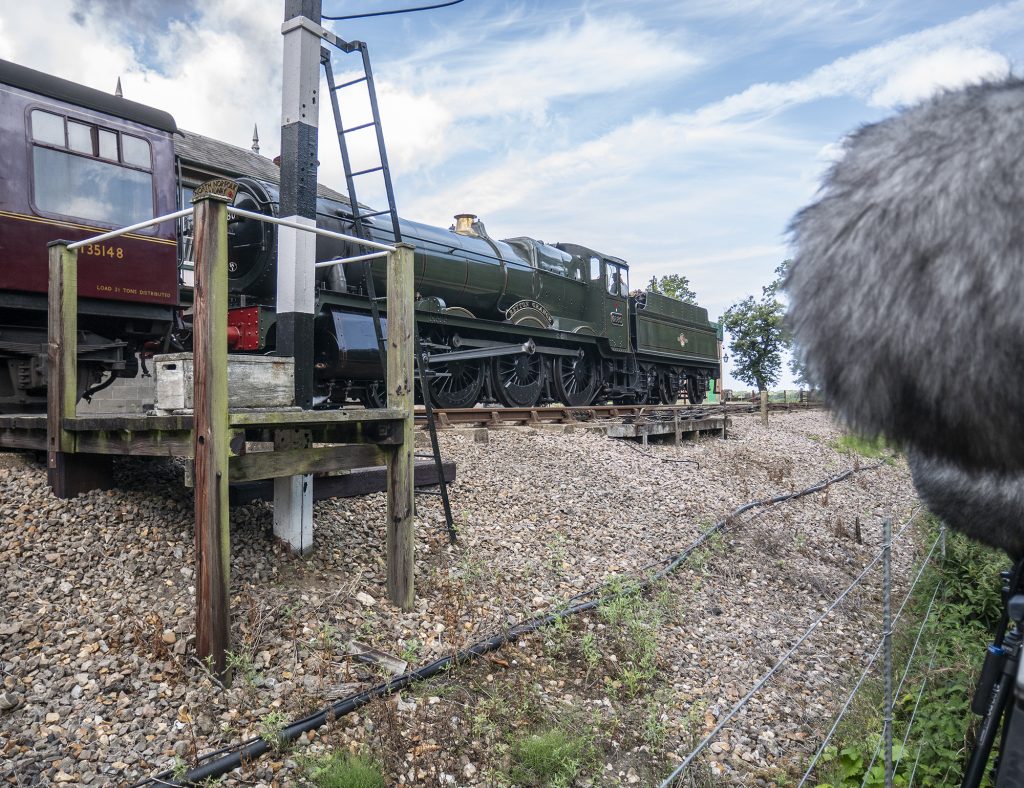
Lineside at Holt station (getting some odd looks and banter as usual, not least from the signalmen) for a DMS vs horizontal B-format comparison, as a Grange class locomotive pulls the train towards Sheringham.

Although rigging DMS with side-address cardioids provides the most obvious physical similarity with horizontal B-format, for my test purposes comparing these two rigs isn’t ideal: the Schoeps mics for the DMS rig are quite different from my Sennheiser mics for the horizontal B-format set-up. In my initial tests with these two rigs, I felt I was more demonstrating the difference between the mics than comparing the different configurations. Using end-address cardioids opens up more options, but, without three MKH 8030 fig 8s here (yet!), the best I can manage is DMS with two MKH 8040s and one MKH 30 vs horizontal B-format with two MKH 8030s and one MKH 8020. The MKH 8030 and MKH 30 are not identical, but, as we have seen before, they are fairly close. So with these two rigs in Mega-Blimps, I headed off to the local steam railway, hacking my way through the brambles and bracken to get to a point just beyond the station platform.

First up, we have the individual files for each of the three mics in each array. The files can be downloaded, and have been level-matched using the published sensitivities:

And here we have the files identically processed using the Harpex-X plug-in to stereo files as a coincident pair of hypercardioids at 127 degrees (i.e. equivalent to cardioid MS with a 50:50 balance between mid and side mics):

For some deeper bass, I then compared the two arrays back at home, starting the car to get some nice low-frequency content and, while at it, the usual Foley-like footsteps, gate openings etc. Again, here are the individual files for each of the three mics in each array:

And, again, here we have the files identically processed in Harpex-X to stereo files as a coincident pair of hypercardioids at 127 degrees (i.e. equivalent to cardioid MS with a 50:50 balance between mid and side mics):

The increased bass of the horizontal B-format array is more noticeable with the car engine than the steam locomotive, as you would expect, but both sets of recordings show broader differences between the two techniques. Some of these differences, mainly for the garden recording where there are close sounds, are an inevitable consequence of the spacing of the two rigs (about 1m apart), but there are very obvious differences that go beyond the fact that the two rigs could not be exactly coincidental. The localisation of even distant sounds is quite different. With the uncertainty of what is going on in the various DMS and B-format plug-ins, it is worth looking at a manual MS decode for the two pairs. For the DMS rig, standard MS was simply derived by using the fig 8 MKH 30 and the forward-facing cardioid MKH 8040 (i.e. ignoring the rear-facing cardioid). With the horizontal B-format all three mics were required, first creating a virtual cardioid from a 50:50 mix of the forward-rearward facing fig 8 MKH 8030 and the omni MKH 8020, and then using this as an MS pair with the sidewards-facing fig 8 MKH 8030. Here are the resultant two files for the steam locomotive departing recording:

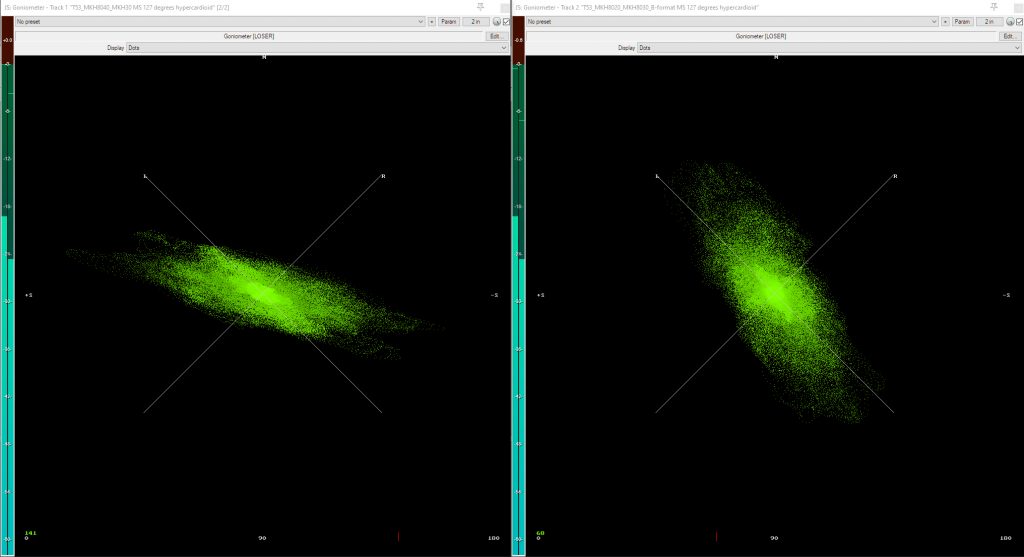
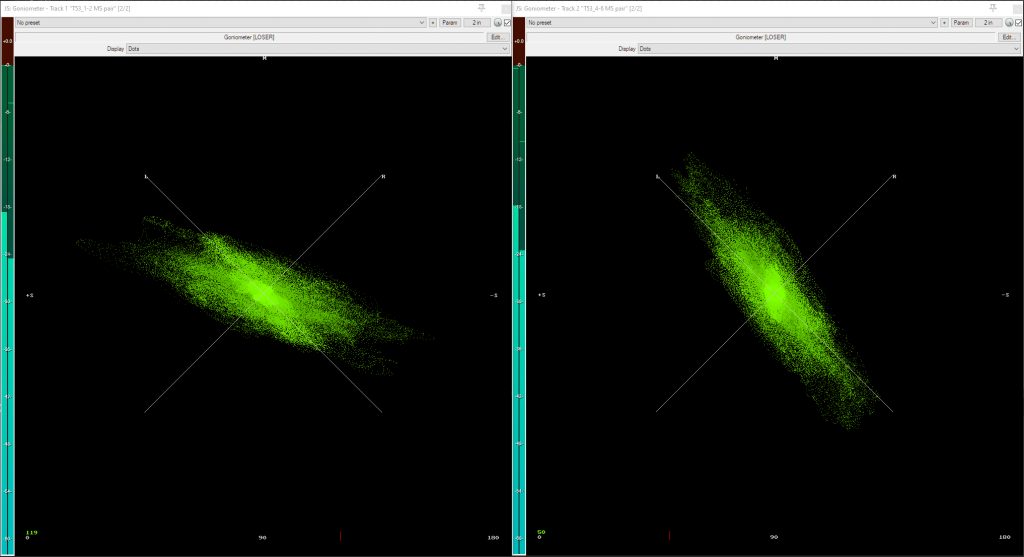
These two MS pairs, decoded to LR, show very similar results to the DMS and horizontal B-format recordings output to stereo. In both cases the stereo field is rather different, with the B-format derived stereo having less stereo spread. You can hear this in the sample files, but, for a visualization, here are the goniometer plots showing the steam locomotive whistle at the beginning of the railway recording for both the DMS/horizontal B-format recordings output to stereo via Harpex-X and for the two MS equivalents that were derived manually. I chose the whistle as a short clear sound located well off to one side (the left).

Goniometer on train whistle for DMS (left) and horizontal B-format (right), both processed in Harpex-X and output to stereo (XY with hypercardioids at 127 degrees).
Goniometer on train whistle for MS using MKH 8040 and MKH 30 (left) and MKH 8020+MKH 8030 (creating virtual cardioid) and MKH 8030 – i.e. manually derived from horizontal B-format (right), decoded to stereo.

In both instances the whistle in the B-format example (or MS derived from combining the omni and forward-facing fig 8 in the B-format rig to create a virtual cardioid, then used with the side-facing fig 8) is rendered a little more centrally. Of course, this is very easy to adjust with DMS or B-format recordings, so, in some sense, is not a practical issue, but the point is that there is a difference and it isn’t simply the result of the behind-scenes mechanics of the conversion plug-in. This suggests that the mathematical combination of an omni and fig 8 to make a cardioid and the practical implementation of this don’t quite match, which is not entirely surprising: factoring in the different sensitivities of the two mics is an obvious source of possible error, changing the resultant polar pattern, although the audible differences suggest – at least to my ears – that perhaps there is more to this than that factor only.

Conclusions

If ever there was a misleading subheading, then this is it: ‘conclusions’ suggests something far more, er, conclusive than I can offer. First up among caveats, my end-use of either DMS or horizontal B-format is primarily for stereo output. Testing the different rigs with a decent, say, 5.1 system would be an interesting exercise, but at least the files above for individual mics will allow others to do that and see if they can draw any conclusions: indeed, that is the primary purpose of the blog post. The second significant caveat is the evident difficult in getting parity between rigs: using an all Sennheiser MKH approach helped, rather than the Schoeps to Sennhesier comparison, but the MKH 30 is not absolutely identical to an MKH 8030, and, of course, it meant that I had to use end-address cardioids for the DMS rig. I could have used an all Rycote mic approach (I have enough BD-10 fig 8s to achieve this), but the longer mic bodies would not have worked for horizontal B-format in the Mega-Blimp (even that has limits!). However, the previous tests comparing DMS with end-address vs side-address cardioids made me much more sanguine about such an approach. Hopefully something is left that, at the very least, provides readers with food for thought: perhaps even to compare horizontal B-format with DMS themselves.

From my own perspective, the ground I have covered in the tests, many necessarily not included here for reasons of space, for these three DMS blog-posts, along with the practicalities of rigging, the key conclusions I have drawn are:

i) use of end-address cardioids (or, at least, very small SDCs, such as MKH 8000 mics with MZLs or the diminutive Nevatons) for DMS has negligible impact on sound resulting from shadowing and, even, off-centre cardioids, especially compared to the impact of most windshields (OK, that’s not relevant to much indoor recording);

ii) there is, therefore, little reason in most circumstances to go for the more transparent approach of using side-address cardioids for DMS, although, of course, no reason to not do so if the mics are available (suitable windshield permitting if outdoors);

iii) unless the low-frequency response of an omni is critical, then there seems no advantage – at least with the mics and usage I have – of horizontal B-format over DMS.

So, going forward, although I plan to utilize both three-mic rigs in the future, I suspect that I will be using DMS more than horizontal B-format, not least as it allows a wider range of my mics to be used: most obviously, the Nevatons I have acquired recently. But equally, and with my predominantly stereo-focused approach in mind, I will continue to use MS far more (or, indeed, other stereo pairs). Certainly the flexibility of horizontal B-format or DMS in terms of selecting polar pattern or, less of an issue, steering the array in post, are insufficient grounds to merit their use for most cases where a stereo end-product is required. I’m very happy with knowing which way to point the mics (!) and happy enough, with MS, to select the mid-mic polar pattern that will suit the job best be that an omni, wide-cardioid, cardioid, supercardioid or fig 8. That said, I occasionally need to produce surround sound field recordings (e.g. recently a recording of the sea for the intro to a pipe-organ SACD – Organ Fantasy by Jean-Paul Imbert and his students) so horizontal B-format and DMS will continue to be part of my recording life.

Audio Gear

Double mid side, part 2: comparing the different rigging options

July 22, 2025
DMS with Schoeps CCM4V side-address cardioids and CCM8 fig 8: the ideal configuration, and in the most transparent mount and windshield I can muster, but does it actually out-perform other setups?

Introduction

In Part 1 of this three-part blog-post on double mid-side I covered the rigging options for DMS using SDC mics. In this second part, I explore the differences between the rigging options, focusing on the option with side-by-side end-address cardiods and the, theoretically, rather better option with side-address cardioids: are there any audible differences? And I also include some clips of recordings to give a sense of the differences between different DMS set ups: that doesn’t just mean how the mics are configured, but, also, different mics.

Shadowing

One of the criticisms thrown at any configuration of coincident mics, but especially at those with multiple mics, is of the impact of shadowing, where elements of the mic shock-mounts or, more substantially, adjacent mics colour the sound. Of the three DMS configurations that with the most obvious shadowing is, of course, the option with side-by-side cardiods: you wouldn’t normally choose to stick something the size of mic immediately adjacent to and projecting forward from a cardioid mic capsule and there is no doubt that, visually, it looks clunky. But does it sound noticeably different?

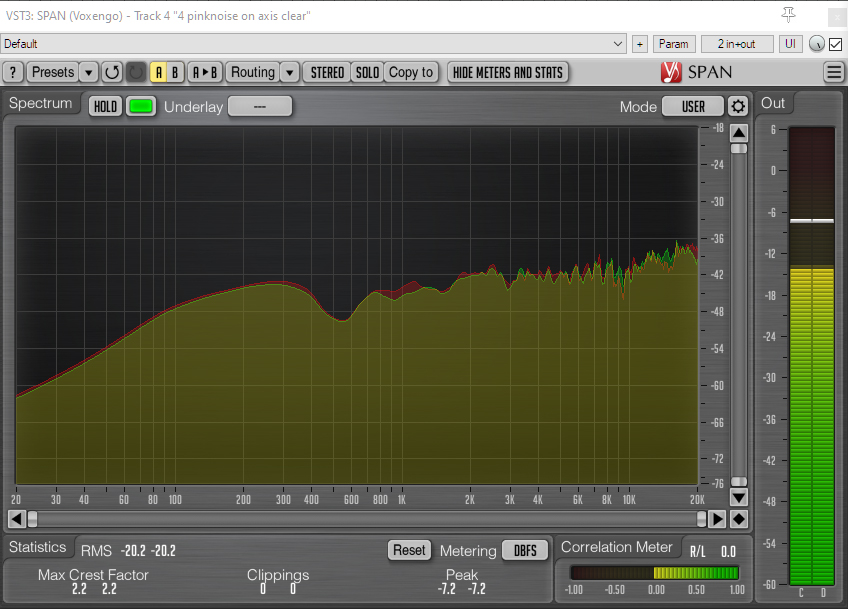
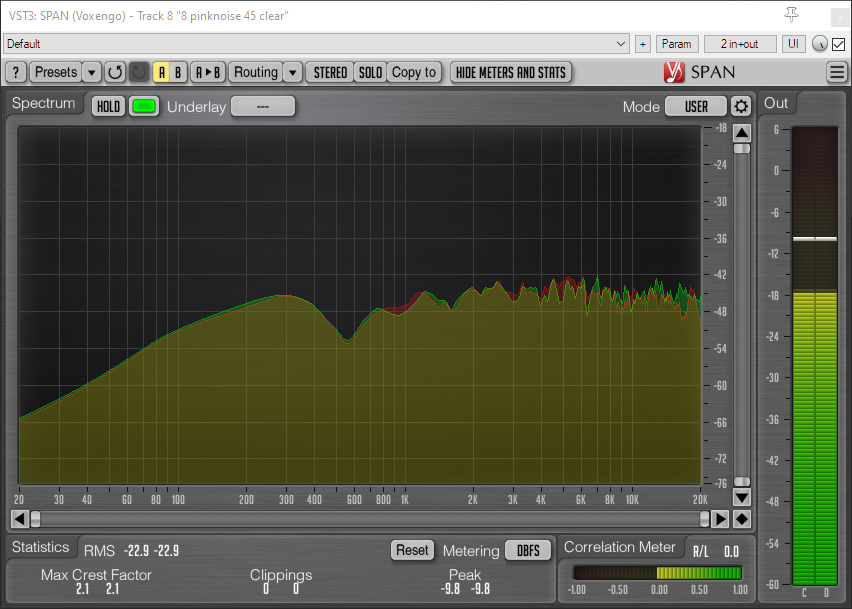
For those interested, I did some tests on the shadowing effect in such a clustered DMS rig (using MKH 8000 mics), recording pink noise played bay through one of my Vivid S12 monitors to the forward-facing cardioid in the DMS array, and then moved the fig 8 and rear-facing cardioid away (the mics were carefully set up with a separate stand for the forward-facing mic so that it remained exactly in position when the other mics were removed). This was done with the mic on axis and then 45 degrees off axis, so that, in the latter, the body of the rear-facing mic was shadowing the forward mic.

Pink noise recording by forward-facing MKH 8040 cardioid mic on axis to sound source with mic clear (green) and within DMS rig (red).
Pink noise recording by forward-facing MKH 8040 cardioid mic at 45 degrees to sound source with mic clear (green) and within DMS rig (red).

You can see from the spectrograms below that there was more of an impact on the high frequencies as expected at 45 degrees. Of itself this doesn’t show whether the differences of the single, unimpeded, cardioid mic vs the identically positioned mic within its DMS cluster are significant, so, by way of comparison we can look at some similar tests exploring the impact of two windshields (which I have shown previously). First we have the MKH 8030 with the Min-ALTO 115 basket turned side-on to the speaker source so that the fig 8 mic is on axis to the sound source:

Pink noise test with Mini-ALTO 115 with MKH8030 fig 8 mic aimed at speaker: green is the bare mic on the shock-mount and the red overlay is the recording with the basket added.

And for another comparison, here is the same fig 8 test repeated with a Rycote Cyclone.

Pink noise test with Cyclone (small) with MKH8030 fig 8 mic aimed at speaker: green is the bare mic on the shock-mount and the red overlay is the recording with the basket added.

In short, the impact of shadowing in the DMS mic array is measurable, but is far less significant than the impact of these two windshields, where the fig 8 (obviously a key element of DMS) is affected by the structure of the windshield baskets, with the particularly noticeable difference in the Cyclone basket doubtless largely due to the substantial plastic ring for its end cap.

And to return to our shadowing tests for the DMS rig, we can listen to how the effect of shadowing actually sounds. I used the same means of removing the fig 8 and rear-facing cardioid without disturbing the forward-facing cardioid’s position as before, and again placed the mics in front of a single speaker (Vivid S12) in my studio and played back a short section of a recent recording of mine of a singer-guitarist (Luke Chapman), angling the mics on axis to the speaker and then at 45 degrees. Here are the resulting mono sound files:

First, here is the pair of recordings of the forward-facing cardioid mic on axis, with no surrounding mics, and then shadowed within the cluster of DMS mics:

Second, here is the pair of recordings of the forward-facing cardioid mic at 45 degrees, with no surrounding mics, and then shadowed within the cluster of DMS mics (the body of the rear-facing cardioid mic shadowing the forward-facing mic in particular):

Obviously, comparisons should not be made between the on-axis and the 45-degree recordings as, by definition, the mic has moved!

I suspect many listening to these examples may be surprised by how little difference there is between the two recordings (clear mic and shadowed mic) in each set up (on axis and at 45 degrees). Certainly, I was reassured that shadowing effects are less than might be feared with this more clustered version of the two options that use end-address cardioids. Obviously use of longer and larger mics (think two MKH 40s and an MKH 30) would have a greater effect, but, conversely, two still shorter cardioids (think of those 23.5mm-long Nevaton MC59uS/C2 mics) would reduce the effect more (subject to the impact of any mounts).

Of course, shadowing is only one potential downside with the clustered DMS rig with two side-by-side cardioids: both cardioids are necessarily offset from the centre of the fig 8 capsule, typically by around 12mm or more. With MS normally the recordist aims to align the mics so that one capsule is precisely directly above the other and as close as possible. Losing that vertical alignment, of course, risks introducing comb filtering to sounds directed at the mics from the horizontal plane (or whatever plane the mics are tilted toward): likewise, increasing the vertical spacing between the mics will introduce more comb filtering and narrow the horizontal band where the effects are minimal or non-existent. The last isn’t an issue with DMS with two side-by-side cardioids (indeed, it can allow the vertical distance between the fig 8 and cardioid capsules to reduce), but the former is: the question, again, is does this matter? I have heard the results of MS recordings of classical music with the mics side-by-side, which sound fine (for example search out the recordings of ex-BBC engineer, Roger Long, who, as ‘Rolo46’, has posted many marvellous MS classical music recordings on Gearspace using side-by-side MS mics, mostly with an MKH 30 pair), but do the theorists, who frown at such setups, have a point? My aim was to test this, simplifying matters by doing so with an MS pair, comparing vertically aligned mics with one with the mid mic offset as if for this DMS configuration, but, try as hard as I could, I simply could not get any method to work convincingly: I tried indoors with a single speaker, but comb filtering for the shifted mid mic was obscured by comb filtering from the room (few studios are entirely free of comb filtering: and evidently mine isn’t!), and I tried outdoors (the poor man’s anechoic chamber!), but just couldn’t get reliable, repeatable or convincing results. Perhaps I will have a moment or revelation and work out what I need to do, but in the meantime I’m sorry to have come up short: you’ll just have to hang your hat on whichever side of the debate convinces you most . And, of course, one can learn something from the comparative field recordings below (or, better, your own), which compare the different rigs in action.

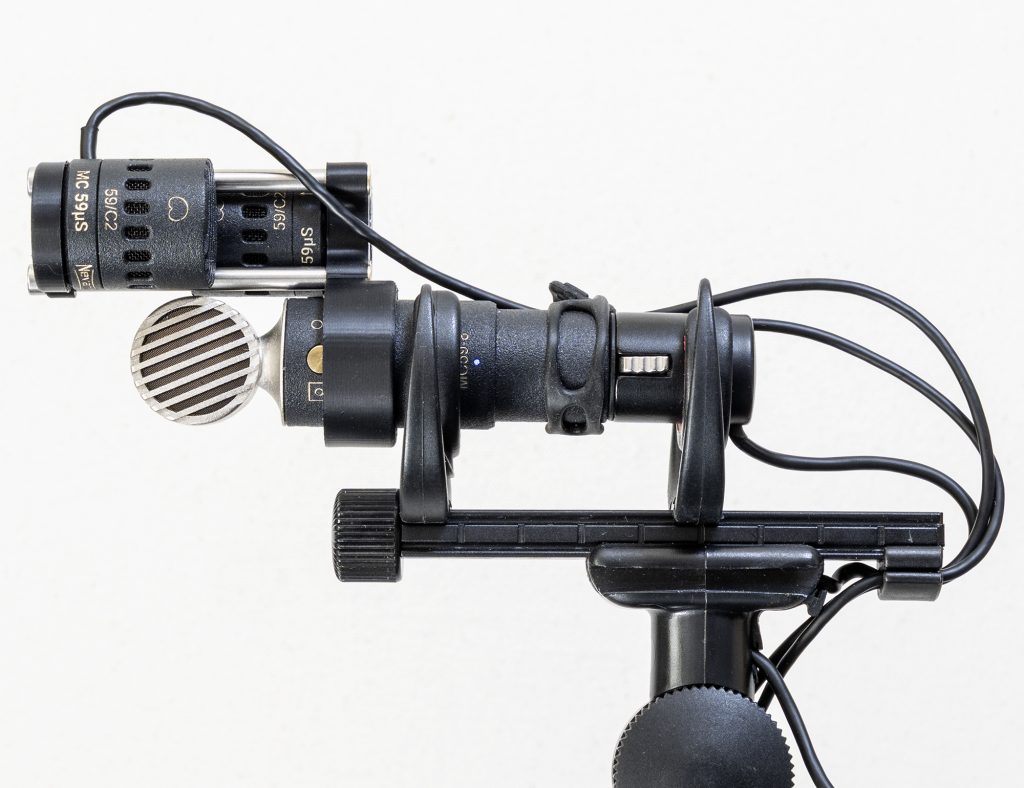
Minimizing the impact of the shadowing of end-address cardioid mics when rigged side-by-side with the ultra-short Nevaton MC59uS/C2 mics.

Field testing the different DMS rigs

On which note, I left behind such tests and took the mics into the field, to compare some real DMS rigs. This looked at a combination of different rigging approaches and, closely related, different microphones. I could have added a third variable of different windshields, but, to make things more fairly comparable, I have stuck with the same windshields in each set of field of tests. Being unadventurous (or just lazy?!), the tests comprise a series of my regular ‘quiet’ village street recordings: birdsong (plenty of swifts screaming overhead this summer), passing cars, and a bit of Foley-esque sound (as I open doors and gates, and stomp around aimlessly) cover quite a few bases. The cocker spaniels even joined in at one point with a bit of snuffling (honest, it wasn’t me!).

First off, I set up two rigs comprising the Schoeps CCM4V side-address cardioids and CCM8 fig 8 trio, and the Sennheiser MKH 8040 cardioids and MKH 8030 fig 8 mics for DMS with the mics side-by-side, recording with a Sound Devices 788T at 24bit/96kHz. In both cases I used Mega-Blimps for the windshields. With such large surround sound rigs two seems a sensible limit: three or more would mean that they are spaced rather too far apart to be comparable. Here is a short clip (1:34) of the resultant recordings, with one mono file for each mic (levels balanced according to mic sensitivity, but with no other processing) so that you can play around with them in, say, the Schoeps DMS or Harpex-X plugins: I use both for DMS processing.

a) Sennheiser:

b) Schoeps:

c) and here are two stereo files, generated in Reaper using Harpex-X (with the Blumlein stereo preset):

Second, here are the mono files for a similar test comparing DMS with the Sennheiser MKH 8040 cardioids and MKH 8030 fig 8 mics vs the Nevaton MC59uS/C2 and MC59/8 mics, again using Mega-Blimps for both rigs:

d) Sennheiser:

e) Nevaton

f) and here are two stereo outputs, generated using Harpex-X (with the Blumlein stereo preset):

And, finally, here are the mono files for another garden test, this time with a bit of wind (but no low-pass filtering applied), comparing DMS with the Schoeps CCM4V side-address cardioids and CCM8 fig 8 vs the Nevaton MC59uS/C2 and MC59/8 mics, again using Mega-Blimps for both rigs:

g) Schoeps:

h) Nevaton:

i) and here are two stereo outputs, generated using Harpex-X (with the Blumlein stereo preset):

Now anyone who downloads all those files and listens to them deserves a medal!

Conclusions

It is extraordinarily difficult to draw conclusions that are relevant to others’ use of DMS (not least since the use of side-address and end-address cardioids inherently means using different mics), but, nonetheless, I will have a stab at this. First off, although generally relaxed about multi-mic coincident pairs and the impacts of shadowing and small offsets, I came into these tests with an expectation that the acoustic problems of side-by-side cardioids in what is doubtless the most popular configuration of DMS would be more noticeable than they have proved to be. In reality, and that is with the caveat that I have not been testing DMS with bulkier SDCs such as the MKH 30 and MKH 40, they are much less significant than the impact of many windshields, especially those that were not designed to offer as much transparency to the sides and rear as to a forward-facing directional mic. So, if the aim is to place a DMS rig in a Radius Windshields Mini-ALTO or a Rycote Cyclone, then the consequences of the mic configuration are nothing compared to the impact of the windshield. However, if using a windshield with much better all round transparency such as the Cinela Pianissimo or, if boom pole use is not needed, one of my Mega-Bimps, then the impact of the different configurations will come into play. But this then gets very complex for several reasons: yes, the Schoeps CCM4V side-address cardioids and CCM8 fig 8 offer good alignment and little no shadowing (both from the other mics and the mounts), so using them in a Cinela Zephyx (for lightness) or Mega-Blimp (for more transparency) would offer the best performance from that perspective. But, at the same time, they have higher self-noise than the MKH 8030 + 2x MKH 8040 setup and lack the more humidity-proof RF technology of the Sennheiser mics. And, of course, the Nevaton MC59/8 + 2x MC59uS/C2 rig offers the most minimal shadowing for DMS with side-by-side cardioids (due to the very short length of the cardioids) as well as the lowest self-noise. As for the sound, well that’s one for individuals. I think the Nevaton DMS rig is the best sounding irrespective of mic configuration, but I may be missing something that more refined ears can pick up. Or perhaps it is just taste: it’s not as if top end classical music recordists all prefer the same mics or the same mics for a specific task.

And, just to add complexity where you don’t need it, I was surprised by the difference between the two plugins I have been using – Schoeps’s own DMS plugin and Harpex-X. In part, at least, this seems a product of the Schoeps plugin having built-in gain and frequency response compensation for its mics (which, evidently, isn’t appropriate for other mics), but the upshot is that it is very easy to get more significant differences by processing the recordings differently than it is from the actual mics or configurations used.

If you have all these mics (or, indeed, other good options) the selection criteria will need to balance all these factors: if you have some of the mics only, then that will simplify the choices; and if you have none of the options, but are thinking of one, then the usefulness of the mics for different purposes are likely to come into play (e.g. would you have use for Schoeps CCM4V side-address cardioids, or would end-address cardioids be more use?).

As for my choices? Well, I don’t own the Schoeps mics, so that does simplify things as the advantages of side-address cardioids wasn’t clear enough for me to buy the mics (especially with no other Schoeps mics in my locker), so DMS for me will be MKH 8000 mics (for tougher conditions) in a Mega-Blimp; otherwise, I will be using the Nevaton MC59/8 + 2x MC59uS/C2 rig in the same windshield for, as I said, to my ears, the best sound and, less subjectively, for even lower self-noise. And for ultra-compact DMS, should I ever need it, I would use either rig in a Nanoshield (the Nevaton DMS won’t fit in a Mini-ALTO, and the Sennheiser rig isn’t suited to the Mini-ALTO due to the fig 8 position in relation to the chunky plastic rings). But, the question I still need to address for my own use is whether DMS is preferable to horizontal B-format: and that, of course, is for Part 3 of my DMS blog-post series!

Audio Gear DIY Projects

Double mid-side, part 1: rigging options.

July 17, 2025

Introduction

Like many, I have used double mid-side (DMS) from time to time and, doubtless less typically, I have used horizontal native B-format arrays too: I have written a couple of blog posts on the latter already. Given that DMS can be converted to horizontal B-format and vice versa, I have wondered why DMS is much more widely used and, more specifically, about the practicalities of mounting both arrays: in short, are the two advantages of DMS in use that a) it requires one fig 8 mic only (vs the two for native B-format) and b) that it lends itself better to compact mounting that fits more easily in a windshield? And if DMS is often achieved using this compact mounting – with the three horizontal mics clustered together – would it be better if implemented more spaciously, and with less difficulty in terms of mounting the rearward-facing cardioid, along the lines of a horizontal B-format array?

Now, fear not, this isn’t a blog post about the theoretical side of DMS (or, indeed, native/horizontal B-format) nor, for that matter, about why anyone should use it in preference to affordable ambisonic mic options (and there are compelling reasons): for that, you are much better in the care of Dr Helmut Wittke (CEO of Schoeps) and his colleagues in publications such as this: Wittek, H., Haut, C., and Keinath, D., Double M/S – a Surround recording technique put to test (Schoeps paper, 10.03.2010).

Rather, this post is about some of my dabbling with practical implementations of DMS rigs both generally and in the context – or constraints – of windshields, and with reference to the analogous horizontal B-format rigs. I include some examples of commercially available DMS mounts (past and present) along with some of my own solutions. I hope it isn’t too much of an idiosyncratic ramble, and that it may chime with or, even, be useful for others.

NB having drafted much this blog post I found it rather long and, also, dividing into a few key sections, so I have divided into three separate blog-posts. This one, (part one), is concerned purely with the rigging options: my take on the options for how to mount mics for DMS. It is concerned with SDC mics and, also, doesn’t go into DMS with shotgun mics: it is primarily focused on rigs suitable for taking into the field (i.e. in windshields). Part 2 concerns practical comparison of the different rigs, not least exploring the reality of shadowing effects caused by mics sitting close to other mics. Part 3, to follow very soon, explores the practical differences between DMS and horizontal B-format set ups: there is so much in common – and conversion from one to the other is simple mathematically – but what are the practical pros and cons? Parts 2 and 3 include sound samples that you can download and play with.

Different mic mounting options for DMS

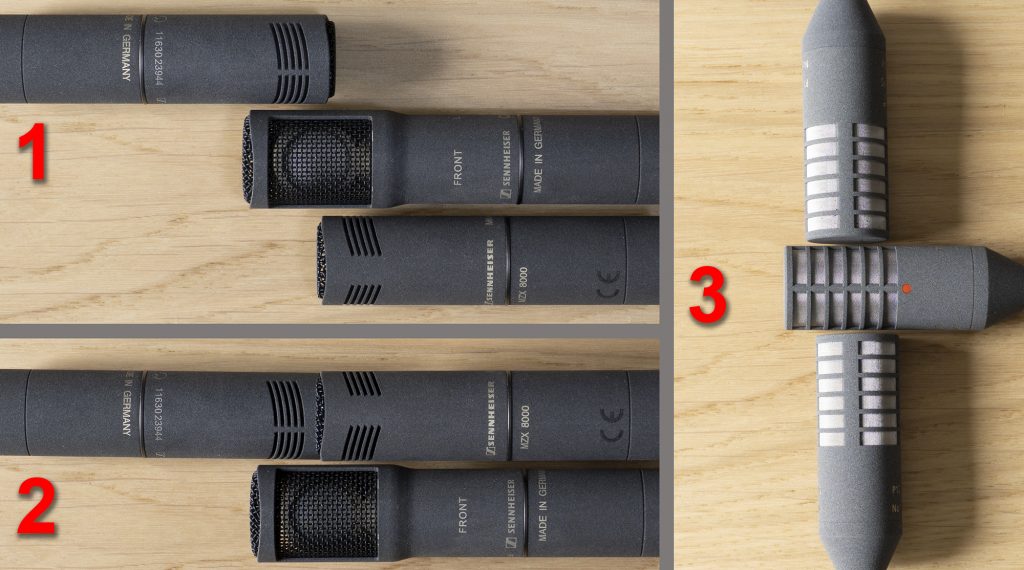
When using small-diaphragm condensers (SDCs) there are three main ways you can configure the three mics needed for DMS:

1) end-address mid mics combined with a side-address fig 8, so that all three horizontally-oriented mics are aligned vertically (typically the central mic is the fig 8, but not always so);

2) end-address mid mics combined with a side-address fig 8, so that all three horizontally-oriented are clustered more closely than in option 1, forming a tightly spaced triangle, but with the two mid mics horizontally offset from the centre of the array (the fig 8 can be above or below the mid mics); and

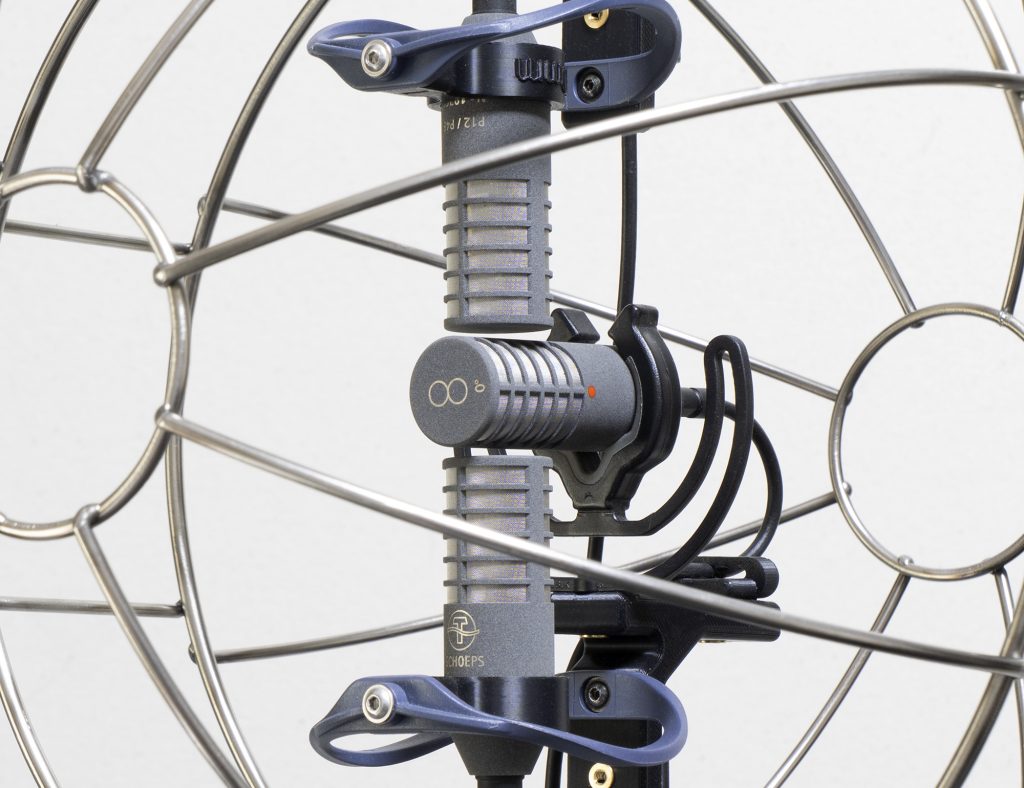
3) side-address mid mics oriented vertically, flanking, from above and below a horizontally-oriented fig 8.

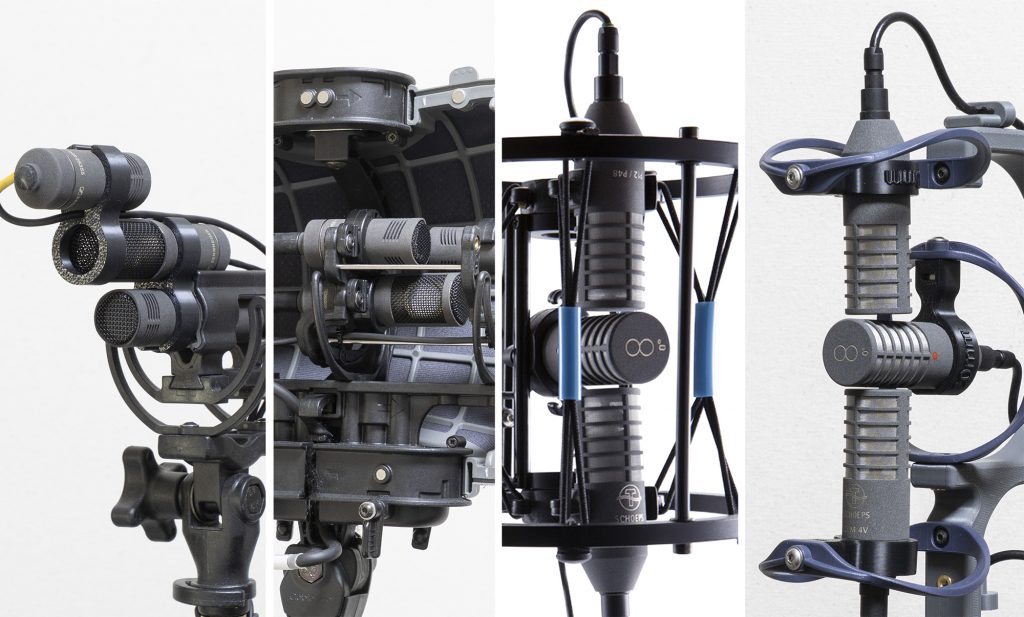
These three configurations are shown with unmounted mics in the image below:

The three fundamental mic configurations for DMS, for clarity shown here without the complexity of mic support. In all three photos the view is as if from the side of the array and front is to the left.

The composite image above shows that, with the end-address mics (options 1 and 2), the forward-facing mic and fig 8 are easy to mount in the manner of a simple mid-side pair, with the complexity coming from the addition of a rearward-facing cardioid, the body of which projects awkwardly away from the front of the other two mics. In a studio context this can be supported by a separate mount and stand, but this still requires fiddly alignment and is a real pain when adjusting the location of the array to the best position. Obviously, mounting the three mics together is more practical and, indeed, is essential for use in the field in a windshield.

Option 1 – end-address cardioids, all aligned

This option with the three mics aligned vertically, is perhaps harder to rig, but with shorter mics (such as Sennheiser MKH 8000 mics with MZLs, and Schoeps CCM mics) it is more feasible. Cinela, for one, has effective windshield mounting solutions shown below, where in each example the rearward-facing mic is supported by pairs of thin struts to reduce acoustic impact. In both these designs the central mic has a long plastic holder to extend the mic to the quite widely-spaced OSIX isolators, necessary to counteract the mass of the three mics at the front.

Cinela Pianissimo with DMS rig, with the mics (Sennheiser MKH 8030 + 2 x MKH 8040) aligned vertically: photo courtesy of Cinela.
In this variation from Cinela, for Schoeps mics, the three mics are again aligned vertically, but the fig 8 mic (CCM8) is at the top: photo courtesy of Cinela.

Of course, where DMS rigs involve a shotgun for the forward mic, then the fig 8 and the rearward facing cardioid can be clipped above and below the long body of the shotgun: this is a not entirely satisfactory use of DMS given the polar pattern of a shotgun mic and the irregular response off-axis arising from its interference tube. With a little bit of head scratching and some 3d printing, similar options can DIY’d, although any shock-mount needs to be able to counter the front-heavy loading.

My 3d-printed DMS rig with the MKH 8030 and 8040 mics aligned vertically and in a Rycote InVision shock-mount. The mics are fairly unimpeded (even the cable – from ETK Cables with custom MZLs – for the top cardioid is routed through the clip and along the null of the fig 8), but, obviously, the rig is rather front-heavy and too tall for most windshields.

Option 2 – end-address cardioids, side-by-side

This mounting option, where the two end-address cardioid mics are positioned side-by-side, has become a common approach. As with the vertical configuration (above), mic length can quickly make things unwieldy: even the modest 78mm length of the Rycote CA-08 cardioid, plus a low-profile XLR connector, makes for a rather long projection of the front (rear-facing) mic, as shown here:

DMS with Rycote mics, showing the significant forward projection of the rear-facing cardioid despite its fairly short (78mm length).

The more diminutive Sennheiser MKH 8000 mics with MZL connectors instead of XLR modules are, of course, the intended mics for my Rycote Cyclone DMS Kit 1, and show rather better the more compact end-result of the side-by-side cardioids in this option :

The Rycote Cyclone DMS Kit 1 with half of the basket shell in place, and with the basket and supporting arm fully removed. MKH 8030 and 8040 mics.

The constraints of the hoop size (which precludes vertical alignment) meant I also adopted this approach with my DMS mount for MKH 8000 mics in the diminutive Radius Windshields Mini-ALTO 115. As with the Rycote Cyclone DMS Kit 1, this uses thin stainless-steel bars to keep the clips aligned, but also uses the small front ring of the MKH 8030 fig 8 as a fixing point for a clip: it is workable if you need an extremely compact DMS array in a windshield, but is a bit fiddly to set up. Moreover, unlike MS pairs in the Mini-ALTO, DMS rigs in this windshield – or at least my attempts! – end up with the fig 8 mic between the hoops, so that the sideward-facing lobes of the mic are aimed directly at the rather chunky plastic ring where the two windshield pods join: obviously not ideal.

Another rig with DMS using the compact side-by-side cardioid approach: in this case my initial 3d-printed design for the Radius Mini-ALTO. MKH 8030 and 8040 mics, with a triple MZL cable by ETK Cables.
A more recent – simplified – variant of the above, which is much easier to use (no fiddly rods). Again, MKH 8030 and 8040 mics, with a triple (customized) MZL cable by ETK Cables. The Onshape files can be accessed here for the front and the rear clips.

While this configuration for DMS is arguably easier to mount and is certainly more compact, there are two obvious downsides. First, the coincidence of the mics in the horizontal plane is lost, with both cardioid mics horizontally offset from the centre of the array. Given how much care is usually taken with MS rigs to ensure that the capsules of the two mics are aligned vertically, to ensure coincident time of arrival (and phase coherence) of sounds from the (usually predominant) horizontal plane at the two mics, this might seem problematic for higher frequencies (depending on spacing, but typically above c.10kHz). Such concerns are often over emphasized by the theorecticians, however, and in practical use – even recording, say, classical music – the effects of even side-by-side MS pairs are not always evident: one to bear in mind and check for your usage and ears, perhaps. The second downside, is that the mics are more obviously shadowing each other than when positioned exactly vertically above each other. The physics are undeniable, but, again, whether it matters or not will come down to how critical the recording is and the nature of the sound source. I will explore this – with sound samples – in Part 2 of my DMS blog-post series. And, of course, mic size comes into play: for example an MKH 30 + 2 x MKH 40 MS rig is quite a different beast to the MKH 8030 + 2 x MKH 8040 rig, especially if the latter uses MZL connectors as in the photos above. And you can take the miniaturization of the cardioid further: below is a photo of my Nevaton DMS rig using their new diminutive MC59uS/C2 cardioid mic, which is only 23.5mm long, with their MC59/8 fig 8. In this case the mics are too wide (22mm diameter) to fit in a Radius hoops (and are here shown on a Rycote Nanoshield shock-mount, although would work in any Rycote or similar windshield), but the difference in size between the fig 8, with its XLR connection, and the tiny cardioids makes mounting a bit easier and, of course, any shadowing effect is reduced to some extent by the shortness of the cardioids. On the downside, the MC59/8 has no front part to be used for support as in my MKH 8030-based DMS rigs above.

DMS rig with MC59uS/C2 cardioid mics and MC59/8 fig 8, using a Rycote Nanoshield shock-mount. This is a fairly clean (in the sense of minimizing shadowing from mics and mount parts) version of the side-by-side cardioid option, although the ‘lollipop’ design of the fig 8 means supporting that rear-facing cardioid out front is a tad trickier. Now if someone would make a fig 8 mic with fixings on the front/top (say a couple of M3 threaded holes) that would make life so much easier for DMS rigging!
DMS rig with MC59uS/C2 cardioid mics and MC59/8 fig 8: head-on view. The cardioids use magnetic mounts.

Option 3 – using side-address cardioids

This mounting option, using side-address cardioids, used to have two commercially-produced options in the form of the Cinela Z-DMS-CCM (for the Cinela Zephyx, launched in 2005) and the Schoeps/Rycote WSR DMS LU (introduced by 2005), which were both designed for the Schoeps CCM8 + two CCM4V combination. The Schoeps/Rycote mount is certainly discontinued, although I understand that the Cinela mount, although no longer on their website, is still produced occasionally as a special item: make certain you ask nicely! The Schoeps option was used to illustrate Wittek et al’s paper on DMS and appears to have been Schoeps’s preferred implementation of DMS for some time, but currently the DMS options on their website use end-address mid mics either in Rycote Cyclone or Cinela Pianissomo windshields. The Schoeps/Rycote and Cinela methods of rigging the DMS setups with side-address cardioids are quite different as you can see from the photos below:

Schoeps/Rycote WSR DMS LU, with Schoeps CCM8 + two CCM4V: photo courtesy of Schoeps.
Cinela Z-DMS-CCM shock-mount for the Cinela Zephyx, again for the Schoeps CCM8 + two CCM4V combination: photo courtesy of Cinela.

I came across both these mounts for DMS with the side-address Schoeps CCM4V only more recently when wondering if my thoughts on adapting the approach taken for horizontal B-format rig to DMS had any precedents: evidently, there is nothing new under the sun! Of course, both the Cinela and Schoeps/Rycote mounts could be used for horizontal B-format too, but I have no idea if that has ever been done: you would hope so.

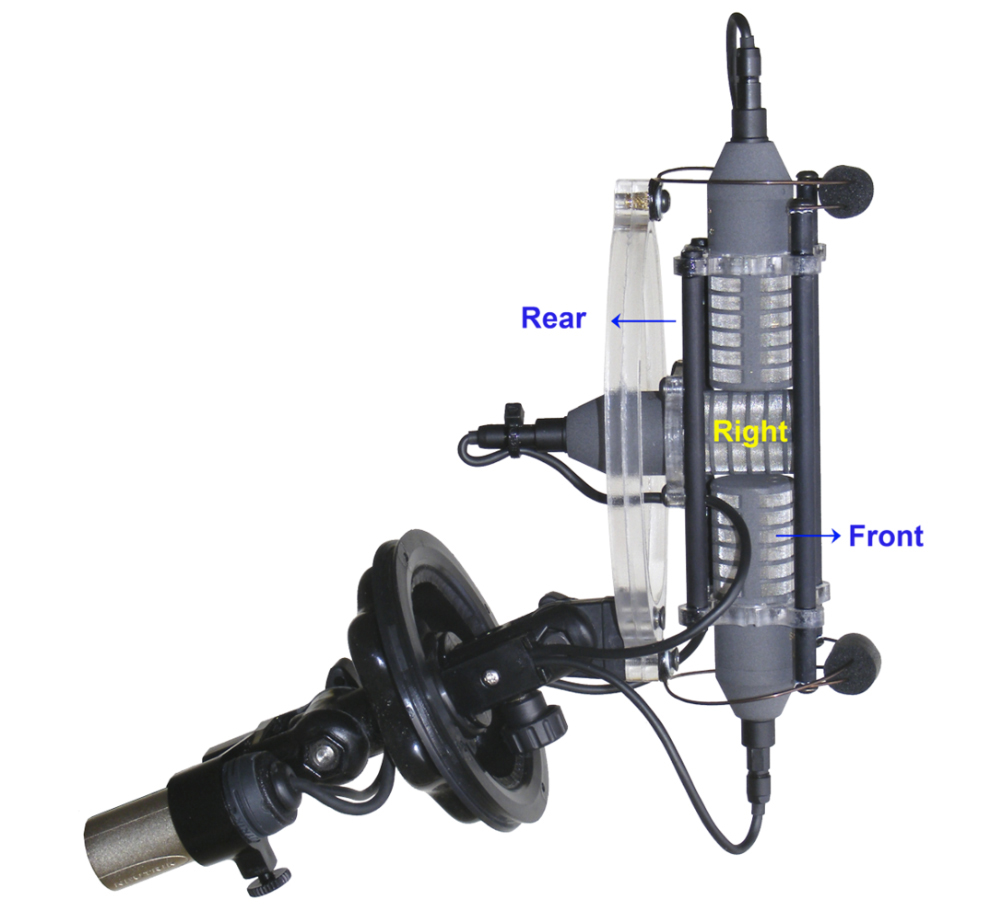
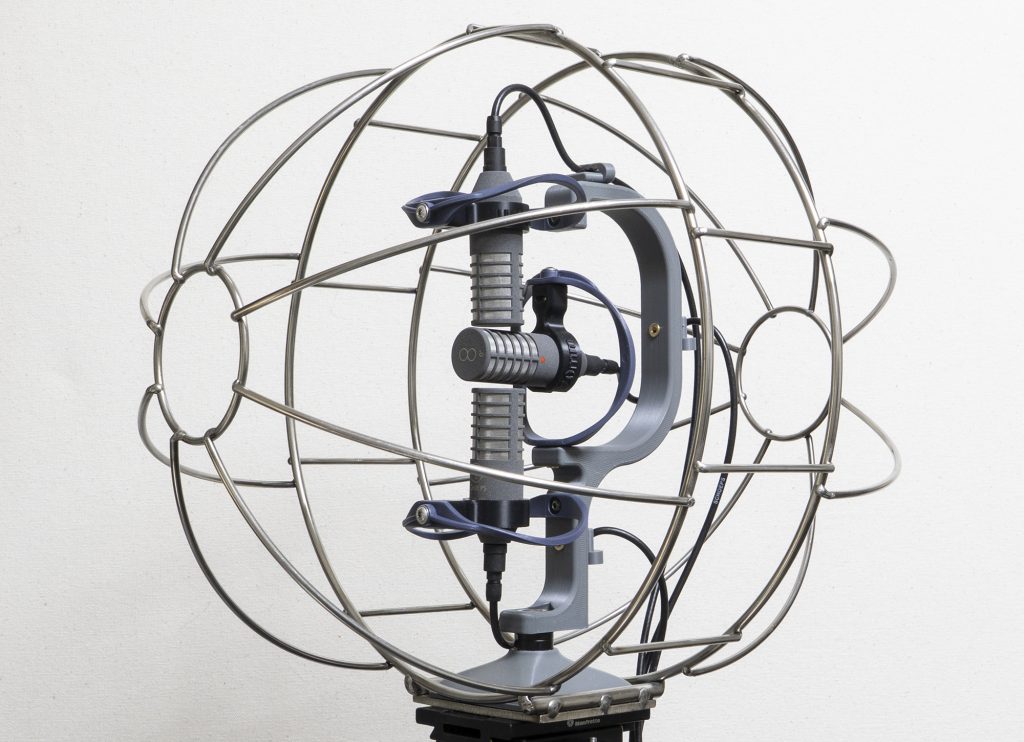
The two different configurations of horizontal B-format figs I have been using (the revised version having the omni mic rigged vertically, so that its polar pattern is more consistent at high frequencies in the horizontal plane): the similarity to DMS with side-address cardioids is evident.

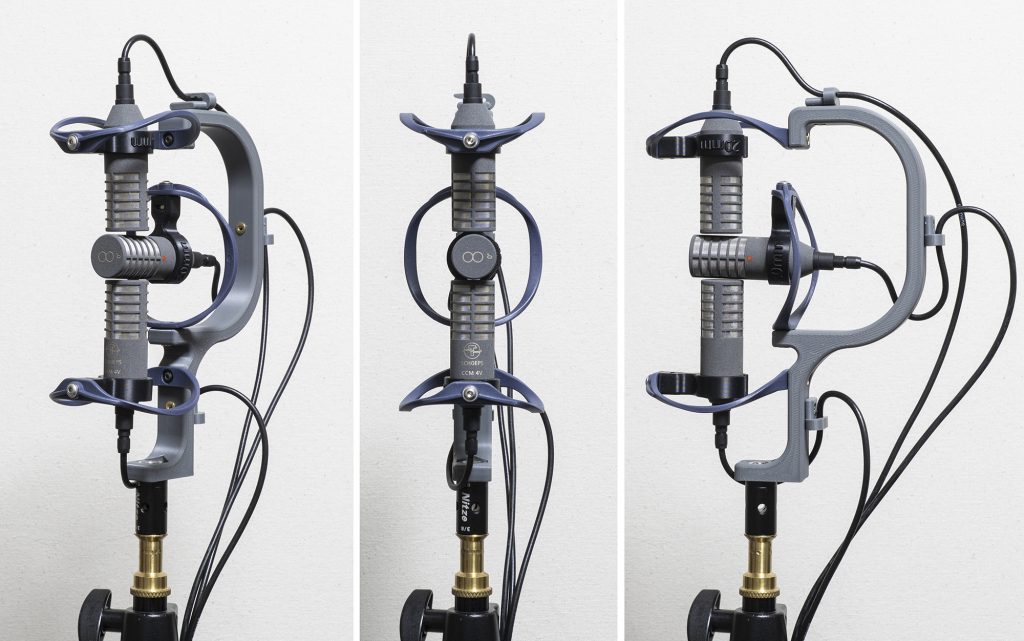
Coming at my own attempts for DMS with the side-address Schoeps CCM4V (and I am grateful to Schoeps for loan of the mics to test this) was, of course, from the perspective of using horizontal B-format either without any windshield (e.g. for location music recording, as with my bagpipe recordings last year) or within one of my Mega-Blimps. The latter, being much larger than windshields used with the commercially produced mounts, mean that a) the windshield basket can be oriented as designed and b) there is scope to reduce the proximity of structural supports around the mics. If the advantage of using side-address cardioids is that one can avoid the cluster of mics and consequence colouration arising from using end-address mics for the most demanding and critical applications, then it seems worth keeping the mics as free as possible of other sources of colouration, be that the windshield basket structure or the supports for the mics. Anyway, that is the rationale behind my DMS mount for the Mega-Blimp, albeit with a balance struck between transparency and isolation from structure-borne noise: i.e. the mics need shock-mounts (in this case mainly Radius Windshield hoops, but also using Rycote lyres where this reduces obstructions in front of the mics). The result does look similar to the horizontal B-format mount, although there are some significant tweaks to the geometry of the design to better fit the three Schoeps mics than the MKH 8000 mics.

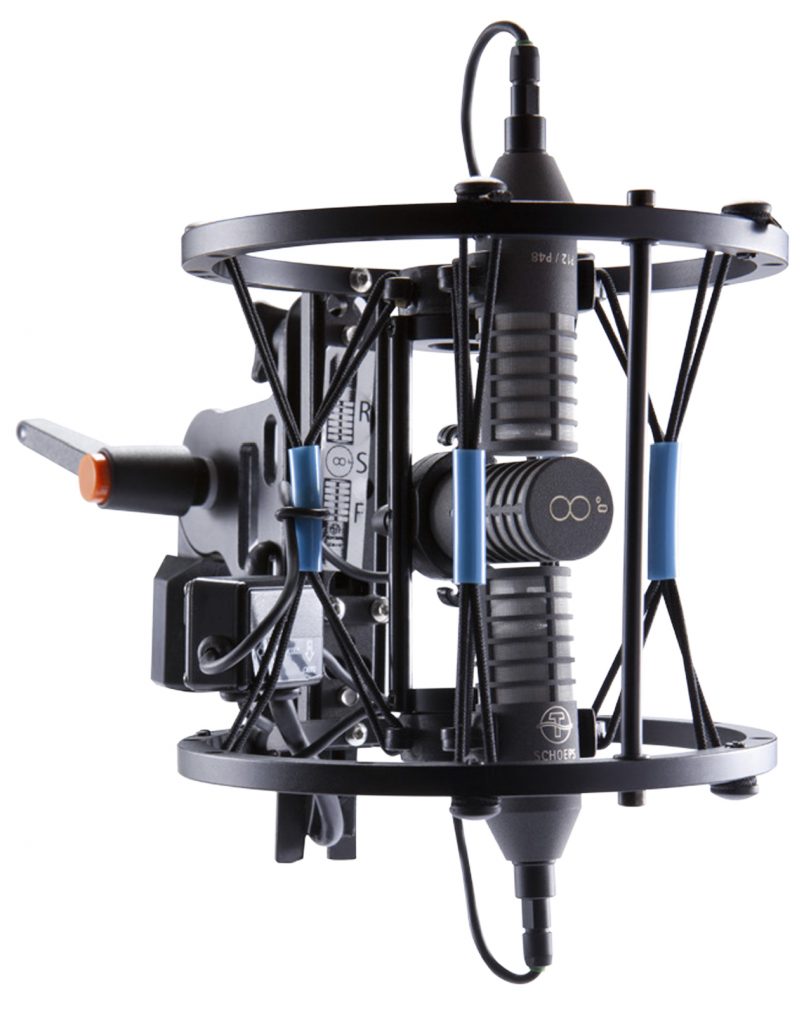
Mount for DMS with Schoeps CCM4V side-address cardioids and CCM8 fig 8 for indoor recording. The hoops and clips, plus the vertical arm to hold the top mic are the main residual items affecting the sound pickup, but the effects are limited to the rear-facing cardioid (the top mic).

Of course, such mounts that aim to minimize colouration are quite large, especially the revised version with its deeper rearward projection, but they fit happily in even my standard-sized Mega-Blimp, which, of course, minimizes additional colouration with its sparse and thin (mostly 3mm diameter) basket structure.

DMS mount (first version) in the shorter, standard, Mega-Blimp.

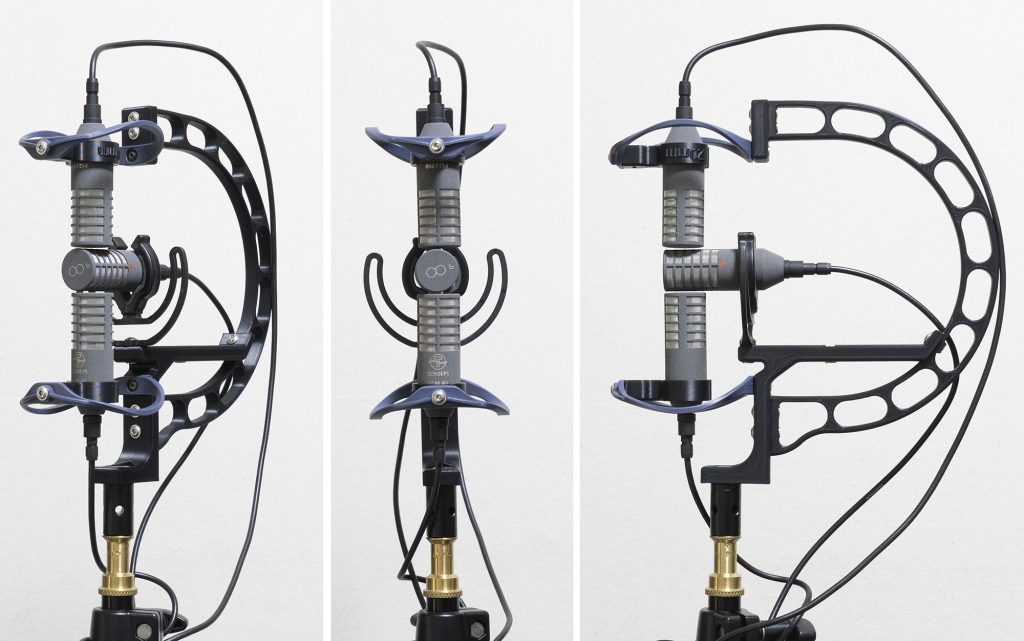
As with the horizontal B-format mic, such a rig presents challenges for the rear-facing upper mic, which here, as with the Schoeps/Rycote WSR DMS LU, has some on axis obstacles, in this case being the hoop and mic clip of the central mic, quite close to the cardioid, and beyond that the 18mm-wide vertical element of the mount. Looking at this more closely, it is, of course, possible to remove the hoop and mic clip by swapping to a Rycote lyre, which supports the fig 8 mic from underneath (and I have made provision in the mount for use of a rear lyre with a 9.5mm mount for the Lemo connector). And the impact of the 18mm-wide rear bar can be addressed by making this much thinner – in this case a slim 8mm (I tried 6mm, but that seemed too flimsy) – and also by moving this further still from the mic. There’s no such thing as a free lunch, however, with the downside of this version being less lateral stiffness for the arm to the upper mic (so not one to use if the mount is being subjected to much vibration). This revised version can be seen below.

Revised mount for DMS with Schoeps CCM4V side-address cardioids and CCM8 fig 8 for indoor recording, with the design modified to reduce the residual impact of structural elements on the rear-facing capsule. I could do with building in some cable clips to this design as with the previous version!
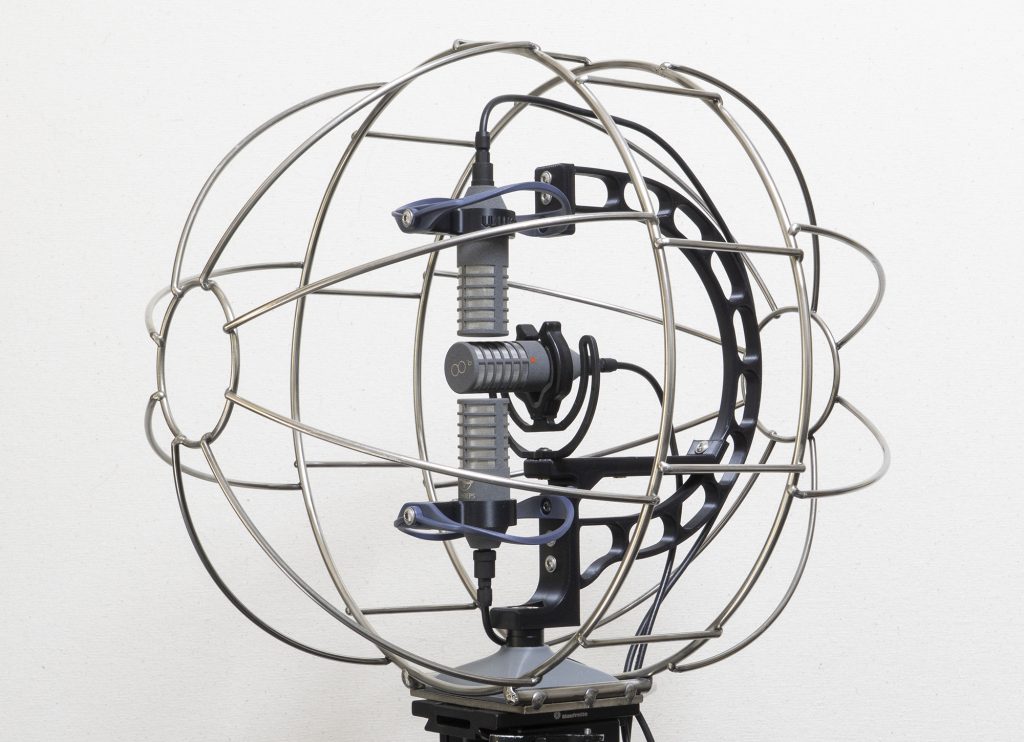
And the same rig in a windshield.

For windshield use only, of course, it is possible to remove the need for an arm extending upwards to the top mic by adopting the approach previously used for one of my horizontal B-format rigs, which removes obstacles in front of the topmost (i.e. rear-facing cardioid) mic without the penalty of introducing more wobbliness to it.

The most transparent solution – well, that I can come up with! – for DMS in the Mega-Blimp, with separate mountings for the bottom and centre mics, and the top mic.
A detail showing the largely unencumbered rear-facing (topmost) cardioid, which is a contrast to the situation in most DMS rigs.

So here we have it: an exploration of the three configurations used for DMS with SDC mics. Commercially available solutions exist for the first two options (with end-address cardioids), but are thin on the ground, to say the least, for the third option (with side-address cardioids). In all three cases there is significant scope for DIY solutions: indeed, for any particular mics this might well be essential. Hopefully some of my ramblings – or at least the photos – might inspire others to their own DMS solutions. Meanwhile, stay tuned for the practical comparisons in Part 2 and Part 3.

Audio Gear

Variation on double mid-side recording

November 7, 2021
AKG Blueline mics used for these tests, top to bottom: CK93 (hypercardioid), CK94 (fig 8) and CK92 (omni): initial rig.
Second setup, bringing the three mics closer together (5mm apart): physically more stable, mics further from edge of the blimp, and fewer phasing issues.

Mid-side recording is a familiar technique to most sound recordists: a coincident stereo pair that is flexible and handy (not least as it can fit in a blimp or windjammer more easily than most pairs). I’ve written previous posts about my mid-side rigs, both for LDC mics and SDC mics. Double mid-side, where the fig 8 side mic is used by two mid mics – one facing forward and one facing backwards – is less used, but still well known, mainly by those recording surround sound. But, of course, the fig 8 side mic can also be shared with two (roughly) forward-facing mid mics: say one pointing up to the mouth of a singer-songwriter and one down to their guitar. Matrix the two mid-side pairs and you have stereo for both vocal and guitar, with reasonably little spill, and – with all three mics coincident – no phasing issues. Hugh Robjohns wrote an article for Sound On Sound about this use a few years back.

But there is another use for double mid-side with the two mid mics facing forward, and one that is rarely used or described: that’s where the two mid mics are pointing the same way but have different polar patterns. Using, say, omni and hypercardioid mid mics, you can matrix either with the side mic and get omni or hypercardioid mid side or matrix both and mix and you can get all the polar patterns in between for your mid mic: say, wide cardioid or cardioid as well as the omni and hypercardioid. This flexibility in polar pattern is quite separate from the familiar aspect of mid-side recordings, where you can vary the width of the stereo image by changing the proportion of mid to side mic: with this arrangement you get both stereo width and polar pattern flexibility in post, and – if using SDC mics – all with a very compact three-channel rig. As you can see, with a few Rycote back-to-back clips you can even fit it in a fairly standard 100mm diameter blimp.

Here’s a vocal test with a group (Norfolk’s raucous folk band, Rattlebox) arranged in a semi-circle around the mics outside on a very windy day (about 20 mph wind), singing Dick Shannon’s ‘The Auld Triangle’: the test was in part to see if the mics would be OK stacked in a standard (in this case Rode) blimp in reasonable wind (the top and bottom mics were nearer to the edge of the blimp than is ideal: at this stage I hadn’t come up with the more compact triangular array). The configuration needs the fig 8 centrally, which is good as fig 8 mics are the most sensitive to wind. The three mics had their 75Hz low-cut filters engaged to counter the wind noise. I matrixed, or decoded, each mid-side pair, so in the video you hear these on their own and then mixed 50:50. In the video, I call this mix of the two pairs a ‘virtual cardioid mid mic’) as it isn’t far off mid side with a cardioid mid mic: of course, a seamless range of possibilities from omni to hypercardioid is possible.

And here’s another test, this time with a guitarist (Luke Chapman) in his workshop (by day Luke is a woodcarver), with the same matrixing/decoding options. With no wind to contend with, the three mics have no low-cut filters engaged. Of course, the smaller sound source of a guitar means the changes in mid-mic polar pattern are fairly subtle.

How best then to process the three channels of audio in post? Well there might appear to be three options: 1) mix the two mid mics first, then decode to LR stereo as per normal mid-side; 2) decode each mid-side pair then mix the resultant LR stereo files; and 3) decode one mid-side pair then mix in the additional mid mic.

A bit of maths shows the first two are identical:

Mixing the mid mics first:
M = μM1 + λM2
L= μM1 + λM2+S
R= μM1 + λM2-S

Decoding each mid-side pair then mixing:
L1=M1+S L2=M2+S
R1=M1-S R2=M2-S
L=μL1+λL2
= μ(M1+S)+ λ(M2+S)
= μM1 + λM2+S

Decoding one mid-side pair then adding the M2 mic (centrally) to the stereo pair, however, gives a different result (as, indeed, you might conclude intuitively when thinking about it):
L = μ(M1+S)+ λM2
= μM1 + λM2+μS

So avoid this third option.

[NB I’ve just done the L channels in the second and third examples, to reduce the off-putting maths…]

In my case, I’ve gone for the second option as it is difficult to determine what mix of mid mics you might want – i.e. what mid-mic virtual polar pattern – without hearing the stereo sound. I must now set up my DAW (Reaper) so that raising one stereo channel reduces the other by the same amount to make assessing the balance/mix easier.

In terms of monitoring when recording you can either just listen to the channels in mono or, with any reasonable recorder, send two of the channels (the fig 8 and, say, the hypercardioid) to be decoded in the headphone monitoring or in the LR mix (either are possible on my Sound Devices MixPre-3): in this way you get confirmation that at least one of the stereo pairs sounds as you want it. With time on your hands, you can, of course, check the other pair in LR stereo too.

UPDATE (9.11.2021). By request I’ve recorded some ambiences (just my quiet Norfolk village street from my garden) with this rig and have uploaded the iso tracks (AKG CK92 omni; AKG CK93 hypercardioid; and AKG CK94 fig 8), the two separate MS recordings (as LR stereo) and the combined MMS recording (giving something akin to cardioid MS). These recordings were made with my modified array (i.e. the mics set in a more compact triangular arrangement, each only 5mm apart from the others).