
Browsing Category

Audio Projects

Audio Projects Film Projects

Experimenting with moving or POV stereo ambiences…

March 6, 2021
Setting off in the cause of research…or seeking ridicule?

I think Lockdown III must be getting to me: I’ve been pondering over stereo ambiences for film lately, wondering if they ever are or should be recorded while moving to match the POV (point of view) of the camera?

This was stimulated by thinking about sound for an upcoming project with drone footage, where the drone will follow the course of a small local river from source to sea – flying fairly low and slowly. I want the sound to match the view – along the bubbling stream, the passing over of weirs, cows and sheep being flown past etc. Obviously bunging a couple of mics on the drone isn’t an option given the noise of the motors and rotors, so any ambiences will need to be recorded quite separately. Initially I thought of helium balloons: I calculated that seven normal-sized party balloons would lift a pair of Rode Wireless GO II transmitters into the air, but, the more I have thought about this the more complex it seems: a totally windless day seems essential and, even then, trying to stop the mics spinning or, harder, trying to get the balloons in the right place seem fraught with difficulties. And then, more fundamentally, what does a moving stereo recording actually sound like? In other words, would it even be worthwhile trying to do this?

Recording to the miniscule MixPre-3

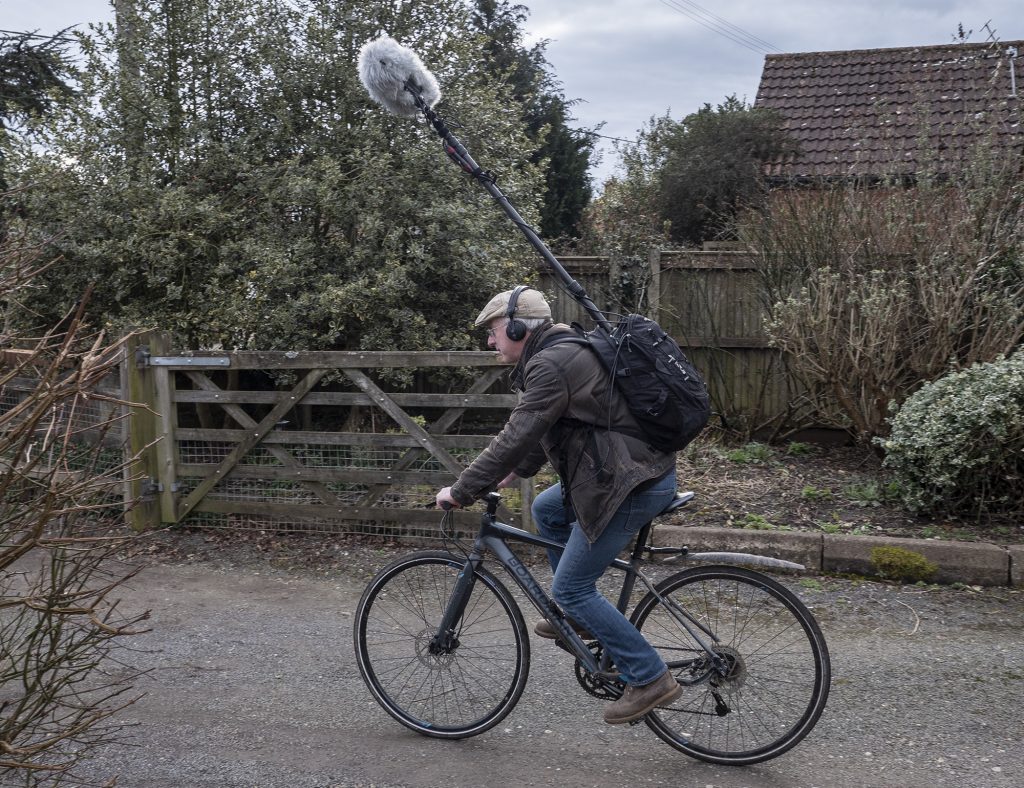
Drawing a blank through internet searches (the nearest thing being people trying to record the sounds of – say – a bike travelling, rather than just the ambience without evidence of the mode of transport), and not knowing how the soundtrack of any film with apparent moving stereo ambiences was actually made, it seemed easiest to experiment. A bicycle appeared to be the best bet for near-silent travel, as long as fast speed or free-wheeling was avoided. After initial less than satisfactory attempts with semi-binaural set-ups of lav mics by my ears and either side of a rucksack (both getting far too much bike noise, and, also, showing up the inadequacies of furry wind-protection for these mics), I rigged up a boom pool to a sheet of ply, cut to the shape of a rucksack, to mount the mics well above me (so further from the bike and road noise) and to prevent unwanted rotation. The mics were omni SDCs mounted end-to-end in a single blimp to minimize windnoise (see my post here on using mics in this way). Extending the boom pole very far got unwieldly, so it was only partly extended. Sound was recorded to a Sound Devices MixPre-3 on a light harness. The results were in a different league to the lav mic experiments, but the bike was still very evident and, above all, I’m not at all convinced that the sense of movement is very strong. This last point is critical. In short, I have no doubt that a better result could be achieved by recording general ambiences and specific sound effects from static positions and amalgamating them into the soundtrack to give the illusion of moving through space: doubtless this is what sound designers know and do, anyway, but it is good to experiment and find that, sometimes, the seemingly logical approach doesn’t work. And if, in doing so, I’ve gained an eccentric reputation in the village (yes, cycling with a blimp on a vertical boom pole does look extremely silly), then so be it…

For anyone interested, here is a recording of one of my tests with the SDC spaced pair in blimp, including the reaction of a passing neighbour.

Audio Projects Film Projects

A European tour

January 8, 2021

An acoustic performance next to the Halle aux grains in Auvillar

With Brexit on its way, in 2017 I organized a small European tour for local band Rattlebox (for which I am sound-engineer). This was an exercise entirely determined by fun and entente cordiale: free gigs in some fairly random and mostly very small places in France, Andorra and Spain, largely determined – though not in all cases – by one of us having some connection; and six families, and a few extras, with us on what would be their summer holiday. Even so, there were practical issues to sort: arranging gigs (much helped by my French-speaking and living elder daughter), accommodation (largely campsites: this was a budget tour), power supplies, intermediary stops (this was part holiday, remember) and, of course, the PA. Anyway, here’s to the gigs:

Fri 28 July: Sainte-Sévère-sur-Indre (central France, midway between Bourges and Limoges). A fitting start to the tour: the gig was in the open-sided market hall in the square of the village made so famous by Jacques Tati’s 1949 film Jour de fête. We were a little nervous about the gig as we had no previous contact in the village, and had just had a few – hard won – emails with the mayor’s office. But they came up trumps, and had set out the market hall with benches (which filled up), put up posters, and even produced a few slabs of beer. We felt as welcome as the fair folk in Jour de fête. After a little electric shock (a reminder that wiring isn’t always what it should be), the technical side went OK: the PA was a combination of Alto and Proel speakers, with a Soundcraft mixing desk, all fairly basic but fine for what is a slightly raucous folk band. Beers after at a bar, then all of a hundred yards to the village campsite with its profusion of Swallowtail butterflies. Perfick, as Pop Larkin would have said.

Sat 29 July: Auvillar (Tarn-et-Garonne, south-west France). A weekend here in this most beautiful of small towns, courtesy of an old friend (a retired French general) and the indefatigable efforts of Gilles Compagnat. Unknown to us beforehand, Gilles organized everything, from a short taster acoustic session by the circular Halle aux grains (where our carefully transported English cider – yes, we took a present of booze to France – went like lightning), paella for all in the square, the main evening gig to an audience of 200 (then a record for Rattlebox) outside the church with its natural ampitheatre (with lights set up specially too), and a Sunday morning acoustic gig in the Place du Château. Having no PA to run on the Sunday morning, I set up a couple of omni mics and recorded the band outside, ambience and all. Goodness, were we sad to leave.

Tues 1 Aug: Vinça (Pyrénées-Orientales: southern France, near the east end of the Pyrénées). After stops at Carcassone, Lagrasse and, for some, the Med, this more workaday small town had a great lake and, by the side of this a lively bar  – the ginguette d’Aquagliss au lac. A compressed stage, but, who cares, there was more paella and dancing for the first time on the tour.

Thurs 3 Aug: Andorra la Vella. It had always been an ambition of Danny (of Rattlebox) to visit Andorra, and as we pitched up in a very urban campsite next to the national football stadium in insanely hot and humid conditions, we wondered why? But the evening gig in the Harlem Bar (organized by the remarkable Pierre Infante Lagrave and the bar owner Josu Adanez) was a great success: small, extremely sweaty and with enthusiastic dancing. What more can you ask for?

Sat 5 Aug: Junzano (near Huesca, Spain). Courtesy of  the sister of Simon (also of Rattlebox), a long-time resident, of this small village, we were part of the municipal fiesta, and welcomed enthusiastically yet again. A bigger stage and, for the first time, other acts: yet more paella (at least in Spain this time), dancing and, afterwards, sad farewells before the long journey home.

During all the mayhem of keeping things on track, running the PA, being the roadie, and occasionally snatching bits of holiday – all in the unremittingly fantastic weather – there wasn’t really any time for serious filmmaking, but here’s an extremely rough film (largely an aide-mémoire for us) that captures something of the fun and, indeed, the welcome: the eternal question down the pub is where next?

Audio Gear Audio Projects

Something (not so) nasty in the woodshed: fun with figure of eights

January 7, 2021

It has been a drawn-out project, what with Covid-19 lockdowns and restrictions, but currently I’m midway through recording an acoustic album for Norfolk singer-songwriter Luke Chapman. It’s a long way from some of Luke’s other musical pursuits, such as the stoner grunge rock Rolodex of Gods. After an initial session at Oulton Chapel (lovely acoustics), we have since been using the woodstore part of his workshop on the edge of the Barningham Hall estate: by day Luke is a woodcarver.

With a sitting position and songs with a huge dynamic range, Luke’s voice and guitar playing need the mics to give as much separation as possible between the tracks. Early tests included using a ribbon mic on his vocals (a NoHype Audio LRM-V), but I have since been using three Rode NT2a mics, all in figure-of-eight pattern so that the nulls are used to great effect to cut out spill as much as possible: the guitar mics – a stereo pair – are parallel at 300mm spacing, one aimed around the 12th fret and one towards the bridge. The results are sounding good (to our ears): the Rode NT2a is often underrated, but the HF1 capsule (also used in the Rode K2 tube mic) is quite different from the harsher capsule of the Rode NT1a and is a pretty neutral beast. And so quiet (7dBA) that you can hear the rats running around in the roof as we record. The three mics are fed through to the ‘control room’ (the main workshop) to a Sound Devices MixPre-3: simple, but effective.

I’ll post more – with some audio – as the project continues.

Audio Projects

Recording a singer-pianist: Ginny Dix

January 7, 2021

Recording a singer-pianist seems so simple, but it is nothing of the sort. Recording a piano itself is hard enough: do you go for one of the wide range of classical approaches to mic positioning (and if so which one?), placing the piano in its (hopefully) good room acoustic, or do you adopt a closer mic technique used more for jazz, rock and pop? And then how do you avoid spill from the piano in the vocal mic and vice versa? Avoiding, or reducing, such spill, of course, cuts the chances of phase issues and lets you edit or process the tracks differently: perhaps a bit more added reverb or compression on the vocal. Overdubbing would make life easier, but, naturally enough, not many singer-songwriters wish to do that: it is unfamiliar and risks the greater problem of a sterile recording. Norwich-based singer-songwriter Ginny Dix certainly wanted to play and sing at the same time and, just to make life fun, required her performance to be filmed at the same time during the recording of her new song, ‘Woman’, in 2017 (recorded in the Barbirolli Room in the Ethelbert Gate at Norwich Cathedral).

I’d previously recorded and filmed Ginny’s song ‘Run Away‘ at the Wharf Academy in 2016, with help from three others. This time, however, I was on my own, so cut out the crane shots and kept it simple: one locked-off shot along the piano, a second tripod shot mostly locked off for close-ups, and one handheld camera moving around, all the time while monitoring the sound and watching those meters. A couple more arms would be helpful. Kit was small and simple as usual: a Lumix GX80, a Lumix LX100, a Nikon D810, a Rode NT55 omni pair for the piano, and an AKG CK93 hypercardioid for vocals. Far from perfect, I know, but it worked out OK: it was interesting to use an SDC on vocals instead of just grabbing the usual LDC. And, yes, Ginny prefers quite a bit of reverb on her voice so that was enhanced with a convolution reverb while editing in Reaper.

Anyway, I hope you enjoy Ginny’s performance.