Browsing Category

Audio Gear

Audio Gear

Variation on double mid-side recording

November 7, 2021
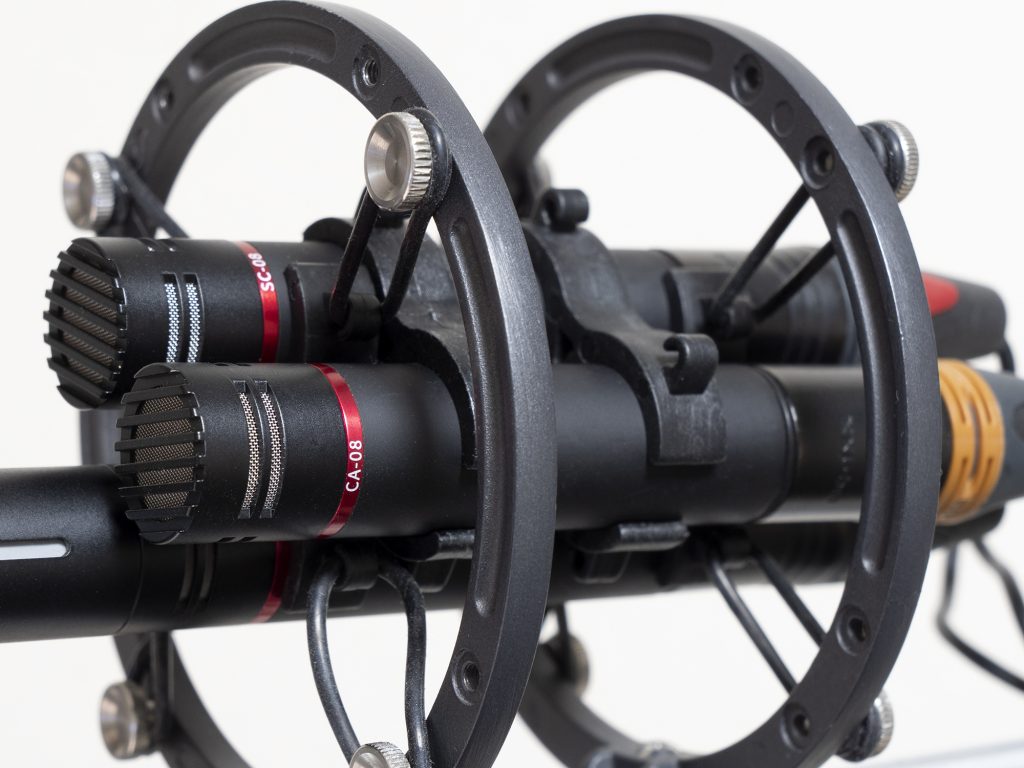
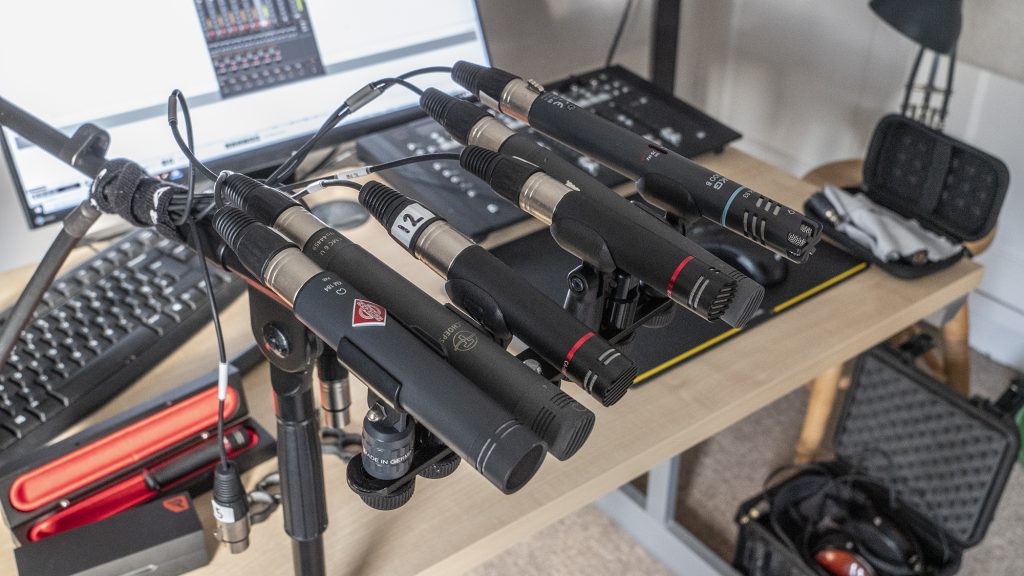
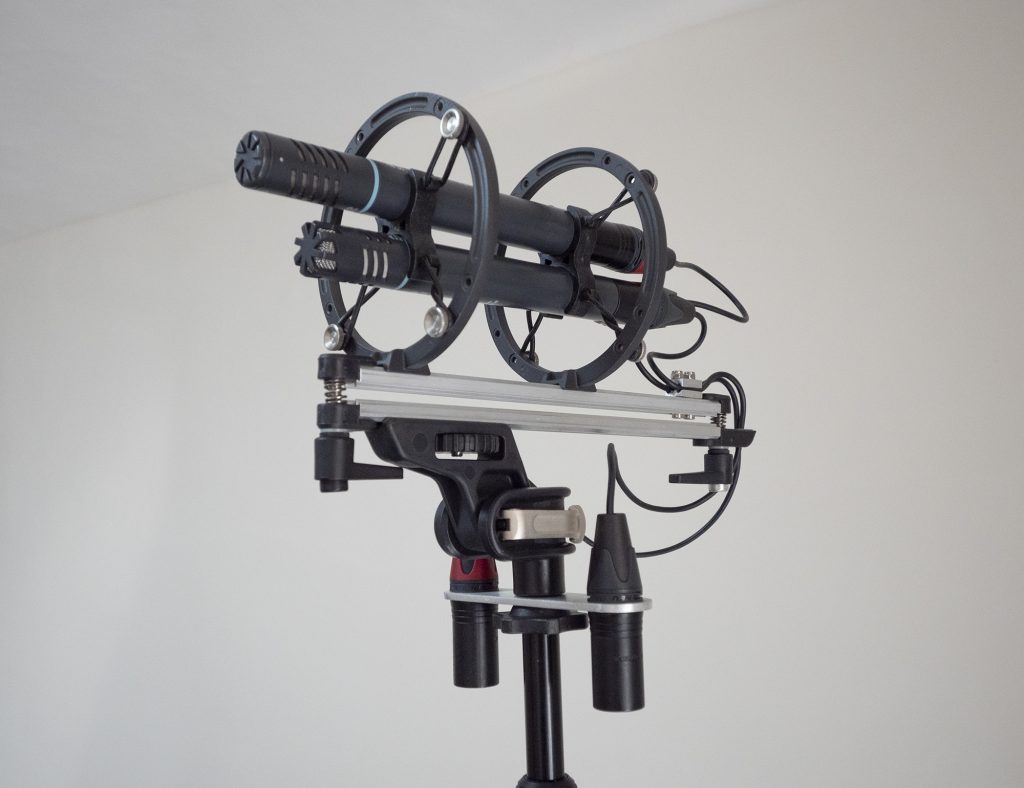
AKG Blueline mics used for these tests, top to bottom: CK93 (hypercardioid), CK94 (fig 8) and CK92 (omni): initial rig.
Second setup, bringing the three mics closer together (5mm apart): physically more stable, mics further from edge of the blimp, and fewer phasing issues.

Mid-side recording is a familiar technique to most sound recordists: a coincident stereo pair that is flexible and handy (not least as it can fit in a blimp or windjammer more easily than most pairs). I’ve written previous posts about my mid-side rigs, both for LDC mics and SDC mics. Double mid-side, where the fig 8 side mic is used by two mid mics – one facing forward and one facing backwards – is less used, but still well known, mainly by those recording surround sound. But, of course, the fig 8 side mic can also be shared with two (roughly) forward-facing mid mics: say one pointing up to the mouth of a singer-songwriter and one down to their guitar. Matrix the two mid-side pairs and you have stereo for both vocal and guitar, with reasonably little spill, and – with all three mics coincident – no phasing issues. Hugh Robjohns wrote an article for Sound On Sound about this use a few years back.

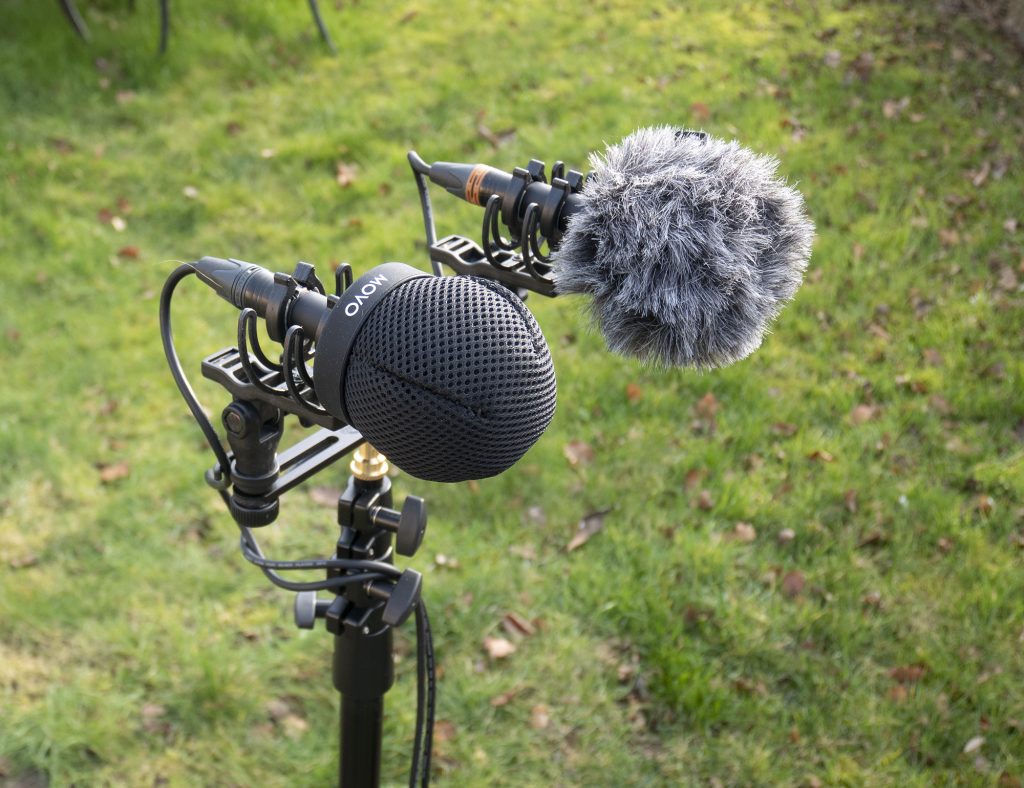
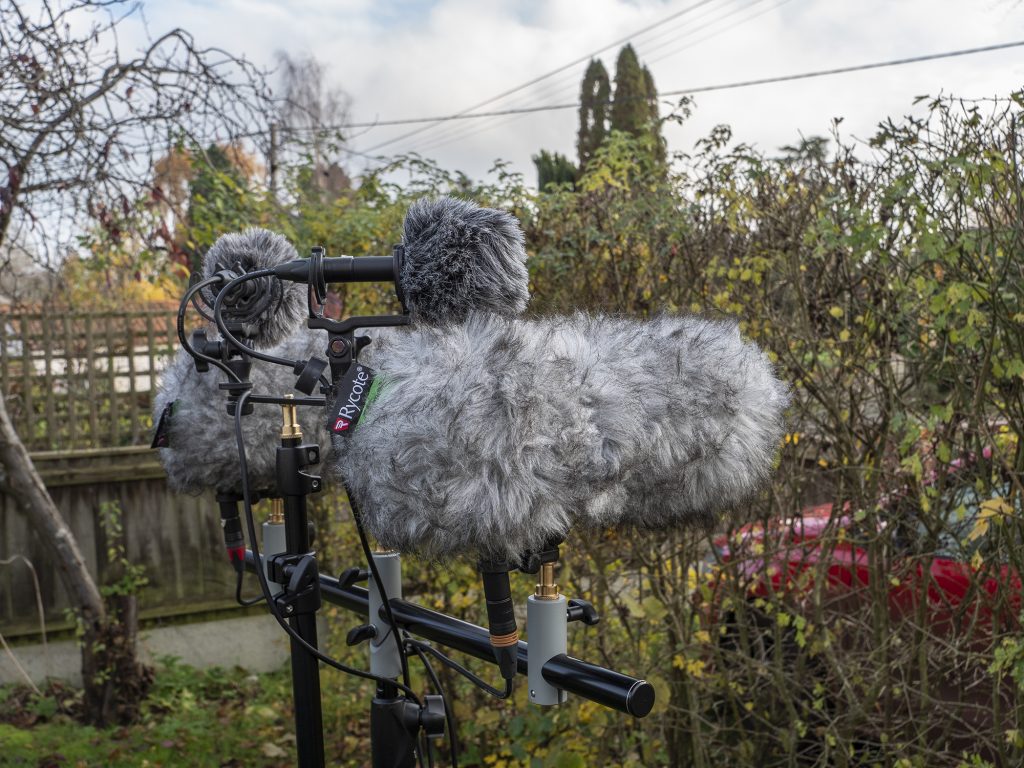
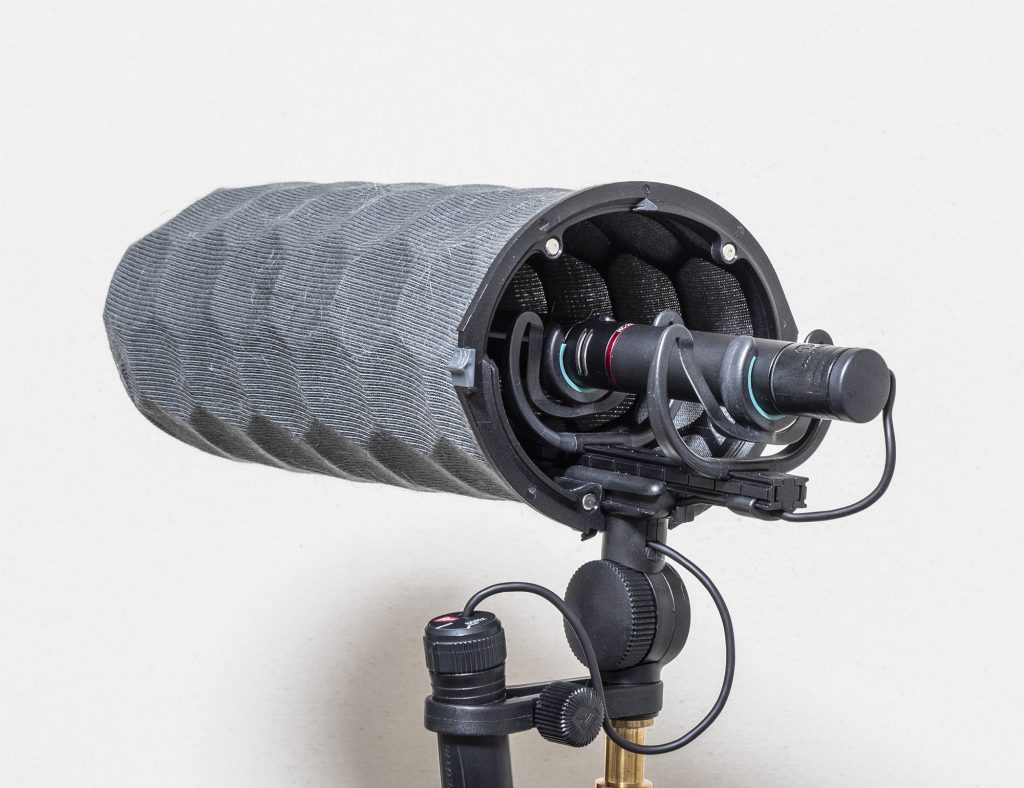
But there is another use for double mid-side with the two mid mics facing forward, and one that is rarely used or described: that’s where the two mid mics are pointing the same way but have different polar patterns. Using, say, omni and hypercardioid mid mics, you can matrix either with the side mic and get omni or hypercardioid mid side or matrix both and mix and you can get all the polar patterns in between for your mid mic: say, wide cardioid or cardioid as well as the omni and hypercardioid. This flexibility in polar pattern is quite separate from the familiar aspect of mid-side recordings, where you can vary the width of the stereo image by changing the proportion of mid to side mic: with this arrangement you get both stereo width and polar pattern flexibility in post, and – if using SDC mics – all with a very compact three-channel rig. As you can see, with a few Rycote back-to-back clips you can even fit it in a fairly standard 100mm diameter blimp.

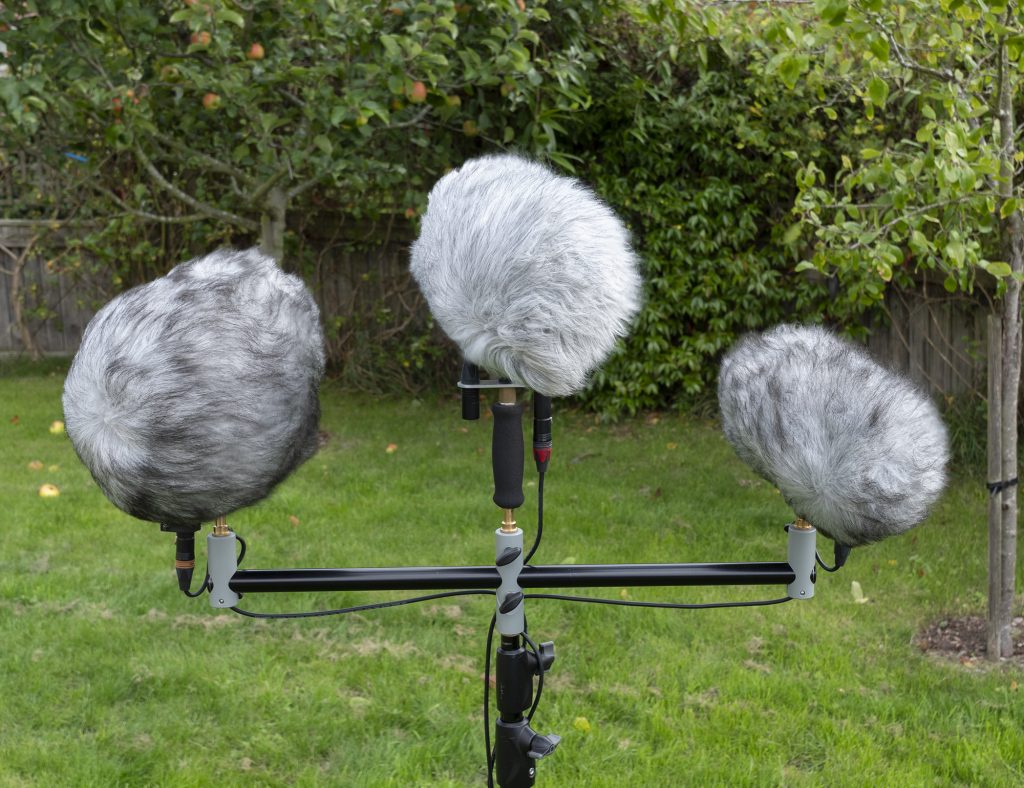
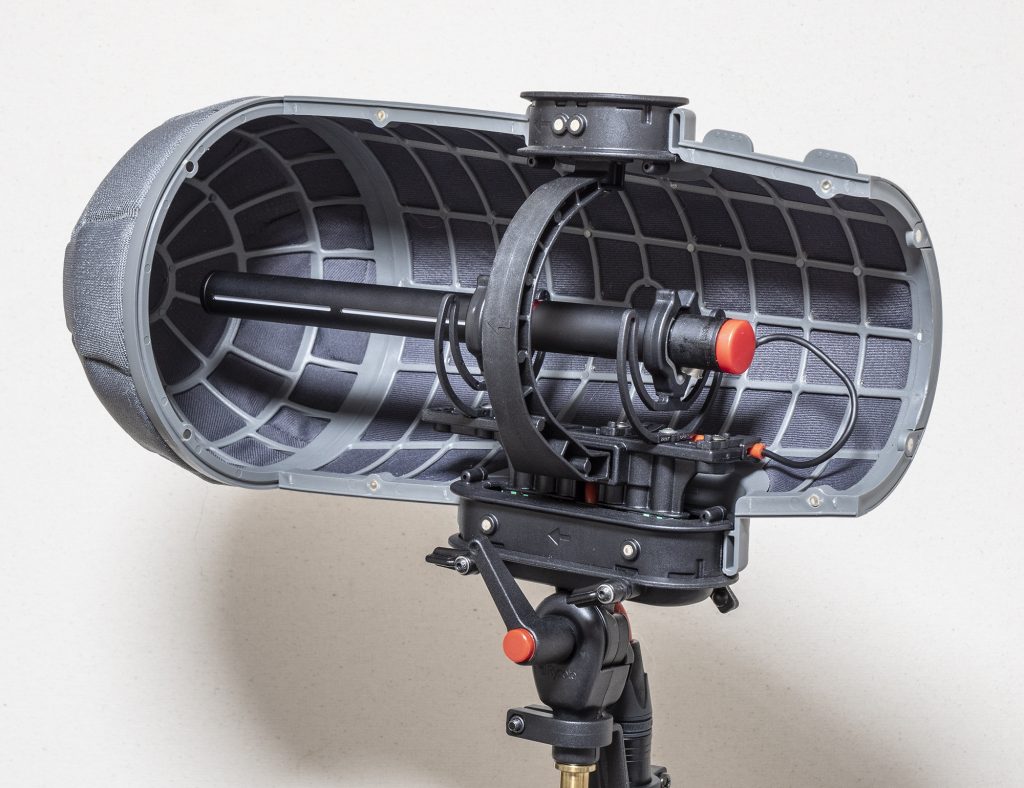
Here’s a vocal test with a group (Norfolk’s raucous folk band, Rattlebox) arranged in a semi-circle around the mics outside on a very windy day (about 20 mph wind), singing Dick Shannon’s ‘The Auld Triangle’: the test was in part to see if the mics would be OK stacked in a standard (in this case Rode) blimp in reasonable wind (the top and bottom mics were nearer to the edge of the blimp than is ideal: at this stage I hadn’t come up with the more compact triangular array). The configuration needs the fig 8 centrally, which is good as fig 8 mics are the most sensitive to wind. The three mics had their 75Hz low-cut filters engaged to counter the wind noise. I matrixed, or decoded, each mid-side pair, so in the video you hear these on their own and then mixed 50:50. In the video, I call this mix of the two pairs a ‘virtual cardioid mid mic’) as it isn’t far off mid side with a cardioid mid mic: of course, a seamless range of possibilities from omni to hypercardioid is possible.

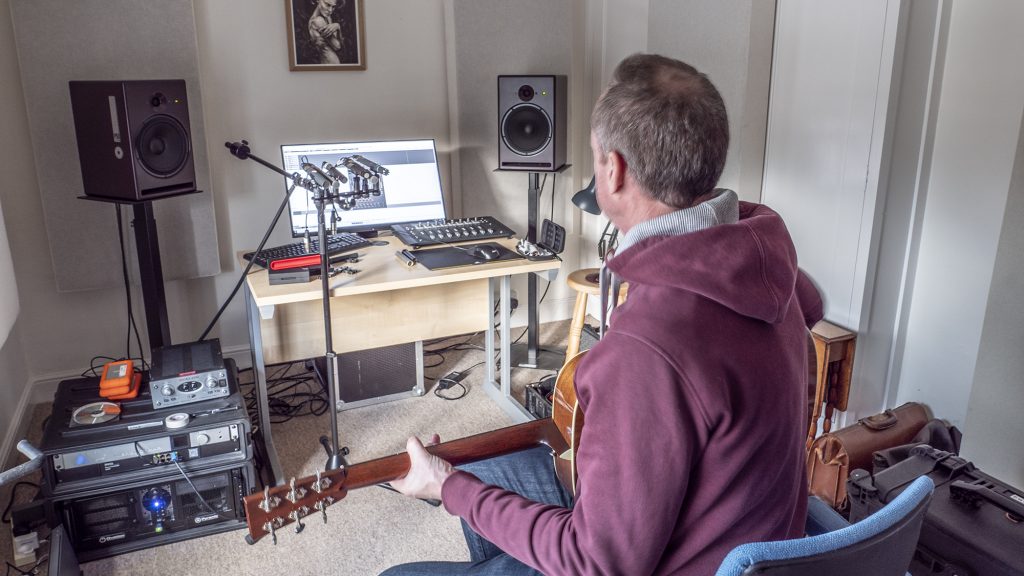
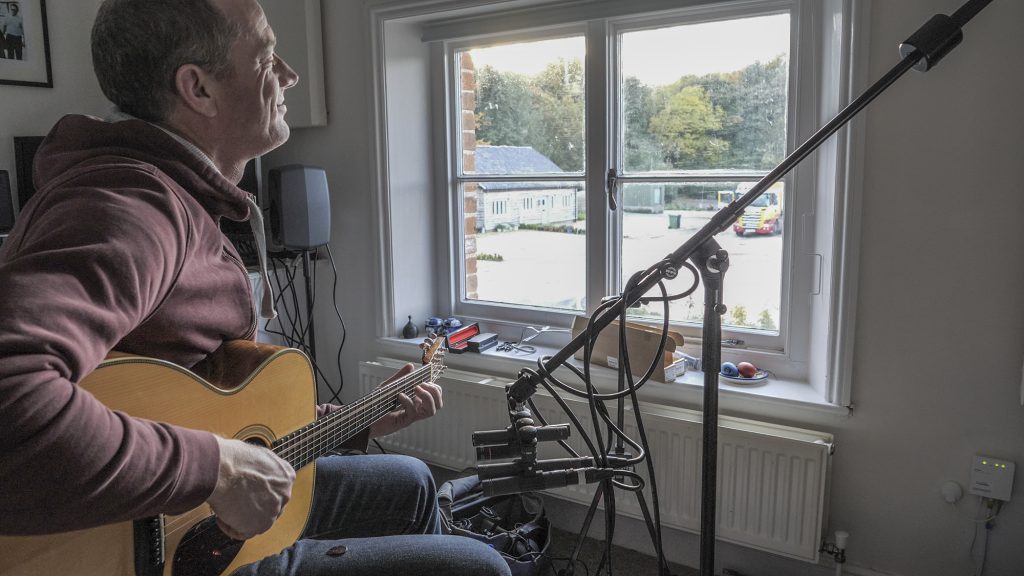
And here’s another test, this time with a guitarist (Luke Chapman) in his workshop (by day Luke is a woodcarver), with the same matrixing/decoding options. With no wind to contend with, the three mics have no low-cut filters engaged. Of course, the smaller sound source of a guitar means the changes in mid-mic polar pattern are fairly subtle.

How best then to process the three channels of audio in post? Well there might appear to be three options: 1) mix the two mid mics first, then decode to LR stereo as per normal mid-side; 2) decode each mid-side pair then mix the resultant LR stereo files; and 3) decode one mid-side pair then mix in the additional mid mic.

A bit of maths shows the first two are identical:

Mixing the mid mics first:
M = μM1 + λM2
L= μM1 + λM2+S
R= μM1 + λM2-S

Decoding each mid-side pair then mixing:
L1=M1+S L2=M2+S
R1=M1-S R2=M2-S
L=μL1+λL2
= μ(M1+S)+ λ(M2+S)
= μM1 + λM2+S

Decoding one mid-side pair then adding the M2 mic (centrally) to the stereo pair, however, gives a different result (as, indeed, you might conclude intuitively when thinking about it):
L = μ(M1+S)+ λM2
= μM1 + λM2+μS

So avoid this third option.

[NB I’ve just done the L channels in the second and third examples, to reduce the off-putting maths…]

In my case, I’ve gone for the second option as it is difficult to determine what mix of mid mics you might want – i.e. what mid-mic virtual polar pattern – without hearing the stereo sound. I must now set up my DAW (Reaper) so that raising one stereo channel reduces the other by the same amount to make assessing the balance/mix easier.

In terms of monitoring when recording you can either just listen to the channels in mono or, with any reasonable recorder, send two of the channels (the fig 8 and, say, the hypercardioid) to be decoded in the headphone monitoring or in the LR mix (either are possible on my Sound Devices MixPre-3): in this way you get confirmation that at least one of the stereo pairs sounds as you want it. With time on your hands, you can, of course, check the other pair in LR stereo too.

UPDATE (9.11.2021). By request I’ve recorded some ambiences (just my quiet Norfolk village street from my garden) with this rig and have uploaded the iso tracks (AKG CK92 omni; AKG CK93 hypercardioid; and AKG CK94 fig 8), the two separate MS recordings (as LR stereo) and the combined MMS recording (giving something akin to cardioid MS). These recordings were made with my modified array (i.e. the mics set in a more compact triangular arrangement, each only 5mm apart from the others).

Audio Gear

Field recording with the Rycote HC-15 and HC-22 mics

October 25, 2021
Out capturing ambiences with the Rycote mics

Following on from my initial tests and review of the Rycote’s first mics – the HC-15 and HC-22 shotgun mics – this shorter post adds some tests of ambience and nature recordings with both mics individually and combined with an AKG CK94 fig 8 mic to give mid-side stereo recordings.

Kicking off at home, I recorded the sounds of what I thought was my quiet Norfolk village street at dusk: birds calling, a tractor passing etc. So I could get the different mid-side recordings at the same time, this meant putting the two Rycote mics and fig 8 together in a blimp as shown in the image below. Experience says that there will be only an imperceptible shadowing effect by the clustered configuration of the mics. The AKG CK94 has a much lower sensitivity, so I added 8dB of gain: it should perhaps have a little more (another 4dB?), but I have posted the individual wav files anyway below.

Rigging three mics for the simultaneous HC-15 and HC-22 mid-side recordings.

Here are the various village street ambiences, both the two mid-side recordings and the individual tracks. I’ve included the AKG CK94 track too, since it shows the origins of any hiss: the two Rycote mics, of course, have unusually low self-noise for shotgun (indeed any SDC) mics at 8.5 dBA (+/- 2 dB).

Looking inland at Cley beach, over the salt marshes.

Heading to the beach with just the Rycote HC-22 and the AKG CK94 in a blimp, here are some more recordings, one slightly away from the waves (with bird calls) and one close to the sea. This time I’ve included the mid-side recordings and the HC-22 tracks on their own. And this time the CK94 fig 8 mic has its gain up 12dB from the Rycote mic, to fully compensate for its lower sensitivity. Watch out for listening levels, especially for the waves – much louder than the village street ambiences above.

Recording the static bells in the massive early 12th-century belfry at Norwich Cathedral.

For something very different, I headed off to Norwich and up the tight spiral stairs into the belfry at the cathedral. The bells have been hung for static chiming since the 19th century, but the five bells (four from the late 15th century, one from 1635) still mark the hours and the quarters. And, needless to say, they are very loud within the belfry. In the recordings – again mid-side (this time with the HC-15 and the AKG CK94, and, for comparison, the hypercardioid AKG CK93 with the AKG CK94) – you can hear the wind whistling through the louvres, the clock setting the chimes in motion, and the automatic clappers chiming the bells.

Obviously using a shotgun mic as part of a mid-side pair for stereo ambiences is a slightly odd choice, and not one I would make normally, but there is a relevance to such tests as location sound recordists do use this combination when they want stereo coverage in addition to the focus of their interest with the mono shotgun. A more typical use of the shotgun mic for nature and sound effects recording, of course, is for focusing tightly on point sources for mono recordings, and with the low noise and good off-axis sound, there is little doubt that the HC-15 and, for a tighter focus, the HC-22 are excellent choices.

Audio Gear

Rycote’s first microphones – review and tests of the HC-15 and HC-22 shotgun mics

October 13, 2021

New microphone manufacturers appear from time-to-time, but when I heard that Rycote – with over 50 years of well-respected design and manufacturing of microphone windshields and suspensions – were producing their first microphones, this stood out as something rather different: both their reputation and experience with other mics suggested that this could be an intriguing addition to the market. Given Rycote’s long involvement with broadcast and film sound, it isn’t that surprising that the two mics are both shotguns: one 15cm long and the other 22cm, giving rise to the HC-15 and HC-22 names. The specs fueled my initial interest as did the fact that they are made entirely in the UK at Rycote’s factory in Stroud. The price is interesting too, with the HC-15 costing £560 and the HC-22 £575 (ex VAT). This places the mics in slightly underpopulated territory, well above the list prices for the Rode NTG5 and NTG3, but well below the list price of the Sanken CS1-E or, say, the Audio Technica BP4073. Many staples of location sound recordists – such as the various shotgun mics made by Sennheiser, Schoeps and DPA – are more costly still. So, intrigued by all this and knowing Rycote to be a friendly and approachable company (see, for example, their help with my oversized LDC mic windshield), I asked whether they would let me review and test the mics: a few email exchanges later, and the mics arrived last week – no conditions/obligations applied nor, indeed, any timescale for their return! They included some foamies and a Classic Softie kit, with a Nano Shield (out of stock) on its way soon.

The approach

I don’t know about you, but I’m not overly excited by mic reviews – usually vlogs – that involve unboxing and reiteration of the published specs, in this case readily available online on the Rycote website, along with some tests of the mics in an unlikely location (e.g. with shotgun mics locked off above a vlogger’s head in their indoor studio). Of course, there is a value in comparative tests of mics, despite the danger (for shotgun mics) of these ending up being grouped in static arrays, but the number of professional shotguns available means that this is outside the scope of what I can do: for the nuances of Mic A vs Mic B there is no substitute for testing and working with both mics yourself and no review or on-line test is going to replace that. Rather, the focus of this review is a series of more real-world tests with the two Rycote mics, some out and about on location, with the aim to see if the Rycote mics are contenders for serious use. Sometimes I use another mic for the purpose of comparison, or to illustrate a point, and mostly I use the HC-15 and HC-22 together – which at least helps clarify the differences between the two. Sometimes I use the HC-15 and HC-22 in combination with a fig 8, to see how they stand up is the mid mic in a mid-side stereo pair: common use for a shotgun mic. But you won’t find any tests of the mics mounted on a camera: I’ve yet to find a need for this, and my gut feeling for such use is the compromised positioning means a more modest shotgun (and perhaps one without P48) will do the job.

Rabbit rabbit

With dialogue or speech recording being key uses for a shotgun mic, I was keen to put the Rycote mics through their paces on voices. There are many different aspects to this, but the ones I was keen to test were overall sound (Rycote describe their mics as ‘precise’ and as having ‘a crisp sound with some additional warmth’) and off-axis response (how coloured is the sound off-axis?).

For this test, I went to a small local theatre (the Sheringham Little Theatre) to use its stage: not a huge sound-treated stage, but a step up from a village hall, and did some tests with the writer (Chris Sainton-Clark) reading excerpts from his one-act play ‘My Other Half’ statically (with the mic on and off axis), and moving about (to see how susceptible the mics are to comb filtering in such a less than ideal interior space). To make it easier to follow the various positions, I have put this test into a video. Oh, and, yes, I know the 180 degrees off-axis test is fairly mad!

Putting the shotgun mics into tougher conditions, I then dragged Chris onto the pavement outside the theatre to ad lib as if for an interview (quite fairly, he chose to promote the theatre where he works!) against the backdrop of the entrance (which houses a bustling café), with noisy traffic and people behind the mic on a busy junction at the centre of the town:

Play it again, Luke

Rarely is a shotgun mic much use in a music studio or, even, for remote location recording of music (e.g. in a church or concert hall), but sometimes the polar pattern of a shotgun mic is necessary. Recording music is also a good test of any mic, so to put the Rycote’s mics to this use I chose to record a guitarist in an indoor non-studio space (a woodcarver’s workshop).

Here are the two mics used to record ‘Moth to a Flame’, written and performed by Luke Chapman. I’ve also included a third version, with the HC-22 paired with an AKG CK94 (i.e. SDC fig 8 mic) to show how the Rycote mics perform as the mid mic and a mid-side stereo pair. The sound is just as it came off the mics, recorded into a Sound Devices MixPre-3.

And here is a short video with clips of Luke Chapman playing the guitar and singing, with the sound (as shown on the screen) switching from HC-15 to HC-22 to HC-22+AKG CK94 mid-side. Again, there is no editing or effects. The limitations of using a single shotgun (even if in one version, combined with a fig 8 side mic) for recording both guitar and vocals simultaneously are evident, and not something I would normally do (in fact, I’m currently recording an album with Luke using three fig 8 LDC mics), but it worked rather better than I thought. And, of course, sometimes a shotgun mic (or shotgun-based mid-side pair) might be an effective solution: e.g. a run-and-gun recording of a busker in a noisy street.

Let’s get physical

While the sound of the mics is the focus of this review, another aspect not clear from the specs is the physical nature of the mic. That is the build quality (insofar that this is clear without dismantling it and using it for years in all conditions), the handling noise (shotguns are forever on the move, at the end of boom poles or on pistol grips), and susceptibility to wind noise.

Build quality seems excellent. With no high-pass filter or pad switches, there are no moving parts to assess, so it’s a simple design. The mix of materials is unusual feeling, but not in a bad way. The brass barrel of the pre-amp (as opposed to the aluminium of the capsule section and interference tube) has a bit of heft (though these are light mics at 90g and 100g): this takes the centre of gravity of the HC-15 a little back from the red ring, and with the HC-22 it is around the paired slots behind the diaphragm. Access to the innards is evidently by release of the brass circlip in the XLR socket, which seems preferable to a screw (the circlip also grounds the mic body to pin 1): I didn’t open up the mics though…The wooden cases are classy, well made and close in a satisfying way (simple pleasures!): not sure many would use them in the field though. More attractive is the lack of gubbins with the mics: no additional equipment means you aren’t paying for things you so often don’t need.

Close-up of the XLR socket with circlip.
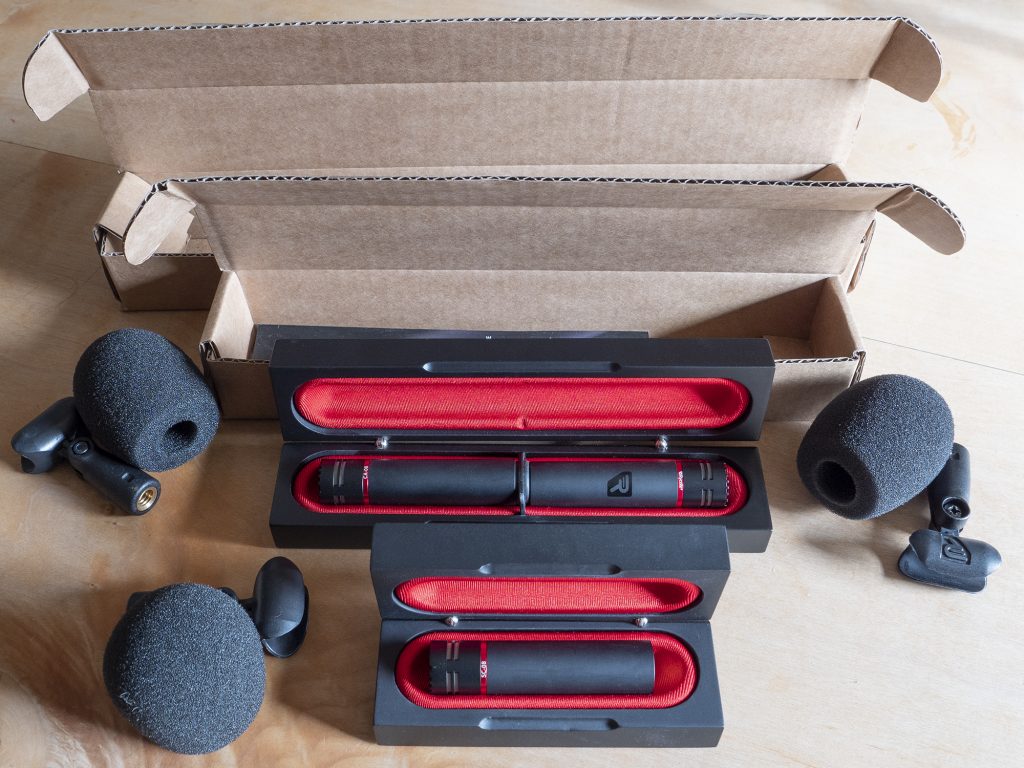
How they come: just the mics, the rather lovely cases and the simple cardboard packaging.

Testing for handling noise transmitted via a boompole required some deliberately bad booming aiming for maximum transmission of vibration to the mics (on an Invision 7 suspension). Unsurprisingly the two Rycote mics are pretty similar, with all the unwanted noise below 50Hz (and therefore addressable by a low-cut filter, if not, of course, by better technique). By way of comparison, here are test files for the HC-15, the Oktava MK012 with the hypercardioid capsule, and the AKG CK93 (hypercardioid), which reveal no major differences:

Wind noise on a mic varies with polar pattern, of course, and, while wind protection from a slip-on foam cover, through softies to a full blimp can address the issue, it is good to examine the baseline susceptibility. For this – not least given relevance to actual use – I have just gone for some simple fast boompole swings, with the mics mounted together. The HC-15 and HC-22 are not that different, with the HC-22 (reflecting better rejection of the sides) performing better than the smaller shotgun:

The susceptibility to wind appears pretty normal for a shotgun mic and even lower-cost versions perform well. Here for example, is the HC-22 compared to the Rode NTG1 (levels adjusted to reflect sensitivity), with the latter a bit quieter:

But comparing the Rycote shotguns to other types of boompole mics – in this case hypercardioids – shows a significant difference: even the more wind-susceptible HC-15 easily outperforms the AKG CK93 and, by a huge margin, the Oktava MK012:

Silence is golden

Of the specs the one that immediately stood out to me was the 8.5 dBA (+/- 2 dB) self-noise. This is about as low as it gets for a shotgun mic (think Sennheiser MKH 60 at 8dBA) and is much better than most of the professionals’ favourites. Diaphragm size is a significant factor in mic self-noise, and, while the size isn’t published, Rycote have told me that a 17mm-diameter diaphragm has been used (not bad in a 19mm-diameter mic body). Of course, not all mic manufacturers measure self-noise in the same manner nor is all self-noise the same, so my first test with the mics was to record nothing. Well, as near nothing as possible outside an anechoic chamber or a nuclear bunker: in the hallway of my house in a rural village, I closed all doors, turned off the mains electricity at the consumer unit, and left the two mics recording into a Sound Devices MixPre-3 (EIN -130dBV/-128dBu) along with a Rode NT2-A (at 7dBA in the same ball park). Self-noise was indistinguishable between all three mics. There’s not a lot of value to uploading WAV files showing the slight hiss with gain cranked up wildly, simply to confirm the published spec, but listening to the boompole handling-noise sound samples above makes clear the difference between the Rycote mics and mics with higher self-noise (the AKG CK93 self-noise is 17dBA and the Oktava MK012 self-noise is 18dBA).

Final thoughts

These tests are neither exhaustive nor especially technical: no anechoic chambers or such like were involved. Nor do they rigorously compare the HC-22 and HC-15 to a whole range of other shotgun mics. But the process of carrying out the tests has shown me that Rycote’s first foray into mic design has huge merit: these mics thoroughly deserve to be considered as alternatives to familiar mics above and, indeed, below their price point. The low self-noise and healthy output makes the mics obvious contenders for nature and effects recording; the same attributes, low weight and good off-axis sound make them contenders for film and TV sound; and the same specs/construction for the two models with different interference tube lengths mean that they are ideal if you want to swap seamlessly from one type of shotgun to the other. Having got my hands on them, I certainly don’t want to send them back to Rycote!

Audio Gear

AKG Blueline mics

August 28, 2021
AKG CK91, CK92 and CK93 rigged for testing

Having had the hypercardioid (CK93) capsule of the the AKG Blueline modular mics for some years (with the SE 300B body/pre-amplifier), I picked up the fig 8 capsule (CK94) and another SE 300B a few months ago (see my post on it here), and have just now added the CK91 cardioid and CK92 omni capsules to the family: a good used bargain, all the way from Shetland, in excellent condition. Although the CK91 cardioid was apparently a staple of radio studios etc. for many years, in the filmmaking world a myth has built up that the hypercardioid was the cream of the crop and by far the best capsule. I suspect this came about since the AKG CK93 is an excellent hypercardioid, and much better than the few alternatives that were available for a modest price (e.g. the Oktava MK012) rather than based on any actual hands-on comparison between the different Blueline capsules.

Certainly, I have begun doing tests and am impressed straight away by how remarkably similar the capsules sound – initially just testing on acoustic guitar and vocals. There really is no stand out or weaker capsule amongst these four (I can’t speak for the CK98 shotgun capsule, which I don’t have and haven’t heard). And equally impressive is how rounded or smooth they all are. For instance, the CK91 cardioid has none of the brittleness of my Rode NT55 cardioid capsules. A surprising extra is that the AKG CK91, CK92 and CK93 capsules also have less evident self-noise than the Rode NT55 mics, despite the specifications suggesting the reverse (17dB vs 15dB). These really have to be some of the most underrated mics out there: great value new (if you can find stock still, as they appear to be being discontinued) and even better used.

I bought the latest two AKG capsules to give me more options for a mid-side pair with the CK94 fig 8 capsule. OK I could use other SDC mics I have (such as the NT55s), but it is nicer to have a more consistent sound across the pair in the mid-side array: that the AKG capsules also sound better is a bonus. When I get the opportunity I will post some samples with the various capsules.

AKG CK91 (cardioid), CK92 (omni), CK93 (hypercardioid) and CK94 (figure of eight) capsules on SE 300 B pre-amplifier bodies. Note some slight visual variations over time with the pre-amplifiers (oldest is on the CK94; next oldest on the CK91 and CK92; and the newest on the CK93): I can’t hear any difference in their performances, but have yet to compare the circuits.

Audio Gear DIY Projects

Mid-side with AKG CK94

May 25, 2021
AKG CK94 (top) and CK93 (bottom) in Rode Mk1 blimp suspension

I’ve had one of the AKG Blueline mics for years. This has the CK93 capsule, which is an excellent mid-price hypercardioid SDC mic that has proved great for booming indoor (and, on occasion, outdoor) dialogue. I have also used it for music recording where I needed a narrower polar pattern than cardioid. It is leagues above my Oktava MK012 hypercardioid – so beloved by indie filmmakers – in terms of build quality, handling noise, and features (having low-cut and attenuation switches).

From time to time I’ve wondered about the other interchangeable capsules in the Blueline range and, above all, about the CK94 – the figure of eight capsule. Of course LDC multi-pattern mics include a fig 8 polar pattern and, paired with another mic, this allows mid-side recording, which I have done many a time. And, as I have posted, with a massive DIY blimp I have even got such an LDC pair outside for field recording. That said, it would be useful and, for most uses, more practical to have a compact SDC mid-side pair. The standard for field-recording pros is the Sennheiser MKH30, which, while excellent and with the advantage of humidity-beating RF technology, has the distinct disadvantage of cost: it has a street price of around £1500, and even used ones seem rare below £1000. Add another Sennheiser MKH mic (say an MKH40) and wind protection to fit and you will need to spend £3000 or more. Unlike other polar patterns, SDC fig 8s are rare, and there are few more affordable ones: ignoring the clunky pseudo fig 8s made by Oktava and Kortwich (made using two cardioids mounted back-to-back, giving a T-shaped mic), the only affordable true single -diaphragm fig 8 other than the AKG CK94 is the Ambient ATE208 Emesser. The latter, however, has a lot of bass roll-off due to it being tailored to match the off-axis response of a shotgun mic (its intended partner). Recently, boutique Taiwanese mic-maker B9Audio has produced the CM180, but it is only available direct from the maker: so this means significant shipping and duty costs need to be added to the US$749 price. Reviews are also thin on the ground to say the least.

So, with all this in mind, the AKG CK94 remains the most viable affordable SDC fig 8 for general usage (i.e. music as well as film sound). Although now out of production (AKG/Harman/Samsung appear to be phasing out the whole Blueline family and the CK94 was the first to be discontinued), at the time of writing it is just possible to find one or two new examples for sale: with the SE 300B amplifier/mic body, street price is around £600. But I’ve been keeping my eye on the used market, and was please to spot one on the Saturn Sound website (where there is a list for a grand closing down sale of mics – with some very rare examples), and – together with the SE300B amplifier/mic body – the other day I became the owner of a very good condition example: indeed, during a pre-sales check, Ashley Styles of Saturn Sound thought the capsule a bit noisy and replaced it with one he still had. All this, plus delivery in person (he has retired not so far away), for a remarkably affordable £200.

I had no concerns about the CK94 for music or louder effects recording, but, with 22dBA self-noise (a long way from the MKH30’s 13dBA) my hopes were low for recording quieter ambiences. So I was surprised how good it sounded during an initial test recording the ambient noise in the garden (in a village in rural Norfolk). You can have listen here:

I was expecting something much noisier.

In terms of rigging it up for field recording, I purchased a couple of the older style (i.e. lower profile) back-to-back clips made by Rycote (ref. no. 048460), which, unlike the new fit-any-mic clips Rycote make for MS pairs, neatly fit into a Rode Mk1 blimp and have lugs to attach to the suspension bands: the mics sit centrally and with a healthy blimp diameter of 100mm there is still plenty of air space around both mics. The CK94 has to project further forward given the location of its capsule (the centres of the two capsules should align, of course). I’ve added a DIY conn box equivalent (a clamp for the two thin cables – Sommer Cicada – that go from the mics to the DIY boompole-top XLR holder) to avoid the two heavier cables entering the blimp, so I’m there with a very nice sounding SDC mid-side rig for a very modest outlay. And, of course, I can use the AKG CK94 with mid-mics other than the hypercardioid CK93: for example, my Rode NT55 mics give me cardioid and omni mid-mic options. I’ll post other recordings – including music – with the CK94-based mid-side rig in due course.

With blimp on, and showing the double XLR holder at the top of the boompole
And a close-up of the DIY double XLR holder at the top of the boompole